

9 Hydraulic Turbines
320
stations with power under 10 MW are classified as small ones and those with power
not exceeding 1 MW are called micro power stations. At present, the second biggest
power station is the Itaipu plant at the Brazil-Paraguay border with 14,000 MW installed power, 20 turbines of nominal power 700 MW, nominal head 118 m, surface
area of the reservoir about 1350 km
2
. The biggest power station is the Three Gorges
plant on the Yangtze river in China with 22,500 MW installed power, 32 turbines
of nominal power 700 MW and 2 smaller turbines of 50 MW, nominal head 81 m,
surface area of the reservoir about 1000 km
2
9.2 Hydraulic Turbine Types
9.2.1 Large Turbines (> 10 MW)
At present, three types are used for larger applications.
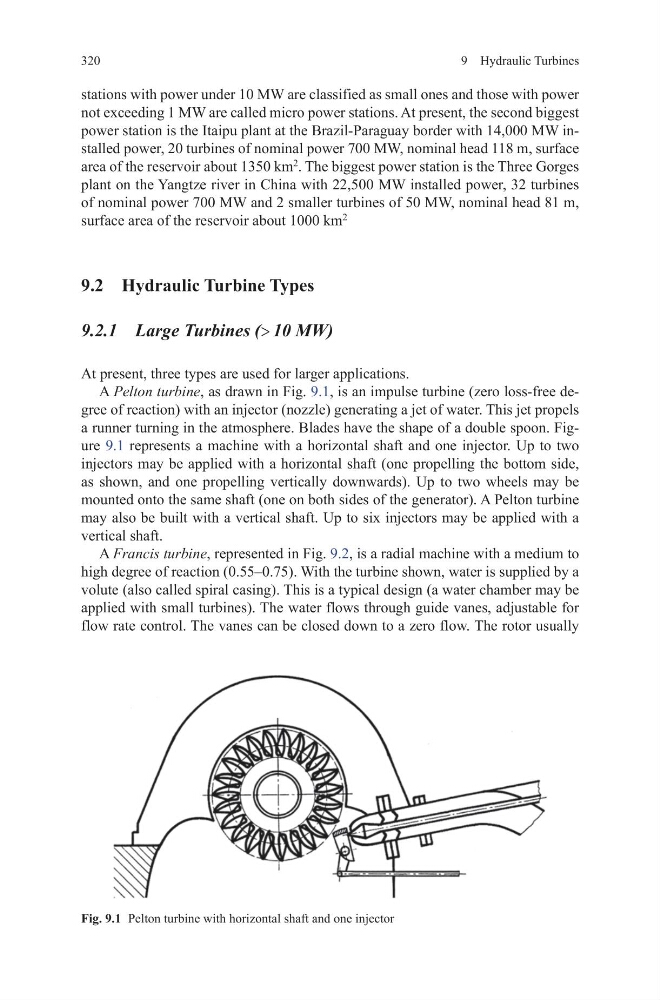
A Pelton turbine, as drawn in Fig. 9.1, is an impulse turbine (zero loss-free degree of reaction) with an injector (nozzle) generating a jet of water. This jet propels
a runner turning in the atmosphere. Blades have the shape of a double spoon. Figure 9.1 represents a machine with a horizontal shaft and one injector. Up to two
injectors may be applied with a horizontal shaft (one propelling the bottom side,
as shown, and one propelling vertically downwards). Up to two wheels may be
mounted onto the same shaft (one on both sides of the generator). A Pelton turbine
may also be built with a vertical shaft. Up to six injectors may be applied with a
vertical shaft.
A Francis turbine, represented in Fig. 9.2, is a radial machine with a medium to
high degree of reaction (0.55–0.75). With the turbine shown, water is supplied by a
volute (also called spiral casing). This is a typical design (a water chamber may be
applied with small turbines). The water flows through guide vanes, adjustable for
flow rate control. The vanes can be closed down to a zero flow. The rotor usually
Fig. 9.1 Pelton turbine with horizontal shaft and one injector
320
stations with power under 10 MW are classified as small ones and those with power
not exceeding 1 MW are called micro power stations. At present, the second biggest
power station is the Itaipu plant at the Brazil-Paraguay border with 14,000 MW installed power, 20 turbines of nominal power 700 MW, nominal head 118 m, surface
area of the reservoir about 1350 km
2
. The biggest power station is the Three Gorges
plant on the Yangtze river in China with 22,500 MW installed power, 32 turbines
of nominal power 700 MW and 2 smaller turbines of 50 MW, nominal head 81 m,
surface area of the reservoir about 1000 km
2
9.2 Hydraulic Turbine Types
9.2.1 Large Turbines (> 10 MW)
At present, three types are used for larger applications.
A Pelton turbine, as drawn in Fig. 9.1, is an impulse turbine (zero loss-free degree of reaction) with an injector (nozzle) generating a jet of water. This jet propels
a runner turning in the atmosphere. Blades have the shape of a double spoon. Figure 9.1 represents a machine with a horizontal shaft and one injector. Up to two
injectors may be applied with a horizontal shaft (one propelling the bottom side,
as shown, and one propelling vertically downwards). Up to two wheels may be
mounted onto the same shaft (one on both sides of the generator). A Pelton turbine
may also be built with a vertical shaft. Up to six injectors may be applied with a
vertical shaft.
A Francis turbine, represented in Fig. 9.2, is a radial machine with a medium to
high degree of reaction (0.55–0.75). With the turbine shown, water is supplied by a
volute (also called spiral casing). This is a typical design (a water chamber may be
applied with small turbines). The water flows through guide vanes, adjustable for
flow rate control. The vanes can be closed down to a zero flow. The rotor usually
Fig. 9.1 Pelton turbine with horizontal shaft and one injector