

8.7 Special Pumps
315
Multistage pumps with mixed-flow rotors and with radial rotors exist. Also singlestage pumps with radial, mixed-flow and even axial rotors are employed. The suction pipe is connected to the upper part of the container, but the suction part of the
pump is near the bottom, so that the inlet pressure is much higher than the pressure
in the suction pipe. This may increase the available net positive suction height with
several meters. A similar arrangement is used with condensate extraction pumps in
thermal power stations, as the fluid is near to vapour pressure. Similar arrangements
may also be used for the same reason in chemical plants.
8.7.7 Partial Emission Pumps
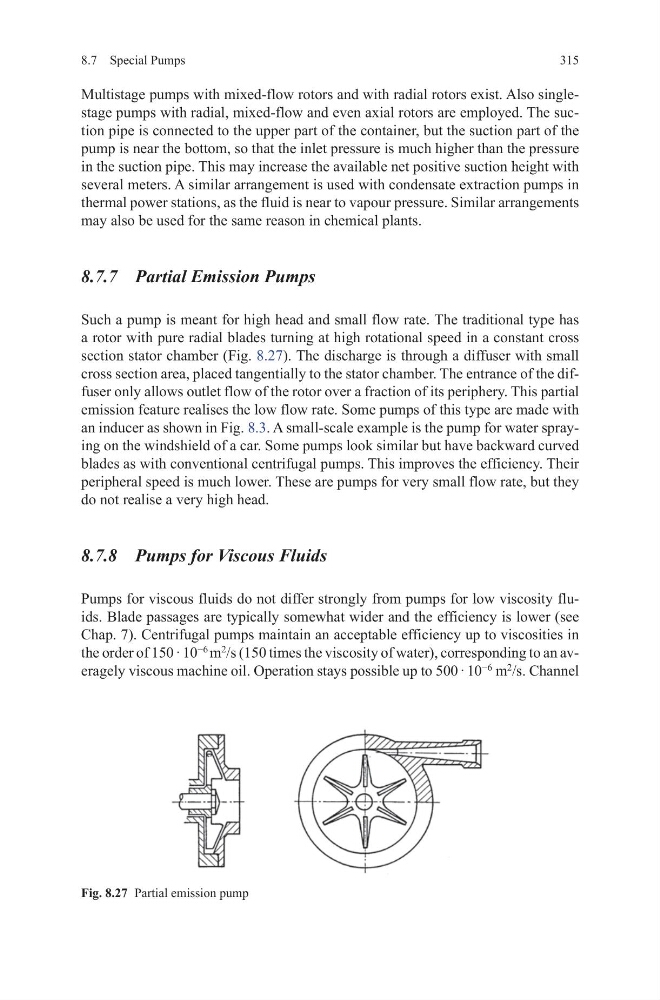
Such a pump is meant for high head and small flow rate. The traditional type has
a rotor with pure radial blades turning at high rotational speed in a constant cross
section stator chamber (Fig. 8.27). The discharge is through a diffuser with small
cross section area, placed tangentially to the stator chamber. The entrance of the diffuser only allows outlet flow of the rotor over a fraction of its periphery. This partial
emission feature realises the low flow rate. Some pumps of this type are made with
an inducer as shown in Fig. 8.3. A small-scale example is the pump for water spraying on the windshield of a car. Some pumps look similar but have backward curved
blades as with conventional centrifugal pumps. This improves the efficiency. Their
peripheral speed is much lower. These are pumps for very small flow rate, but they
do not realise a very high head.
8.7.8 Pumps for Viscous Fluids
Pumps for viscous fluids do not differ strongly from pumps for low viscosity fluids. Blade passages are typically somewhat wider and the efficiency is lower (see
Chap. 7). Centrifugal pumps maintain an acceptable efficiency up to viscosities in
the order of 150 · 10
−6
m
2
/s (150 times the viscosity of water), corresponding to an averagely viscous machine oil. Operation stays possible up to 500 · 10
−6
m
2
/s. Channel
Fig. 8.27 Partial emission pump
315
Multistage pumps with mixed-flow rotors and with radial rotors exist. Also singlestage pumps with radial, mixed-flow and even axial rotors are employed. The suction pipe is connected to the upper part of the container, but the suction part of the
pump is near the bottom, so that the inlet pressure is much higher than the pressure
in the suction pipe. This may increase the available net positive suction height with
several meters. A similar arrangement is used with condensate extraction pumps in
thermal power stations, as the fluid is near to vapour pressure. Similar arrangements
may also be used for the same reason in chemical plants.
8.7.7 Partial Emission Pumps
Such a pump is meant for high head and small flow rate. The traditional type has
a rotor with pure radial blades turning at high rotational speed in a constant cross
section stator chamber (Fig. 8.27). The discharge is through a diffuser with small
cross section area, placed tangentially to the stator chamber. The entrance of the diffuser only allows outlet flow of the rotor over a fraction of its periphery. This partial
emission feature realises the low flow rate. Some pumps of this type are made with
an inducer as shown in Fig. 8.3. A small-scale example is the pump for water spraying on the windshield of a car. Some pumps look similar but have backward curved
blades as with conventional centrifugal pumps. This improves the efficiency. Their
peripheral speed is much lower. These are pumps for very small flow rate, but they
do not realise a very high head.
8.7.8 Pumps for Viscous Fluids
Pumps for viscous fluids do not differ strongly from pumps for low viscosity fluids. Blade passages are typically somewhat wider and the efficiency is lower (see
Chap. 7). Centrifugal pumps maintain an acceptable efficiency up to viscosities in
the order of 150 · 10
−6
m
2
/s (150 times the viscosity of water), corresponding to an averagely viscous machine oil. Operation stays possible up to 500 · 10
−6
m
2
/s. Channel
Fig. 8.27 Partial emission pump