

8 Pumps
314
8.7.5 Pumping of Solid Materials
Solid materials, mixed with a liquid, can easily be pumped with special pumps.
For pumping sand and gravel, as with dredge pumps, pumps are quite conventional
ones, except that passages are large and wear-resistant materials are used. Also, the
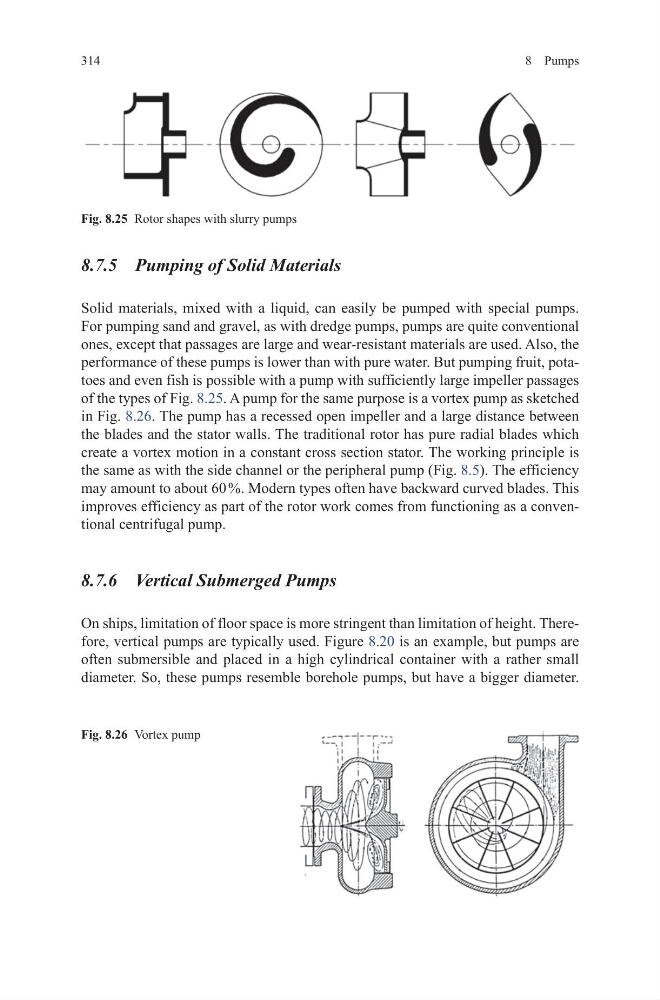
performance of these pumps is lower than with pure water. But pumping fruit, potatoes and even fish is possible with a pump with sufficiently large impeller passages
of the types of Fig. 8.25. A pump for the same purpose is a vortex pump as sketched
in Fig. 8.26. The pump has a recessed open impeller and a large distance between
the blades and the stator walls. The traditional rotor has pure radial blades which
create a vortex motion in a constant cross section stator. The working principle is
the same as with the side channel or the peripheral pump (Fig. 8.5). The efficiency
may amount to about 60 %. Modern types often have backward curved blades. This
improves efficiency as part of the rotor work comes from functioning as a conventional centrifugal pump.
8.7.6 Vertical Submerged Pumps
On ships, limitation of floor space is more stringent than limitation of height. Therefore, vertical pumps are typically used. Figure 8.20 is an example, but pumps are
often submersible and placed in a high cylindrical container with a rather small
diameter. So, these pumps resemble borehole pumps, but have a bigger diameter.
Fig. 8.25 Rotor shapes with slurry pumps
Fig. 8.26 Vortex pump
314
8.7.5 Pumping of Solid Materials
Solid materials, mixed with a liquid, can easily be pumped with special pumps.
For pumping sand and gravel, as with dredge pumps, pumps are quite conventional
ones, except that passages are large and wear-resistant materials are used. Also, the
performance of these pumps is lower than with pure water. But pumping fruit, potatoes and even fish is possible with a pump with sufficiently large impeller passages
of the types of Fig. 8.25. A pump for the same purpose is a vortex pump as sketched
in Fig. 8.26. The pump has a recessed open impeller and a large distance between
the blades and the stator walls. The traditional rotor has pure radial blades which
create a vortex motion in a constant cross section stator. The working principle is
the same as with the side channel or the peripheral pump (Fig. 8.5). The efficiency
may amount to about 60 %. Modern types often have backward curved blades. This
improves efficiency as part of the rotor work comes from functioning as a conventional centrifugal pump.
8.7.6 Vertical Submerged Pumps
On ships, limitation of floor space is more stringent than limitation of height. Therefore, vertical pumps are typically used. Figure 8.20 is an example, but pumps are
often submersible and placed in a high cylindrical container with a rather small
diameter. So, these pumps resemble borehole pumps, but have a bigger diameter.
Fig. 8.25 Rotor shapes with slurry pumps
Fig. 8.26 Vortex pump