

6
1 Working Principles
(also called tangential direction) for a given axial and radial position. The real flow
is always unsteady due to the presence of the running rotor. The average flow is
steady at a constant speed of rotation, due to the circumferential periodicity of rotor
and stator blade systems. It is further assumed that the average flow is described by
steady flow equations. Strictly, this cannot be correct, as products of flow quantities occur in the flow equations. The average value of a product does not equal
the product of the average values. Deviation terms are generated, which in fluid
mechanics are called Reynolds terms. The terms arrived at here are similar to the
terms generated by averaging a turbulent flow in time. The Reynolds terms are
ignored (or replaced by a model) in a fundamental analysis. The approximation is
good, as long as circumferential flow variations are not very significant. As a rule,
this is the case with a machine operating not extremely far away from design conditions. When the flow periodicity is seriously broken, the approximation is less good.
In principle, some prudence is called for when applying relations from a circumferentially averaged flow representation. But, generally, this flow model produces
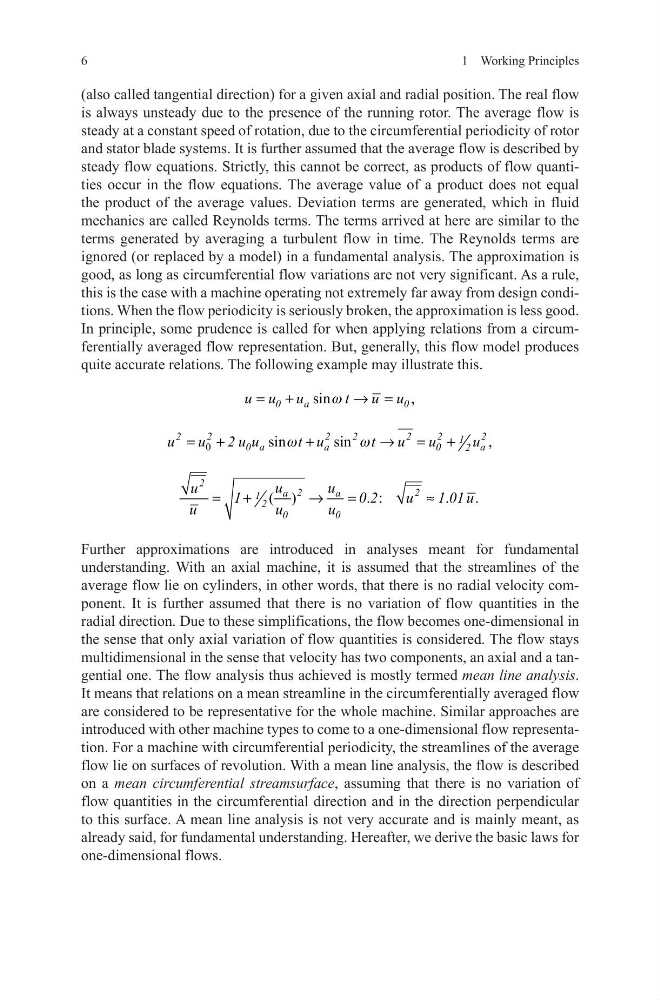
quite accurate relations. The following example may illustrate this.
Further approximations are introduced in analyses meant for fundamental
understanding. With an axial machine, it is assumed that the streamlines of the
average flow lie on cylinders, in other words, that there is no radial velocity component. It is further assumed that there is no variation of flow quantities in the
radial direction. Due to these simplifications, the flow becomes one-dimensional in
the sense that only axial variation of flow quantities is considered. The flow stays
multidimensional in the sense that velocity has two components, an axial and a tangential one. The flow analysis thus achieved is mostly termed mean line analysis.
It means that relations on a mean streamline in the circumferentially averaged flow
are considered to be representative for the whole machine. Similar approaches are
introduced with other machine types to come to a one-dimensional flow representation. For a machine with circumferential periodicity, the streamlines of the average
flow lie on surfaces of revolution. With a mean line analysis, the flow is described
on a mean circumferential streamsurface, assuming that there is no variation of
flow quantities in the circumferential direction and in the direction perpendicular
to this surface. A mean line analysis is not very accurate and is mainly meant, as
already said, for fundamental understanding. Hereafter, we derive the basic laws for
one-dimensional flows.
sin
,
0
a
0
u u u
t u u
w
= +
→ =
0
sin
sin
,
2
2
2
2
2
2
2
1
0 a
a
0
a
2
u
u 2u u
t u
t u
u
u
w
w
+
+
= +
→
=
( )
. :
.
.
2
2
2
a
a
1 2
0
0
u
u
u
1
0 2
u
1 01 u
u
u
u
= +
=
≈
→
1 Working Principles
(also called tangential direction) for a given axial and radial position. The real flow
is always unsteady due to the presence of the running rotor. The average flow is
steady at a constant speed of rotation, due to the circumferential periodicity of rotor
and stator blade systems. It is further assumed that the average flow is described by
steady flow equations. Strictly, this cannot be correct, as products of flow quantities occur in the flow equations. The average value of a product does not equal
the product of the average values. Deviation terms are generated, which in fluid
mechanics are called Reynolds terms. The terms arrived at here are similar to the
terms generated by averaging a turbulent flow in time. The Reynolds terms are
ignored (or replaced by a model) in a fundamental analysis. The approximation is
good, as long as circumferential flow variations are not very significant. As a rule,
this is the case with a machine operating not extremely far away from design conditions. When the flow periodicity is seriously broken, the approximation is less good.
In principle, some prudence is called for when applying relations from a circumferentially averaged flow representation. But, generally, this flow model produces
quite accurate relations. The following example may illustrate this.
Further approximations are introduced in analyses meant for fundamental
understanding. With an axial machine, it is assumed that the streamlines of the
average flow lie on cylinders, in other words, that there is no radial velocity component. It is further assumed that there is no variation of flow quantities in the
radial direction. Due to these simplifications, the flow becomes one-dimensional in
the sense that only axial variation of flow quantities is considered. The flow stays
multidimensional in the sense that velocity has two components, an axial and a tangential one. The flow analysis thus achieved is mostly termed mean line analysis.
It means that relations on a mean streamline in the circumferentially averaged flow
are considered to be representative for the whole machine. Similar approaches are
introduced with other machine types to come to a one-dimensional flow representation. For a machine with circumferential periodicity, the streamlines of the average
flow lie on surfaces of revolution. With a mean line analysis, the flow is described
on a mean circumferential streamsurface, assuming that there is no variation of
flow quantities in the circumferential direction and in the direction perpendicular
to this surface. A mean line analysis is not very accurate and is mainly meant, as
already said, for fundamental understanding. Hereafter, we derive the basic laws for
one-dimensional flows.
sin
,
0
a
0
u u u
t u u
w
= +
→ =
0
sin
sin
,
2
2
2
2
2
2
2
1
0 a
a
0
a
2
u
u 2u u
t u
t u
u
u
w
w
+
+
= +
→
=
( )
. :
.
.
2
2
2
a
a
1 2
0
0
u
u
u
1
0 2
u
1 01 u
u
u
u
= +
=
≈
→