

8 Pumps
294
rotation, a liquid ring is formed, becoming less thick in the radial direction as the
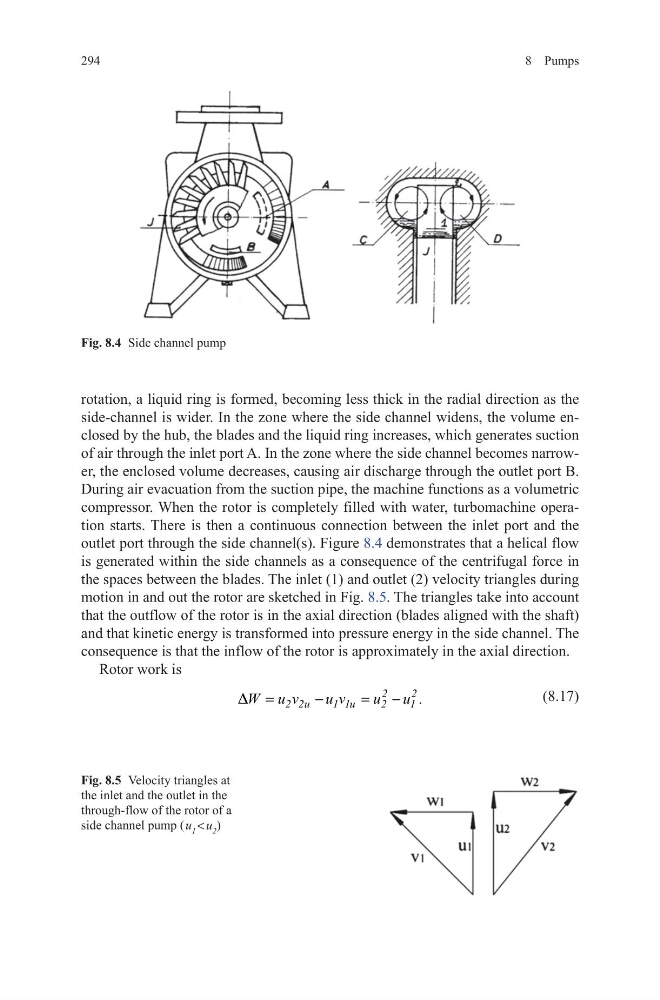
side-channel is wider. In the zone where the side channel widens, the volume enclosed by the hub, the blades and the liquid ring increases, which generates suction
of air through the inlet port A. In the zone where the side channel becomes narrower, the enclosed volume decreases, causing air discharge through the outlet port B.
During air evacuation from the suction pipe, the machine functions as a volumetric
compressor. When the rotor is completely filled with water, turbomachine operation starts. There is then a continuous connection between the inlet port and the
outlet port through the side channel(s). Figure 8.4 demonstrates that a helical flow
is generated within the side channels as a consequence of the centrifugal force in
the spaces between the blades. The inlet (1) and outlet (2) velocity triangles during
motion in and out the rotor are sketched in Fig. 8.5. The triangles take into account
that the outflow of the rotor is in the axial direction (blades aligned with the shaft)
and that kinetic energy is transformed into pressure energy in the side channel. The
consequence is that the inflow of the rotor is approximately in the axial direction.
Rotor work is
(8.17)
D =
−
=
−
2
2
2 2u
1 1u
2
1
W u v
u v
u u .
Fig. 8.4 Side channel pump
Fig. 8.5 Velocity triangles at
the inlet and the outlet in the
through-flow of the rotor of a
side channel pump ( u 1 < u 2 )
294
rotation, a liquid ring is formed, becoming less thick in the radial direction as the
side-channel is wider. In the zone where the side channel widens, the volume enclosed by the hub, the blades and the liquid ring increases, which generates suction
of air through the inlet port A. In the zone where the side channel becomes narrower, the enclosed volume decreases, causing air discharge through the outlet port B.
During air evacuation from the suction pipe, the machine functions as a volumetric
compressor. When the rotor is completely filled with water, turbomachine operation starts. There is then a continuous connection between the inlet port and the
outlet port through the side channel(s). Figure 8.4 demonstrates that a helical flow
is generated within the side channels as a consequence of the centrifugal force in
the spaces between the blades. The inlet (1) and outlet (2) velocity triangles during
motion in and out the rotor are sketched in Fig. 8.5. The triangles take into account
that the outflow of the rotor is in the axial direction (blades aligned with the shaft)
and that kinetic energy is transformed into pressure energy in the side channel. The
consequence is that the inflow of the rotor is approximately in the axial direction.
Rotor work is
(8.17)
D =
−
=
−
2
2
2 2u
1 1u
2
1
W u v
u v
u u .
Fig. 8.4 Side channel pump
Fig. 8.5 Velocity triangles at
the inlet and the outlet in the
through-flow of the rotor of a
side channel pump ( u 1 < u 2 )