

8.1 Cavitation
285
static conditions. Inertia and viscous effects intervene as well within a flow. These
generate delay between the location where the critical pressure is reached and the
location of bubble formation. The equation describing the radius of a bubble, as a
function of surface tension and viscous forces, is known as the Rayleigh-Plesset
equation [1, 4]. It allows the calculation, with numerical methods, of bubble generation, if the critical pressure is known. The liquid state determining the critical
pressure is termed water quality. It mainly concerns the size of the largest cores
and the thermodynamic state, first of all the temperature. The critical pressure is
rather difficult to predict, which makes the calculation of bubble cavitation (and
derived forms) a quite delicate matter.
The study of incipient cavitation (bubble cavitation) is not crucial with pumps
and hydraulic turbines, as incipient cavitation neither causes erosion nor performance decrease. For these phenomena to occur, a significantly large cavitation zone
is required. A large zone is always attached to the suction side of a blade and, therefore, the term attached cavitation is used. With an attached cavitation bubble, it may
be assumed that the pressure within and around the bubble is vapour pressure with
no interfering effect of surface tension. The occurrence of cavitation thus becomes
independent of water quality. Henceforth we assume that cavitation occurs as soon
as the local pressure attains the vapour pressure. This is a justified assumption for
developed cavitation. Further, we may assume that the vapour pressure at the cavitation bubble has the same value as at the pump inlet. This is a good assumption for
a cold fluid. For a fluid near evaporation, the vapour pressure at the cavitation zone
may significantly be lower than at the pump entrance because the latent heat necessary for vaporisation lowers the local temperature.
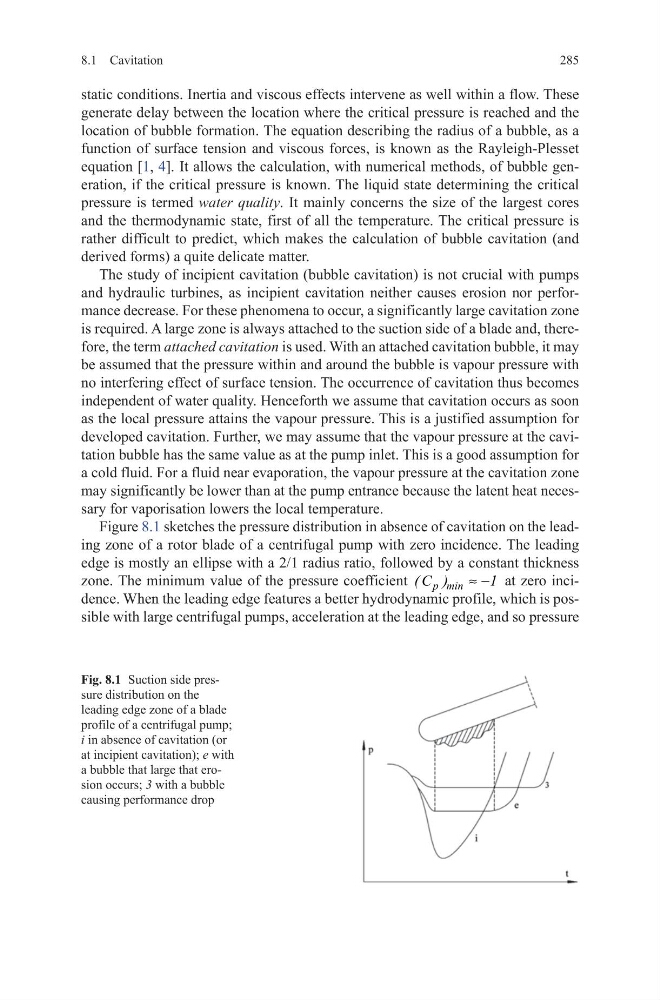
Figure 8.1 sketches the pressure distribution in absence of cavitation on the leading zone of a rotor blade of a centrifugal pump with zero incidence. The leading
edge is mostly an ellipse with a 2/1 radius ratio, followed by a constant thickness
zone. The minimum value of the pressure coefficient
≈ −
p min
( C )
1 at zero incidence. When the leading edge features a better hydrodynamic profile, which is possible with large centrifugal pumps, acceleration at the leading edge, and so pressure
Fig. 8.1 Suction side pressure distribution on the
leading edge zone of a blade
profile of a centrifugal pump;
i in absence of cavitation (or
at incipient cavitation); e with
a bubble that large that erosion occurs; 3 with a bubble
causing performance drop
285
static conditions. Inertia and viscous effects intervene as well within a flow. These
generate delay between the location where the critical pressure is reached and the
location of bubble formation. The equation describing the radius of a bubble, as a
function of surface tension and viscous forces, is known as the Rayleigh-Plesset
equation [1, 4]. It allows the calculation, with numerical methods, of bubble generation, if the critical pressure is known. The liquid state determining the critical
pressure is termed water quality. It mainly concerns the size of the largest cores
and the thermodynamic state, first of all the temperature. The critical pressure is
rather difficult to predict, which makes the calculation of bubble cavitation (and
derived forms) a quite delicate matter.
The study of incipient cavitation (bubble cavitation) is not crucial with pumps
and hydraulic turbines, as incipient cavitation neither causes erosion nor performance decrease. For these phenomena to occur, a significantly large cavitation zone
is required. A large zone is always attached to the suction side of a blade and, therefore, the term attached cavitation is used. With an attached cavitation bubble, it may
be assumed that the pressure within and around the bubble is vapour pressure with
no interfering effect of surface tension. The occurrence of cavitation thus becomes
independent of water quality. Henceforth we assume that cavitation occurs as soon
as the local pressure attains the vapour pressure. This is a justified assumption for
developed cavitation. Further, we may assume that the vapour pressure at the cavitation bubble has the same value as at the pump inlet. This is a good assumption for
a cold fluid. For a fluid near evaporation, the vapour pressure at the cavitation zone
may significantly be lower than at the pump entrance because the latent heat necessary for vaporisation lowers the local temperature.
Figure 8.1 sketches the pressure distribution in absence of cavitation on the leading zone of a rotor blade of a centrifugal pump with zero incidence. The leading
edge is mostly an ellipse with a 2/1 radius ratio, followed by a constant thickness
zone. The minimum value of the pressure coefficient
≈ −
p min
( C )
1 at zero incidence. When the leading edge features a better hydrodynamic profile, which is possible with large centrifugal pumps, acceleration at the leading edge, and so pressure
Fig. 8.1 Suction side pressure distribution on the
leading edge zone of a blade
profile of a centrifugal pump;
i in absence of cavitation (or
at incipient cavitation); e with
a bubble that large that erosion occurs; 3 with a bubble
causing performance drop