

7.4 Imperfect Similitude
269
relations allow calculating the flow rate and head with water (subscript w), from
which the pump can be chosen. With the known efficiency in water, the efficiency
with the viscous fluid can be estimated. Quite often in chemical industry the same
pump or compressor is used with various fluids. Performance is normally determined by the manufacturer with water and air as fluids. Calculating the expected
performance with another fluid is very important for the manufacturer because of
the guarantee to be given to a user. Therefore, a calculation method for radial compressors was worked out by a group of manufacturers [3, 11]. The procedure is
quite rational and may be applied to pumps too, although it has not been developed
specifically for pumps.
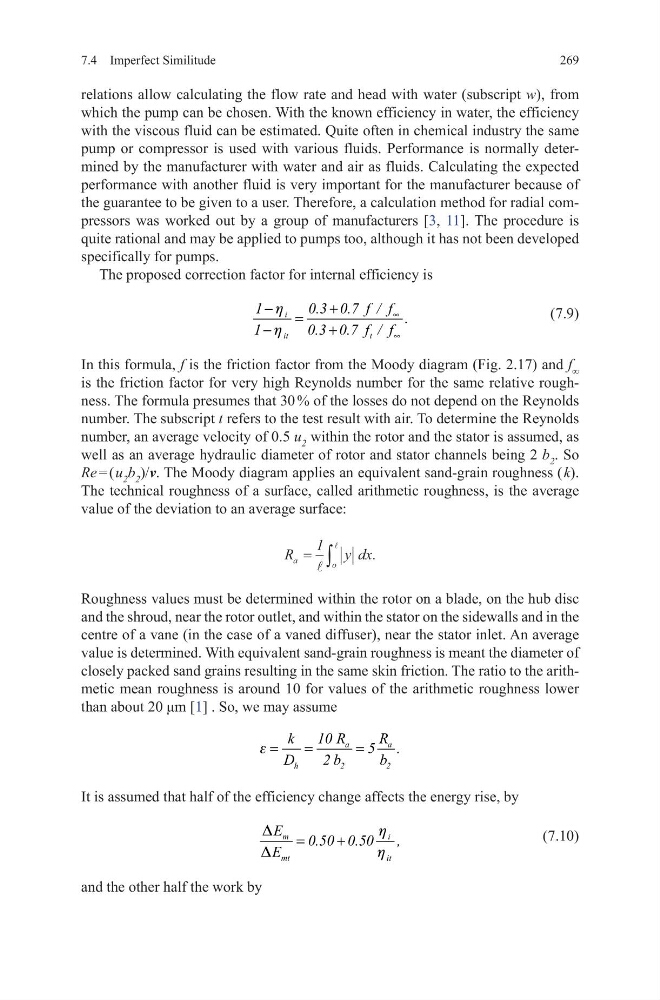
The proposed correction factor for internal efficiency is
(7.9)
In this formula, f is the friction factor from the Moody diagram (Fig. 2.17) and f ∞
is the friction factor for very high Reynolds number for the same relative roughness. The formula presumes that 30 % of the losses do not depend on the Reynolds
number. The subscript t refers to the test result with air. To determine the Reynolds
number, an average velocity of 0.5 u 2 within the rotor and the stator is assumed, as
well as an average hydraulic diameter of rotor and stator channels being 2 b 2 . So
Re = ( u 2 b 2 )/ν. The Moody diagram applies an equivalent sand-grain roughness ( k).
The technical roughness of a surface, called arithmetic roughness, is the average
value of the deviation to an average surface:
Roughness values must be determined within the rotor on a blade, on the hub disc
and the shroud, near the rotor outlet, and within the stator on the sidewalls and in the
centre of a vane (in the case of a vaned diffuser), near the stator inlet. An average
value is determined. With equivalent sand-grain roughness is meant the diameter of
closely packed sand grains resulting in the same skin friction. The ratio to the arithmetic mean roughness is around 10 for values of the arithmetic roughness lower
than about 20 μm [1] . So, we may assume
It is assumed that half of the efficiency change affects the energy rise, by
(7.10)
and the other half the work by
i
it
t
1
0.3 0.7 f / f .
1
0.3 0.7 f / f
h
h
∞
∞
−
+
=
−
+
R
y dx
a
o
= ∫
1
.
a
a
h
2
2
10 R
R
k
5 .
D
2 b
b
e =
=
=
m
i
mt
it
E
0.50 0.50
,
E
D
h
D
h
=
+
269
relations allow calculating the flow rate and head with water (subscript w), from
which the pump can be chosen. With the known efficiency in water, the efficiency
with the viscous fluid can be estimated. Quite often in chemical industry the same
pump or compressor is used with various fluids. Performance is normally determined by the manufacturer with water and air as fluids. Calculating the expected
performance with another fluid is very important for the manufacturer because of
the guarantee to be given to a user. Therefore, a calculation method for radial compressors was worked out by a group of manufacturers [3, 11]. The procedure is
quite rational and may be applied to pumps too, although it has not been developed
specifically for pumps.
The proposed correction factor for internal efficiency is
(7.9)
In this formula, f is the friction factor from the Moody diagram (Fig. 2.17) and f ∞
is the friction factor for very high Reynolds number for the same relative roughness. The formula presumes that 30 % of the losses do not depend on the Reynolds
number. The subscript t refers to the test result with air. To determine the Reynolds
number, an average velocity of 0.5 u 2 within the rotor and the stator is assumed, as
well as an average hydraulic diameter of rotor and stator channels being 2 b 2 . So
Re = ( u 2 b 2 )/ν. The Moody diagram applies an equivalent sand-grain roughness ( k).
The technical roughness of a surface, called arithmetic roughness, is the average
value of the deviation to an average surface:
Roughness values must be determined within the rotor on a blade, on the hub disc
and the shroud, near the rotor outlet, and within the stator on the sidewalls and in the
centre of a vane (in the case of a vaned diffuser), near the stator inlet. An average
value is determined. With equivalent sand-grain roughness is meant the diameter of
closely packed sand grains resulting in the same skin friction. The ratio to the arithmetic mean roughness is around 10 for values of the arithmetic roughness lower
than about 20 μm [1] . So, we may assume
It is assumed that half of the efficiency change affects the energy rise, by
(7.10)
and the other half the work by
i
it
t
1
0.3 0.7 f / f .
1
0.3 0.7 f / f
h
h
∞
∞
−
+
=
−
+
R
y dx
a
o
= ∫
1
.
a
a
h
2
2
10 R
R
k
5 .
D
2 b
b
e =
=
=
m
i
mt
it
E
0.50 0.50
,
E
D
h
D
h
=
+