

7.4 Imperfect Similitude
267
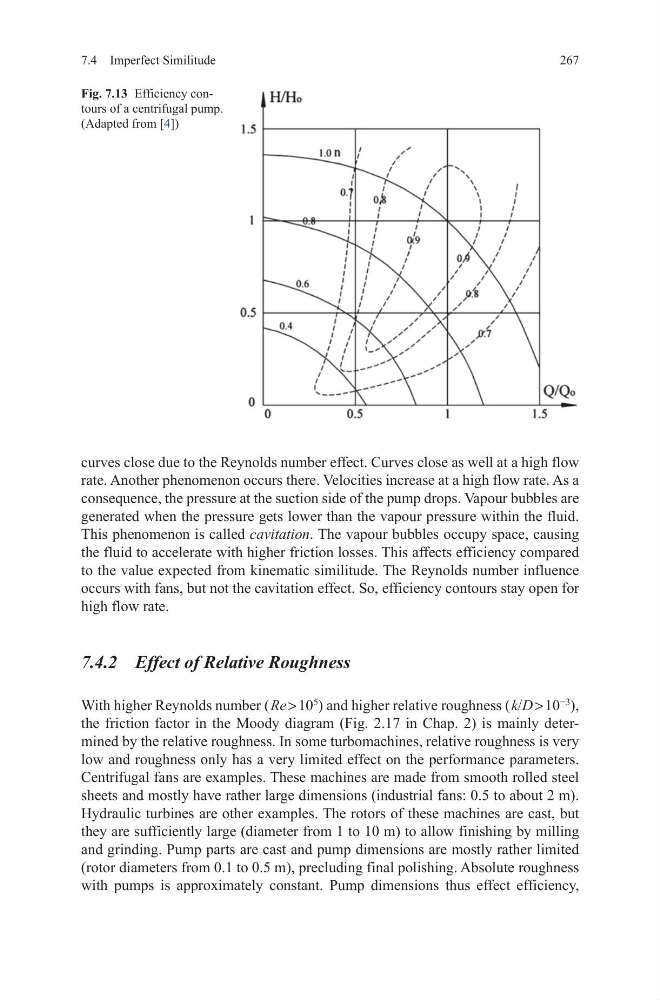
curves close due to the Reynolds number effect. Curves close as well at a high flow
rate. Another phenomenon occurs there. Velocities increase at a high flow rate. As a
consequence, the pressure at the suction side of the pump drops. Vapour bubbles are
generated when the pressure gets lower than the vapour pressure within the fluid.
This phenomenon is called cavitation. The vapour bubbles occupy space, causing
the fluid to accelerate with higher friction losses. This affects efficiency compared
to the value expected from kinematic similitude. The Reynolds number influence
occurs with fans, but not the cavitation effect. So, efficiency contours stay open for
high flow rate.
7.4.2 Effect of Relative Roughness
With higher Reynolds number ( Re > 10
5
) and higher relative roughness ( k/D > 10
−3
),
the friction factor in the Moody diagram (Fig. 2.17 in Chap. 2) is mainly determined by the relative roughness. In some turbomachines, relative roughness is very
low and roughness only has a very limited effect on the performance parameters.
Centrifugal fans are examples. These machines are made from smooth rolled steel
sheets and mostly have rather large dimensions (industrial fans: 0.5 to about 2 m).
Hydraulic turbines are other examples. The rotors of these machines are cast, but
they are sufficiently large (diameter from 1 to 10 m) to allow finishing by milling
and grinding. Pump parts are cast and pump dimensions are mostly rather limited
(rotor diameters from 0.1 to 0.5 m), precluding final polishing. Absolute roughness
with pumps is approximately constant. Pump dimensions thus effect efficiency,
Fig. 7.13 Efficiency contours of a centrifugal pump.
(Adapted from [4])
267
curves close due to the Reynolds number effect. Curves close as well at a high flow
rate. Another phenomenon occurs there. Velocities increase at a high flow rate. As a
consequence, the pressure at the suction side of the pump drops. Vapour bubbles are
generated when the pressure gets lower than the vapour pressure within the fluid.
This phenomenon is called cavitation. The vapour bubbles occupy space, causing
the fluid to accelerate with higher friction losses. This affects efficiency compared
to the value expected from kinematic similitude. The Reynolds number influence
occurs with fans, but not the cavitation effect. So, efficiency contours stay open for
high flow rate.
7.4.2 Effect of Relative Roughness
With higher Reynolds number ( Re > 10
5
) and higher relative roughness ( k/D > 10
−3
),
the friction factor in the Moody diagram (Fig. 2.17 in Chap. 2) is mainly determined by the relative roughness. In some turbomachines, relative roughness is very
low and roughness only has a very limited effect on the performance parameters.
Centrifugal fans are examples. These machines are made from smooth rolled steel
sheets and mostly have rather large dimensions (industrial fans: 0.5 to about 2 m).
Hydraulic turbines are other examples. The rotors of these machines are cast, but
they are sufficiently large (diameter from 1 to 10 m) to allow finishing by milling
and grinding. Pump parts are cast and pump dimensions are mostly rather limited
(rotor diameters from 0.1 to 0.5 m), precluding final polishing. Absolute roughness
with pumps is approximately constant. Pump dimensions thus effect efficiency,
Fig. 7.13 Efficiency contours of a centrifugal pump.
(Adapted from [4])