

7.3 Application Example of Similitude: Variable Rotational Speed with a Pump
265
There are pump applications similar to the one in Fig. 7.10, where a large capacity of the discharge reservoir is unwanted, or where even no reservoir is wanted.
Pumps in chemical plants or pumps for hot water distribution in central heating
systems are examples. Such pumps must allow flow rate variation. The classical
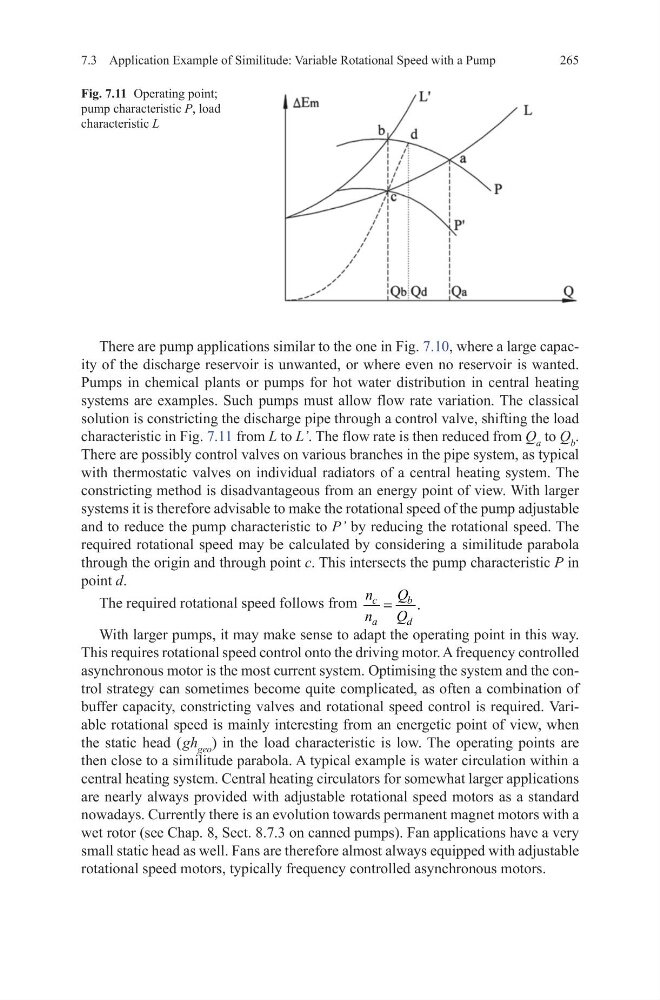
solution is constricting the discharge pipe through a control valve, shifting the load
characteristic in Fig. 7.11 from L to L’. The flow rate is then reduced from Q a to Q b .
There are possibly control valves on various branches in the pipe system, as typical
with thermostatic valves on individual radiators of a central heating system. The
constricting method is disadvantageous from an energy point of view. With larger
systems it is therefore advisable to make the rotational speed of the pump adjustable
and to reduce the pump characteristic to P’ by reducing the rotational speed. The
required rotational speed may be calculated by considering a similitude parabola
through the origin and through point c. This intersects the pump characteristic P in
point d.
The required rotational speed follows from
.
c
b
a
d
n
Q
n
Q
=
With larger pumps, it may make sense to adapt the operating point in this way.
This requires rotational speed control onto the driving motor. A frequency controlled
asynchronous motor is the most current system. Optimising the system and the control strategy can sometimes become quite complicated, as often a combination of
buffer capacity, constricting valves and rotational speed control is required. Variable rotational speed is mainly interesting from an energetic point of view, when
the static head ( gh geo ) in the load characteristic is low. The operating points are
then close to a similitude parabola. A typical example is water circulation within a
central heating system. Central heating circulators for somewhat larger applications
are nearly always provided with adjustable rotational speed motors as a standard
nowadays. Currently there is an evolution towards permanent magnet motors with a
wet rotor (see Chap. 8, Sect. 8.7.3 on canned pumps). Fan applications have a very
small static head as well. Fans are therefore almost always equipped with adjustable
rotational speed motors, typically frequency controlled asynchronous motors.
Fig. 7.11 Operating point;
pump characteristic P, load
characteristic L
265
There are pump applications similar to the one in Fig. 7.10, where a large capacity of the discharge reservoir is unwanted, or where even no reservoir is wanted.
Pumps in chemical plants or pumps for hot water distribution in central heating
systems are examples. Such pumps must allow flow rate variation. The classical
solution is constricting the discharge pipe through a control valve, shifting the load
characteristic in Fig. 7.11 from L to L’. The flow rate is then reduced from Q a to Q b .
There are possibly control valves on various branches in the pipe system, as typical
with thermostatic valves on individual radiators of a central heating system. The
constricting method is disadvantageous from an energy point of view. With larger
systems it is therefore advisable to make the rotational speed of the pump adjustable
and to reduce the pump characteristic to P’ by reducing the rotational speed. The
required rotational speed may be calculated by considering a similitude parabola
through the origin and through point c. This intersects the pump characteristic P in
point d.
The required rotational speed follows from
.
c
b
a
d
n
Q
n
Q
=
With larger pumps, it may make sense to adapt the operating point in this way.
This requires rotational speed control onto the driving motor. A frequency controlled
asynchronous motor is the most current system. Optimising the system and the control strategy can sometimes become quite complicated, as often a combination of
buffer capacity, constricting valves and rotational speed control is required. Variable rotational speed is mainly interesting from an energetic point of view, when
the static head ( gh geo ) in the load characteristic is low. The operating points are
then close to a similitude parabola. A typical example is water circulation within a
central heating system. Central heating circulators for somewhat larger applications
are nearly always provided with adjustable rotational speed motors as a standard
nowadays. Currently there is an evolution towards permanent magnet motors with a
wet rotor (see Chap. 8, Sect. 8.7.3 on canned pumps). Fan applications have a very
small static head as well. Fans are therefore almost always equipped with adjustable
rotational speed motors, typically frequency controlled asynchronous motors.
Fig. 7.11 Operating point;
pump characteristic P, load
characteristic L