

7 Dynamic Similitude
248
7.1.2 Dimensionless Parameter Groups
Similar lengths have a constant ratio within similar flows. Similar velocities have
a constant ratio as well. As velocity is a length divided by time, the combination of
velocity and length implies that similar time intervals have a constant ratio. Analogously, from the constant ratio of forces and from the equality of a force to a mass
times a length divided by the square of a time ( N = kgm/s
2
), it follows that similar
masses have a constant ratio. The fundamental quantities, i.e. length, mass and time,
by which all mechanical quantities may be expressed, thus show a constant ratio at
homologous points within similar flows. The consequence is that a dimensionless
group of parameters formed by combining quantities describing the flow must have
the same value in homologous points. For example, pressure has the same dimension as the product of a density (kg/m
3
) and the square of a velocity (m
2
/s
2
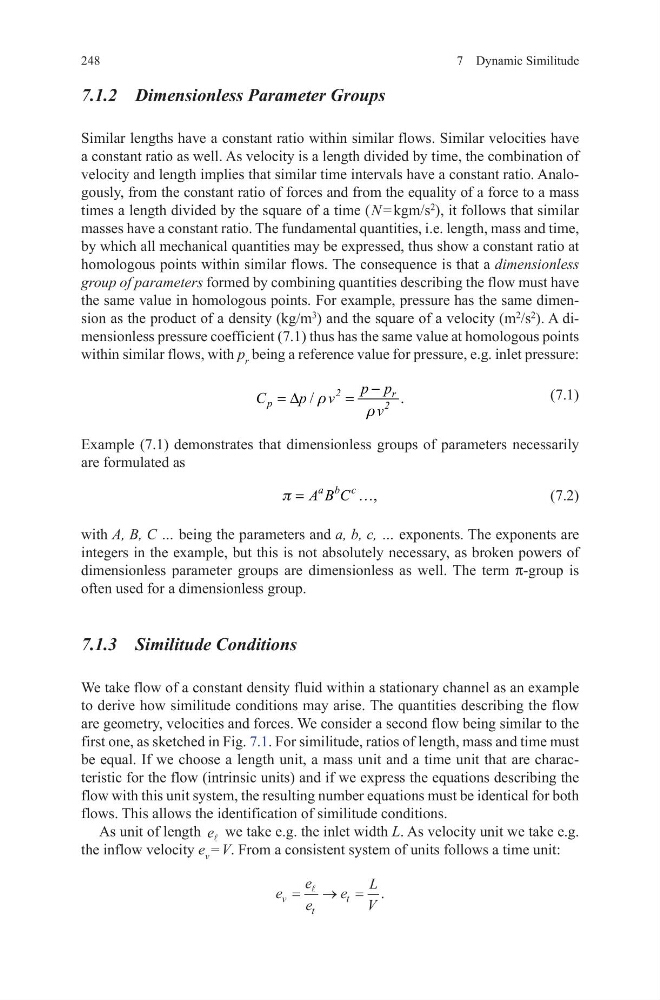
). A dimensionless pressure coefficient (7.1) thus has the same value at homologous points
within similar flows, with p r being a reference value for pressure, e.g. inlet pressure:
(7.1)
Example (7.1) demonstrates that dimensionless groups of parameters necessarily
are formulated as
(7.2)
with A, B, C … being the parameters and a, b, c, … exponents. The exponents are
integers in the example, but this is not absolutely necessary, as broken powers of
dimensionless parameter groups are dimensionless as well. The term π-group is
often used for a dimensionless group.
7.1.3 Similitude Conditions
We take flow of a constant density fluid within a stationary channel as an example
to derive how similitude conditions may arise. The quantities describing the flow
are geometry, velocities and forces. We consider a second flow being similar to the
first one, as sketched in Fig. 7.1. For similitude, ratios of length, mass and time must
be equal. If we choose a length unit, a mass unit and a time unit that are characteristic for the flow (intrinsic units) and if we express the equations describing the
flow with this unit system, the resulting number equations must be identical for both
flows. This allows the identification of similitude conditions.
As unit of length e we take e.g. the inlet width L. As velocity unit we take e.g.
the inflow velocity e v = V. From a consistent system of units follows a time unit:
/
.
2
r
p
2
p p
C
p v
v
r
r
−
= ∆
=
,
a b c
A B C
p =
…
e
e
e
e
L
V
v
t
t
= → =
.
248
7.1.2 Dimensionless Parameter Groups
Similar lengths have a constant ratio within similar flows. Similar velocities have
a constant ratio as well. As velocity is a length divided by time, the combination of
velocity and length implies that similar time intervals have a constant ratio. Analogously, from the constant ratio of forces and from the equality of a force to a mass
times a length divided by the square of a time ( N = kgm/s
2
), it follows that similar
masses have a constant ratio. The fundamental quantities, i.e. length, mass and time,
by which all mechanical quantities may be expressed, thus show a constant ratio at
homologous points within similar flows. The consequence is that a dimensionless
group of parameters formed by combining quantities describing the flow must have
the same value in homologous points. For example, pressure has the same dimension as the product of a density (kg/m
3
) and the square of a velocity (m
2
/s
2
). A dimensionless pressure coefficient (7.1) thus has the same value at homologous points
within similar flows, with p r being a reference value for pressure, e.g. inlet pressure:
(7.1)
Example (7.1) demonstrates that dimensionless groups of parameters necessarily
are formulated as
(7.2)
with A, B, C … being the parameters and a, b, c, … exponents. The exponents are
integers in the example, but this is not absolutely necessary, as broken powers of
dimensionless parameter groups are dimensionless as well. The term π-group is
often used for a dimensionless group.
7.1.3 Similitude Conditions
We take flow of a constant density fluid within a stationary channel as an example
to derive how similitude conditions may arise. The quantities describing the flow
are geometry, velocities and forces. We consider a second flow being similar to the
first one, as sketched in Fig. 7.1. For similitude, ratios of length, mass and time must
be equal. If we choose a length unit, a mass unit and a time unit that are characteristic for the flow (intrinsic units) and if we express the equations describing the
flow with this unit system, the resulting number equations must be identical for both
flows. This allows the identification of similitude conditions.
As unit of length e we take e.g. the inlet width L. As velocity unit we take e.g.
the inflow velocity e v = V. From a consistent system of units follows a time unit:
/
.
2
r
p
2
p p
C
p v
v
r
r
−
= ∆
=
,
a b c
A B C
p =
…
e
e
e
e
L
V
v
t
t
= → =
.