

242
6 Steam Turbines
2
2
1
1
0
1
1u
1a
2
2
h h
v
v .
= +
+
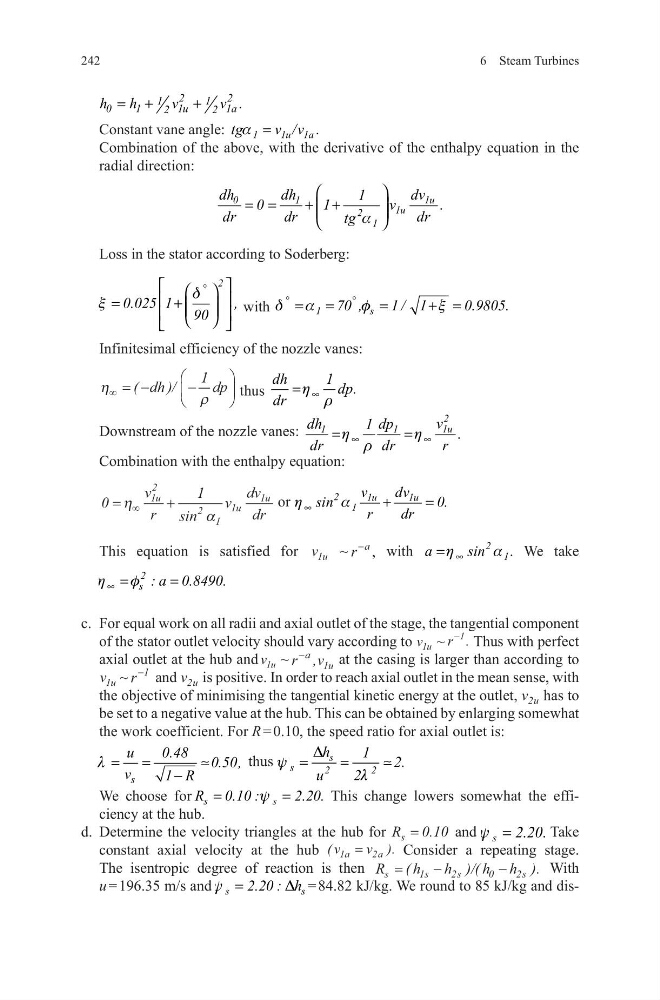
Constant vane angle:
1
1u 1a
tg
v /v .
=
a
Combination of the above, with the derivative of the enthalpy equation in the
radial direction:
0
1u
1
1u
2 1
dh
dv
dh
1
0
1
v
.
dr
dr
dr
tg
= =
+ +
a
Loss in the stator according to Soderberg:
2
0.025 1
,
90
°
=
+
d
x
with
1
s
70 ,
1 / 1
0.9805.
°
°
=
=
=
+ =
d a
f
x
Infinitesimal efficiency of the nozzle vanes:
η
ρ
∞ = −
−
(
)/
dh
dp
1
thus
dh
1 dp.
dr
∞
= h r
Downstream of the nozzle vanes:
2
1u
1
1
v
dh
dp
1
.
dr
dr
r
∞
∞
=
=
h
h
r
Combination with the enthalpy equation:
0
1
1
2
2 1
1
1
=
+
∞
η
α
v
r
v
dv
dr
u
u
u
sin
or
2
1u
1u
1
v
dv
sin
0.
r
dr
∞
+
=
h
a
This equation is satisfied for v u
1
~ r
a
−
, with
2 1
a
sin
.
∞
= h
a We take
2
s : a 0.8490.
∞ =
=
h
f
c. For equal work on all radii and axial outlet of the stage, the tangential component
of the stator outlet velocity should vary according to v u
1 ~ r
−1
. Thus with perfect
axial outlet at the hub and v u
1 ~ r v
a
u
−
, 1 at the casing is larger than according to
v u
1 ~ r
−1
and v u
2 is positive. In order to reach axial outlet in the mean sense, with
the objective of minimising the tangential kinetic energy at the outlet, v u
2 has to
be set to a negative value at the hub. This can be obtained by enlarging somewhat
the work coefficient. For R = 0.10, the speed ratio for axial outlet is:
s
u
0.48
0.50,
v
1 R
= =
−
l
thus
s
s
2
2
h
1
2.
u
2
=
=
D
y
l
We choose for s
s
R 0.10 :
2.20.
=
=
y
This change lowers somewhat the efficiency at the hub.
d. Determine the velocity triangles at the hub for R s = 0 10
. and s 2.20.
=
y
Take
constant axial velocity at the hub (
) .
v
v
a
a
1
2
=
Consider a repeating stage.
The isentropic degree of reaction is then R
h
h
h h
s
s
s
s
=
−
−
(
) /(
).
1
2
0
2
With
u = 196.35 m/s and s
s
2.20 : h
=
y
D = 84.82 kJ/kg. We round to 85 kJ/kg and dis-
6 Steam Turbines
2
2
1
1
0
1
1u
1a
2
2
h h
v
v .
= +
+
Constant vane angle:
1
1u 1a
tg
v /v .
=
a
Combination of the above, with the derivative of the enthalpy equation in the
radial direction:
0
1u
1
1u
2 1
dh
dv
dh
1
0
1
v
.
dr
dr
dr
tg
= =
+ +
a
Loss in the stator according to Soderberg:
2
0.025 1
,
90
°
=
+
d
x
with
1
s
70 ,
1 / 1
0.9805.
°
°
=
=
=
+ =
d a
f
x
Infinitesimal efficiency of the nozzle vanes:
η
ρ
∞ = −
−
(
)/
dh
dp
1
thus
dh
1 dp.
dr
∞
= h r
Downstream of the nozzle vanes:
2
1u
1
1
v
dh
dp
1
.
dr
dr
r
∞
∞
=
=
h
h
r
Combination with the enthalpy equation:
0
1
1
2
2 1
1
1
=
+
∞
η
α
v
r
v
dv
dr
u
u
u
sin
or
2
1u
1u
1
v
dv
sin
0.
r
dr
∞
+
=
h
a
This equation is satisfied for v u
1
~ r
a
−
, with
2 1
a
sin
.
∞
= h
a We take
2
s : a 0.8490.
∞ =
=
h
f
c. For equal work on all radii and axial outlet of the stage, the tangential component
of the stator outlet velocity should vary according to v u
1 ~ r
−1
. Thus with perfect
axial outlet at the hub and v u
1 ~ r v
a
u
−
, 1 at the casing is larger than according to
v u
1 ~ r
−1
and v u
2 is positive. In order to reach axial outlet in the mean sense, with
the objective of minimising the tangential kinetic energy at the outlet, v u
2 has to
be set to a negative value at the hub. This can be obtained by enlarging somewhat
the work coefficient. For R = 0.10, the speed ratio for axial outlet is:
s
u
0.48
0.50,
v
1 R
= =
−
l
thus
s
s
2
2
h
1
2.
u
2
=
=
D
y
l
We choose for s
s
R 0.10 :
2.20.
=
=
y
This change lowers somewhat the efficiency at the hub.
d. Determine the velocity triangles at the hub for R s = 0 10
. and s 2.20.
=
y
Take
constant axial velocity at the hub (
) .
v
v
a
a
1
2
=
Consider a repeating stage.
The isentropic degree of reaction is then R
h
h
h h
s
s
s
s
=
−
−
(
) /(
).
1
2
0
2
With
u = 196.35 m/s and s
s
2.20 : h
=
y
D = 84.82 kJ/kg. We round to 85 kJ/kg and dis-