

236
6 Steam Turbines
The adaptations discussed above are to a certain degree applied in all reaction
stages, but not leading to such extreme shapes as in the last stage. The motivation is
reducing the degree of reaction at the casing, which is advantageous for the reduction of leakage losses. Thanks to aerodynamic optimisation, the efficiency in the LP
part of a turbine yields about 92 % for dry flow. In reality, condensation reduces the
efficiency to about 90 %. The efficiency of an entire large steam turbine comes to
about 92.5 % (HP 94 %, IP 96 %, LP 90 %).
6.10 Exercises
6.10.1. Compare the energy loss coefficient (Eq. 6.11) and the pressure loss
coefficient (Eq. 6.12) applied to the expansion of air ( γ = 1.4) in a nozzle with
infinitesimal efficiency 0.9 for varying outlet Mach number M 1 = 0.25, 0.50, 1
and 2. Ignore the kinetic energy at the inlet of the nozzle. Use the formulae of
Chap. 4. Observe that the energy loss coefficient decreases weakly with increasing Mach number (the energy loss coefficient is linked to the isentropic efficiency:
s
1 /
1
=
−
x
h
and 0 1 s
x
h
= − ) and that the pressure loss coefficient increases quite
strongly with increasing Mach number. Remark that the Mach number influence
on the pressure loss coefficient may be neutralised by using the logarithm of pressure instead of pressure (such a modified coefficient is then linked to the polytropic
efficiency). Remark that the polytropic efficiency can be obtained in an experiment
by measurement of the kinetic energy and calculation of the polytropic enthalpy
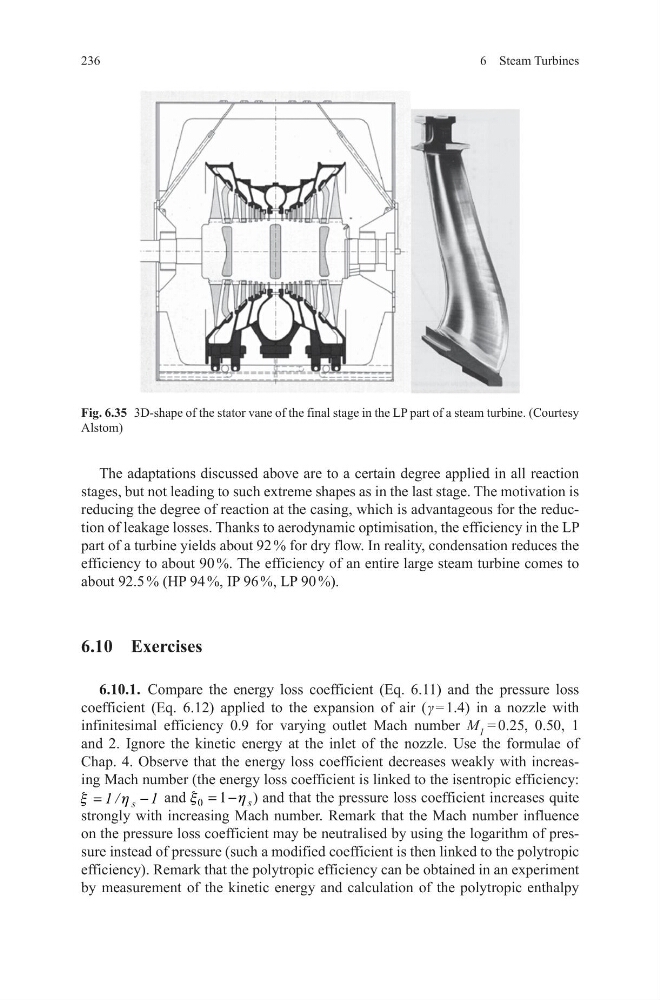
Fig. 6.35 3D-shape of the stator vane of the final stage in the LP part of a steam turbine. (Courtesy
Alstom)
6 Steam Turbines
The adaptations discussed above are to a certain degree applied in all reaction
stages, but not leading to such extreme shapes as in the last stage. The motivation is
reducing the degree of reaction at the casing, which is advantageous for the reduction of leakage losses. Thanks to aerodynamic optimisation, the efficiency in the LP
part of a turbine yields about 92 % for dry flow. In reality, condensation reduces the
efficiency to about 90 %. The efficiency of an entire large steam turbine comes to
about 92.5 % (HP 94 %, IP 96 %, LP 90 %).
6.10 Exercises
6.10.1. Compare the energy loss coefficient (Eq. 6.11) and the pressure loss
coefficient (Eq. 6.12) applied to the expansion of air ( γ = 1.4) in a nozzle with
infinitesimal efficiency 0.9 for varying outlet Mach number M 1 = 0.25, 0.50, 1
and 2. Ignore the kinetic energy at the inlet of the nozzle. Use the formulae of
Chap. 4. Observe that the energy loss coefficient decreases weakly with increasing Mach number (the energy loss coefficient is linked to the isentropic efficiency:
s
1 /
1
=
−
x
h
and 0 1 s
x
h
= − ) and that the pressure loss coefficient increases quite
strongly with increasing Mach number. Remark that the Mach number influence
on the pressure loss coefficient may be neutralised by using the logarithm of pressure instead of pressure (such a modified coefficient is then linked to the polytropic
efficiency). Remark that the polytropic efficiency can be obtained in an experiment
by measurement of the kinetic energy and calculation of the polytropic enthalpy
Fig. 6.35 3D-shape of the stator vane of the final stage in the LP part of a steam turbine. (Courtesy
Alstom)