

235
6.9 Blade Shaping
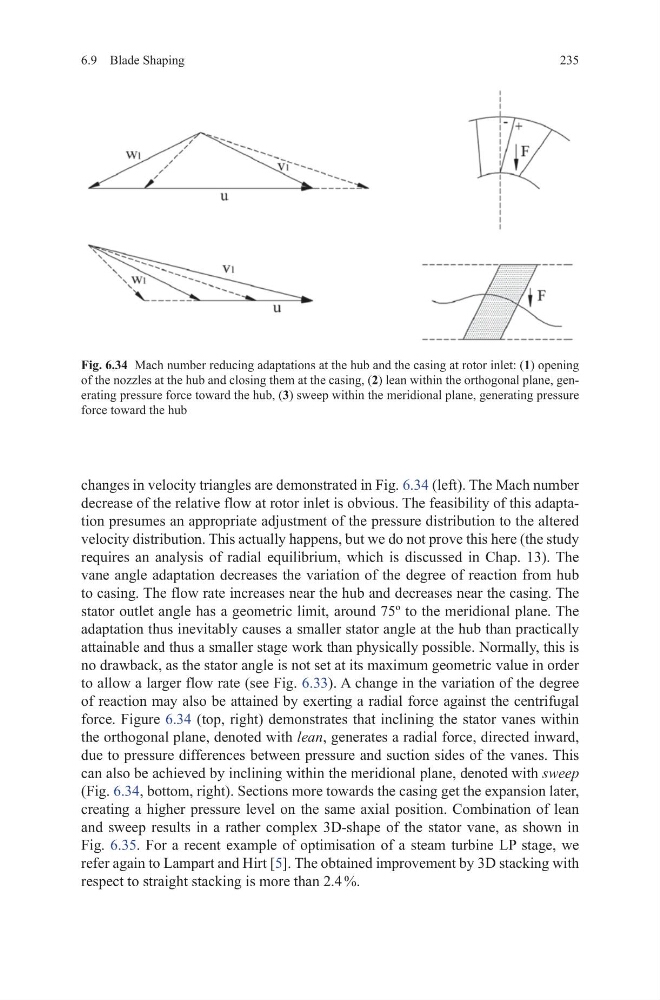
changes in velocity triangles are demonstrated in Fig. 6.34 (left). The Mach number
decrease of the relative flow at rotor inlet is obvious. The feasibility of this adaptation presumes an appropriate adjustment of the pressure distribution to the altered
velocity distribution. This actually happens, but we do not prove this here (the study
requires an analysis of radial equilibrium, which is discussed in Chap. 13). The
vane angle adaptation decreases the variation of the degree of reaction from hub
to casing. The flow rate increases near the hub and decreases near the casing. The
stator outlet angle has a geometric limit, around 75º to the meridional plane. The
adaptation thus inevitably causes a smaller stator angle at the hub than practically
attainable and thus a smaller stage work than physically possible. Normally, this is
no drawback, as the stator angle is not set at its maximum geometric value in order
to allow a larger flow rate (see Fig. 6.33). A change in the variation of the degree
of reaction may also be attained by exerting a radial force against the centrifugal
force. Figure 6.34 (top, right) demonstrates that inclining the stator vanes within
the orthogonal plane, denoted with lean, generates a radial force, directed inward,
due to pressure differences between pressure and suction sides of the vanes. This
can also be achieved by inclining within the meridional plane, denoted with sweep
(Fig. 6.34, bottom, right). Sections more towards the casing get the expansion later,
creating a higher pressure level on the same axial position. Combination of lean
and sweep results in a rather complex 3D-shape of the stator vane, as shown in
Fig. 6.35. For a recent example of optimisation of a steam turbine LP stage, we
refer again to Lampart and Hirt [5]. The obtained improvement by 3D stacking with
respect to straight stacking is more than 2.4 %.
Fig. 6.34 Mach number reducing adaptations at the hub and the casing at rotor inlet: (1) opening
of the nozzles at the hub and closing them at the casing, (2) lean within the orthogonal plane, generating pressure force toward the hub, (3) sweep within the meridional plane, generating pressure
force toward the hub
6.9 Blade Shaping
changes in velocity triangles are demonstrated in Fig. 6.34 (left). The Mach number
decrease of the relative flow at rotor inlet is obvious. The feasibility of this adaptation presumes an appropriate adjustment of the pressure distribution to the altered
velocity distribution. This actually happens, but we do not prove this here (the study
requires an analysis of radial equilibrium, which is discussed in Chap. 13). The
vane angle adaptation decreases the variation of the degree of reaction from hub
to casing. The flow rate increases near the hub and decreases near the casing. The
stator outlet angle has a geometric limit, around 75º to the meridional plane. The
adaptation thus inevitably causes a smaller stator angle at the hub than practically
attainable and thus a smaller stage work than physically possible. Normally, this is
no drawback, as the stator angle is not set at its maximum geometric value in order
to allow a larger flow rate (see Fig. 6.33). A change in the variation of the degree
of reaction may also be attained by exerting a radial force against the centrifugal
force. Figure 6.34 (top, right) demonstrates that inclining the stator vanes within
the orthogonal plane, denoted with lean, generates a radial force, directed inward,
due to pressure differences between pressure and suction sides of the vanes. This
can also be achieved by inclining within the meridional plane, denoted with sweep
(Fig. 6.34, bottom, right). Sections more towards the casing get the expansion later,
creating a higher pressure level on the same axial position. Combination of lean
and sweep results in a rather complex 3D-shape of the stator vane, as shown in
Fig. 6.35. For a recent example of optimisation of a steam turbine LP stage, we
refer again to Lampart and Hirt [5]. The obtained improvement by 3D stacking with
respect to straight stacking is more than 2.4 %.
Fig. 6.34 Mach number reducing adaptations at the hub and the casing at rotor inlet: (1) opening
of the nozzles at the hub and closing them at the casing, (2) lean within the orthogonal plane, generating pressure force toward the hub, (3) sweep within the meridional plane, generating pressure
force toward the hub