

232
6 Steam Turbines
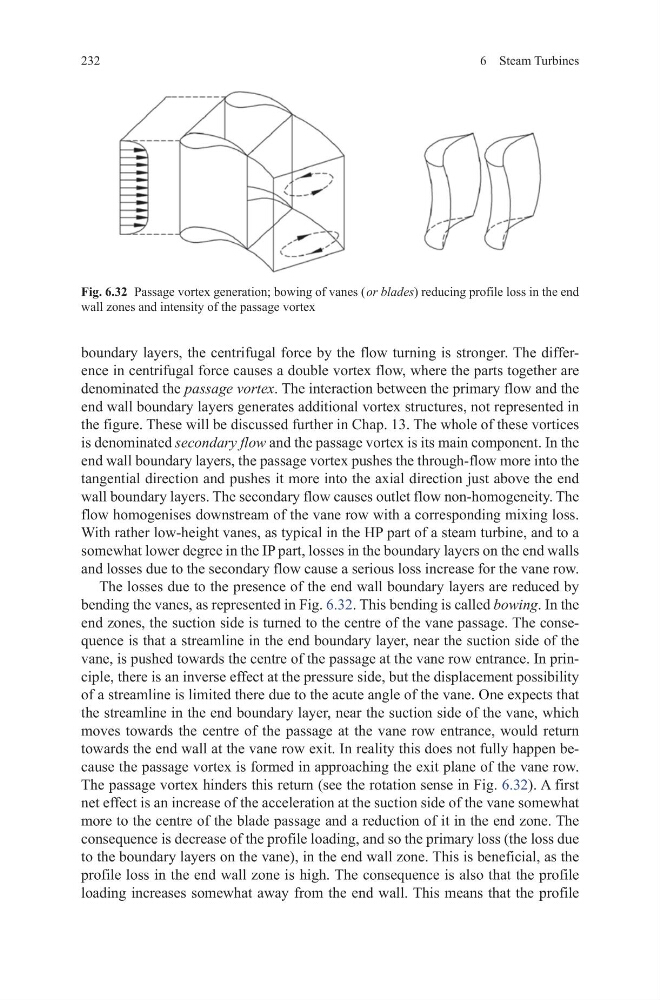
boundary layers, the centrifugal force by the flow turning is stronger. The difference in centrifugal force causes a double vortex flow, where the parts together are
denominated the passage vortex. The interaction between the primary flow and the
end wall boundary layers generates additional vortex structures, not represented in
the figure. These will be discussed further in Chap. 13. The whole of these vortices
is denominated secondary flow and the passage vortex is its main component. In the
end wall boundary layers, the passage vortex pushes the through-flow more into the
tangential direction and pushes it more into the axial direction just above the end
wall boundary layers. The secondary flow causes outlet flow non-homogeneity. The
flow homogenises downstream of the vane row with a corresponding mixing loss.
With rather low-height vanes, as typical in the HP part of a steam turbine, and to a
somewhat lower degree in the IP part, losses in the boundary layers on the end walls
and losses due to the secondary flow cause a serious loss increase for the vane row.
The losses due to the presence of the end wall boundary layers are reduced by
bending the vanes, as represented in Fig. 6.32. This bending is called bowing. In the
end zones, the suction side is turned to the centre of the vane passage. The consequence is that a streamline in the end boundary layer, near the suction side of the
vane, is pushed towards the centre of the passage at the vane row entrance. In principle, there is an inverse effect at the pressure side, but the displacement possibility
of a streamline is limited there due to the acute angle of the vane. One expects that
the streamline in the end boundary layer, near the suction side of the vane, which
moves towards the centre of the passage at the vane row entrance, would return
towards the end wall at the vane row exit. In reality this does not fully happen because the passage vortex is formed in approaching the exit plane of the vane row.
The passage vortex hinders this return (see the rotation sense in Fig. 6.32). A first
net effect is an increase of the acceleration at the suction side of the vane somewhat
more to the centre of the blade passage and a reduction of it in the end zone. The
consequence is decrease of the profile loading, and so the primary loss (the loss due
to the boundary layers on the vane), in the end wall zone. This is beneficial, as the
profile loss in the end wall zone is high. The consequence is also that the profile
loading increases somewhat away from the end wall. This means that the profile
Fig. 6.32 Passage vortex generation; bowing of vanes ( or blades) reducing profile loss in the end
wall zones and intensity of the passage vortex
6 Steam Turbines
boundary layers, the centrifugal force by the flow turning is stronger. The difference in centrifugal force causes a double vortex flow, where the parts together are
denominated the passage vortex. The interaction between the primary flow and the
end wall boundary layers generates additional vortex structures, not represented in
the figure. These will be discussed further in Chap. 13. The whole of these vortices
is denominated secondary flow and the passage vortex is its main component. In the
end wall boundary layers, the passage vortex pushes the through-flow more into the
tangential direction and pushes it more into the axial direction just above the end
wall boundary layers. The secondary flow causes outlet flow non-homogeneity. The
flow homogenises downstream of the vane row with a corresponding mixing loss.
With rather low-height vanes, as typical in the HP part of a steam turbine, and to a
somewhat lower degree in the IP part, losses in the boundary layers on the end walls
and losses due to the secondary flow cause a serious loss increase for the vane row.
The losses due to the presence of the end wall boundary layers are reduced by
bending the vanes, as represented in Fig. 6.32. This bending is called bowing. In the
end zones, the suction side is turned to the centre of the vane passage. The consequence is that a streamline in the end boundary layer, near the suction side of the
vane, is pushed towards the centre of the passage at the vane row entrance. In principle, there is an inverse effect at the pressure side, but the displacement possibility
of a streamline is limited there due to the acute angle of the vane. One expects that
the streamline in the end boundary layer, near the suction side of the vane, which
moves towards the centre of the passage at the vane row entrance, would return
towards the end wall at the vane row exit. In reality this does not fully happen because the passage vortex is formed in approaching the exit plane of the vane row.
The passage vortex hinders this return (see the rotation sense in Fig. 6.32). A first
net effect is an increase of the acceleration at the suction side of the vane somewhat
more to the centre of the blade passage and a reduction of it in the end zone. The
consequence is decrease of the profile loading, and so the primary loss (the loss due
to the boundary layers on the vane), in the end wall zone. This is beneficial, as the
profile loss in the end wall zone is high. The consequence is also that the profile
loading increases somewhat away from the end wall. This means that the profile
Fig. 6.32 Passage vortex generation; bowing of vanes ( or blades) reducing profile loss in the end
wall zones and intensity of the passage vortex