

209
6.4 The Single Impulse Stage or Laval Stage
with the outlet kinetic energy as reference term.
Enthalpy loss coefficients may be obtained with Soderberg’s loss correlation
(1949), adapted by later researchers [3, 6]. We use here the simplified version by
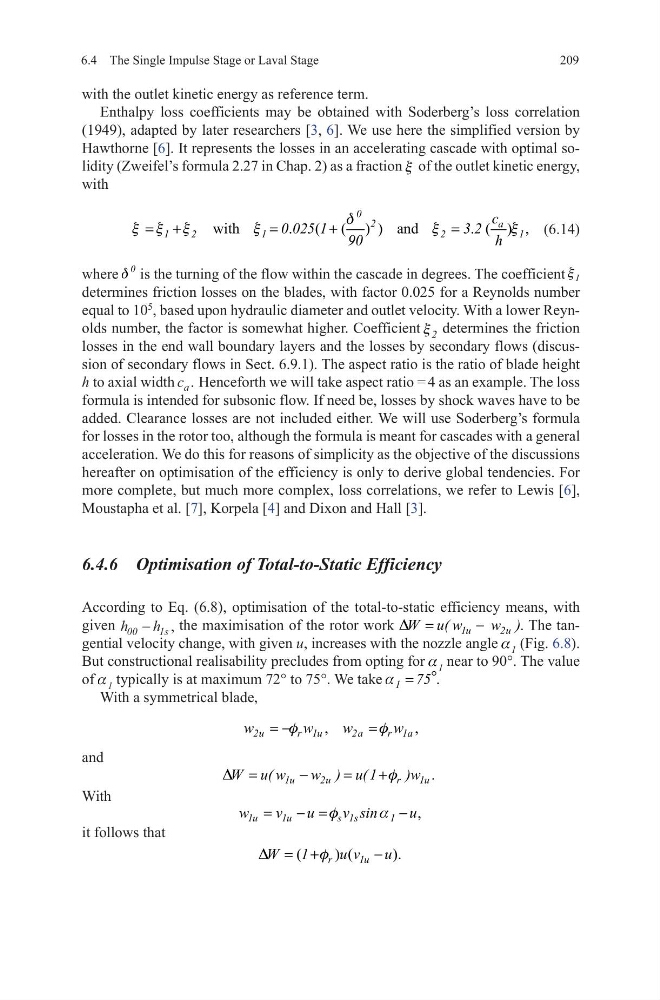
Hawthorne [6]. It represents the losses in an accelerating cascade with optimal solidity (Zweifel’s formula 2.27 in Chap. 2) as a fraction x of the outlet kinetic energy,
with
(6.14)
where
0
d is the turning of the flow within the cascade in degrees. The coefficient 1
x
determines friction losses on the blades, with factor 0.025 for a Reynolds number
equal to 10
5
, based upon hydraulic diameter and outlet velocity. With a lower Reynolds number, the factor is somewhat higher. Coefficient 2
x determines the friction
losses in the end wall boundary layers and the losses by secondary flows (discussion of secondary flows in Sect. 6.9.1). The aspect ratio is the ratio of blade height
h to axial width c a . Henceforth we will take aspect ratio = 4 as an example. The loss
formula is intended for subsonic flow. If need be, losses by shock waves have to be
added. Clearance losses are not included either. We will use Soderberg’s formula
for losses in the rotor too, although the formula is meant for cascades with a general
acceleration. We do this for reasons of simplicity as the objective of the discussions
hereafter on optimisation of the efficiency is only to derive global tendencies. For
more complete, but much more complex, loss correlations, we refer to Lewis [6],
Moustapha et al. [7], Korpela [4] and Dixon and Hall [3].
6.4.6 Optimisation of Total-to-Static Efficiency
According to Eq. (6.8), optimisation of the total-to-static efficiency means, with
given h
h s
00
1
− , the maximisation of the rotor work
1u
2u
W u( w
w ).
=
−
D
The tangential velocity change, with given u, increases with the nozzle angle a 1 (Fig. 6.8).
But constructional realisability precludes from opting for a 1 near to 90°. The value
of a 1 typically is at maximum 72° to 75°. We take
° .
1 75
a =
With a symmetrical blade,
and
With
it follows that
with
.
( ( ) ) and
. ( ) ,
1
2
1
0 2
a
2
1
c
0 025 1
3 2
90
h
d
x x x
x
x
x
=
+
=
= +
,
,
2u
r 1u
2a
r 1a
w
w
w
w
f
f
= −
=
1u
2u
r
1u
W u( w
w ) u( 1
)w .
=
−
=
+
D
f
,
1u
1u
s 1s
1
w
v
u
v sin
u
f
a
=
− =
−
(
) (
).
r
1u
W 1
u v
u
D
f
= +
−
6.4 The Single Impulse Stage or Laval Stage
with the outlet kinetic energy as reference term.
Enthalpy loss coefficients may be obtained with Soderberg’s loss correlation
(1949), adapted by later researchers [3, 6]. We use here the simplified version by
Hawthorne [6]. It represents the losses in an accelerating cascade with optimal solidity (Zweifel’s formula 2.27 in Chap. 2) as a fraction x of the outlet kinetic energy,
with
(6.14)
where
0
d is the turning of the flow within the cascade in degrees. The coefficient 1
x
determines friction losses on the blades, with factor 0.025 for a Reynolds number
equal to 10
5
, based upon hydraulic diameter and outlet velocity. With a lower Reynolds number, the factor is somewhat higher. Coefficient 2
x determines the friction
losses in the end wall boundary layers and the losses by secondary flows (discussion of secondary flows in Sect. 6.9.1). The aspect ratio is the ratio of blade height
h to axial width c a . Henceforth we will take aspect ratio = 4 as an example. The loss
formula is intended for subsonic flow. If need be, losses by shock waves have to be
added. Clearance losses are not included either. We will use Soderberg’s formula
for losses in the rotor too, although the formula is meant for cascades with a general
acceleration. We do this for reasons of simplicity as the objective of the discussions
hereafter on optimisation of the efficiency is only to derive global tendencies. For
more complete, but much more complex, loss correlations, we refer to Lewis [6],
Moustapha et al. [7], Korpela [4] and Dixon and Hall [3].
6.4.6 Optimisation of Total-to-Static Efficiency
According to Eq. (6.8), optimisation of the total-to-static efficiency means, with
given h
h s
00
1
− , the maximisation of the rotor work
1u
2u
W u( w
w ).
=
−
D
The tangential velocity change, with given u, increases with the nozzle angle a 1 (Fig. 6.8).
But constructional realisability precludes from opting for a 1 near to 90°. The value
of a 1 typically is at maximum 72° to 75°. We take
° .
1 75
a =
With a symmetrical blade,
and
With
it follows that
with
.
( ( ) ) and
. ( ) ,
1
2
1
0 2
a
2
1
c
0 025 1
3 2
90
h
d
x x x
x
x
x
=
+
=
= +
,
,
2u
r 1u
2a
r 1a
w
w
w
w
f
f
= −
=
1u
2u
r
1u
W u( w
w ) u( 1
)w .
=
−
=
+
D
f
,
1u
1u
s 1s
1
w
v
u
v sin
u
f
a
=
− =
−
(
) (
).
r
1u
W 1
u v
u
D
f
= +
−