

200
6 Steam Turbines
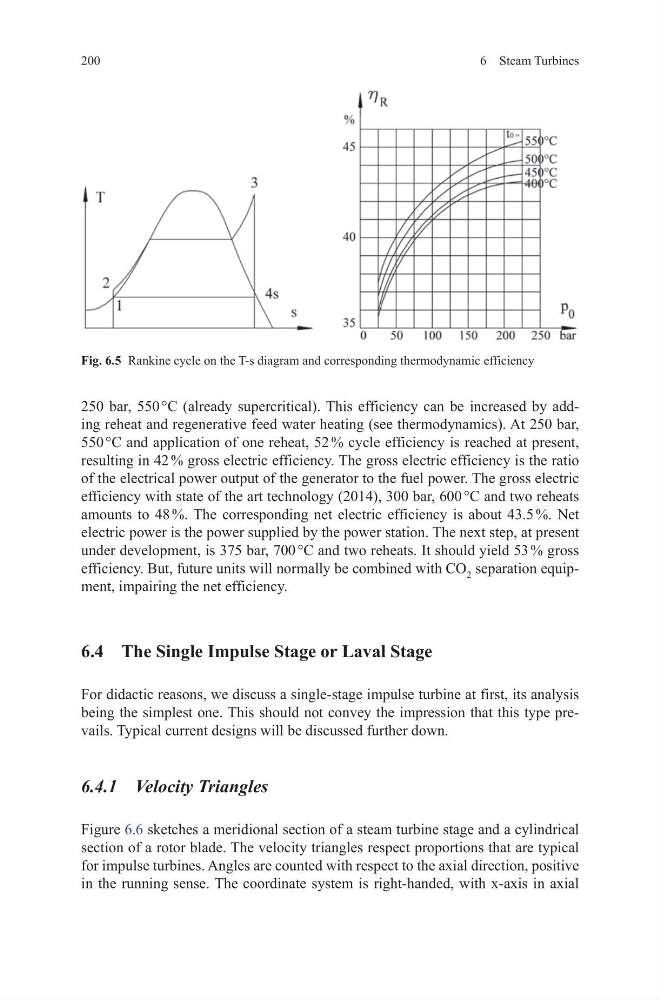
250 bar, 550 °C (already supercritical). This efficiency can be increased by adding reheat and regenerative feed water heating (see thermodynamics). At 250 bar,
550 °C and application of one reheat, 52 % cycle efficiency is reached at present,
resulting in 42 % gross electric efficiency. The gross electric efficiency is the ratio
of the electrical power output of the generator to the fuel power. The gross electric
efficiency with state of the art technology (2014), 300 bar, 600 °C and two reheats
amounts to 48 %. The corresponding net electric efficiency is about 43.5 %. Net
electric power is the power supplied by the power station. The next step, at present
under development, is 375 bar, 700 °C and two reheats. It should yield 53 % gross
efficiency. But, future units will normally be combined with CO 2 separation equipment, impairing the net efficiency.
6.4 The Single Impulse Stage or Laval Stage
For didactic reasons, we discuss a single-stage impulse turbine at first, its analysis
being the simplest one. This should not convey the impression that this type prevails. Typical current designs will be discussed further down.
6.4.1 Velocity Triangles
Figure 6.6 sketches a meridional section of a steam turbine stage and a cylindrical
section of a rotor blade. The velocity triangles respect proportions that are typical
for impulse turbines. Angles are counted with respect to the axial direction, positive
in the running sense. The coordinate system is right-handed, with x-axis in axial
Fig. 6.5 Rankine cycle on the T-s diagram and corresponding thermodynamic efficiency
6 Steam Turbines
250 bar, 550 °C (already supercritical). This efficiency can be increased by adding reheat and regenerative feed water heating (see thermodynamics). At 250 bar,
550 °C and application of one reheat, 52 % cycle efficiency is reached at present,
resulting in 42 % gross electric efficiency. The gross electric efficiency is the ratio
of the electrical power output of the generator to the fuel power. The gross electric
efficiency with state of the art technology (2014), 300 bar, 600 °C and two reheats
amounts to 48 %. The corresponding net electric efficiency is about 43.5 %. Net
electric power is the power supplied by the power station. The next step, at present
under development, is 375 bar, 700 °C and two reheats. It should yield 53 % gross
efficiency. But, future units will normally be combined with CO 2 separation equipment, impairing the net efficiency.
6.4 The Single Impulse Stage or Laval Stage
For didactic reasons, we discuss a single-stage impulse turbine at first, its analysis
being the simplest one. This should not convey the impression that this type prevails. Typical current designs will be discussed further down.
6.4.1 Velocity Triangles
Figure 6.6 sketches a meridional section of a steam turbine stage and a cylindrical
section of a rotor blade. The velocity triangles respect proportions that are typical
for impulse turbines. Angles are counted with respect to the axial direction, positive
in the running sense. The coordinate system is right-handed, with x-axis in axial
Fig. 6.5 Rankine cycle on the T-s diagram and corresponding thermodynamic efficiency