

196
6 Steam Turbines
yields about 10 kJ/kg. Hydraulic turbines are always of the single-stage type for that
reason. In general, steam turbines are multistage machines. Further, the low steam
density allows very high flow speeds. The outlet speed at the stator blades typically
amounts to about 400 m/s, even to 600 m/s. The corresponding kinetic energy is
of the 100 kJ/kg order. This value also represents the order of magnitude of the
enthalpy drop of a stage.
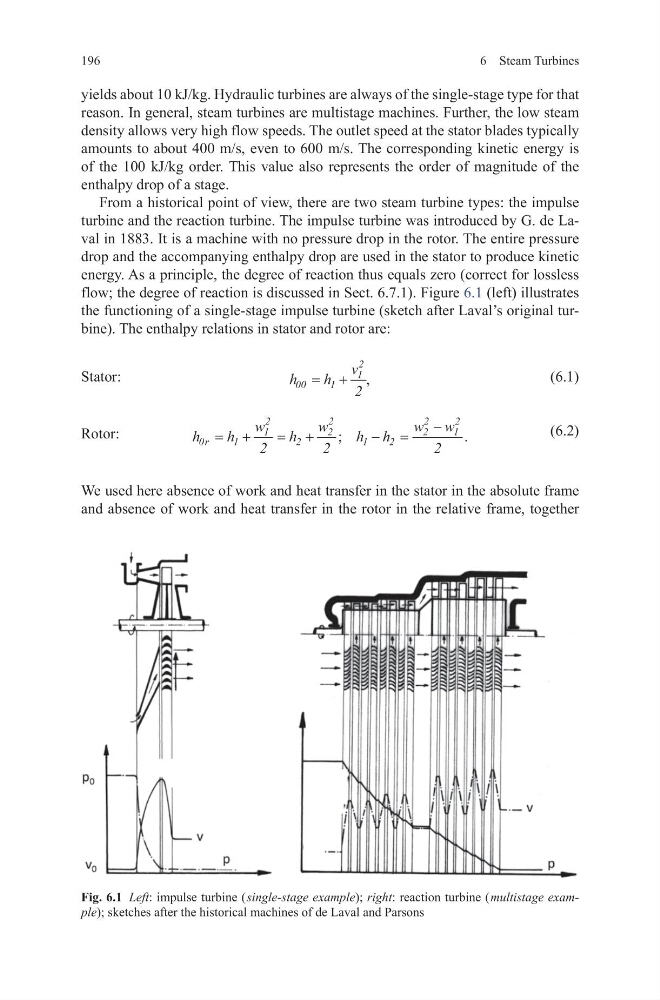
From a historical point of view, there are two steam turbine types: the impulse
turbine and the reaction turbine. The impulse turbine was introduced by G. de Laval in 1883. It is a machine with no pressure drop in the rotor. The entire pressure
drop and the accompanying enthalpy drop are used in the stator to produce kinetic
energy. As a principle, the degree of reaction thus equals zero (correct for lossless
flow; the degree of reaction is discussed in Sect. 6.7.1). Figure 6.1 (left) illustrates
the functioning of a single-stage impulse turbine (sketch after Laval’s original turbine). The enthalpy relations in stator and rotor are:
Stator:
(6.1)
Rotor:
(6.2)
We used here absence of work and heat transfer in the stator in the absolute frame
and absence of work and heat transfer in the rotor in the relative frame, together
h
h
v
00
1
1
2
2
= + ,
h
h
w
h
w
h h
w w
r
0
1
1
2
2
2
2
1
2
2
2
1
2
2
2
2
= +
= +
− =
−
;
.
Fig. 6.1 Left: impulse turbine ( single-stage example); right: reaction turbine ( multistage example); sketches after the historical machines of de Laval and Parsons
6 Steam Turbines
yields about 10 kJ/kg. Hydraulic turbines are always of the single-stage type for that
reason. In general, steam turbines are multistage machines. Further, the low steam
density allows very high flow speeds. The outlet speed at the stator blades typically
amounts to about 400 m/s, even to 600 m/s. The corresponding kinetic energy is
of the 100 kJ/kg order. This value also represents the order of magnitude of the
enthalpy drop of a stage.
From a historical point of view, there are two steam turbine types: the impulse
turbine and the reaction turbine. The impulse turbine was introduced by G. de Laval in 1883. It is a machine with no pressure drop in the rotor. The entire pressure
drop and the accompanying enthalpy drop are used in the stator to produce kinetic
energy. As a principle, the degree of reaction thus equals zero (correct for lossless
flow; the degree of reaction is discussed in Sect. 6.7.1). Figure 6.1 (left) illustrates
the functioning of a single-stage impulse turbine (sketch after Laval’s original turbine). The enthalpy relations in stator and rotor are:
Stator:
(6.1)
Rotor:
(6.2)
We used here absence of work and heat transfer in the stator in the absolute frame
and absence of work and heat transfer in the rotor in the relative frame, together
h
h
v
00
1
1
2
2
= + ,
h
h
w
h
w
h h
w w
r
0
1
1
2
2
2
2
1
2
2
2
1
2
2
2
2
= +
= +
− =
−
;
.
Fig. 6.1 Left: impulse turbine ( single-stage example); right: reaction turbine ( multistage example); sketches after the historical machines of de Laval and Parsons