

171
4.8 Exercises
For ρ constant and η ∞ constant, the infinitesimal efficiency expression can be integrated leading to the same result as the isentropic efficiency expression.
4.8 Exercises
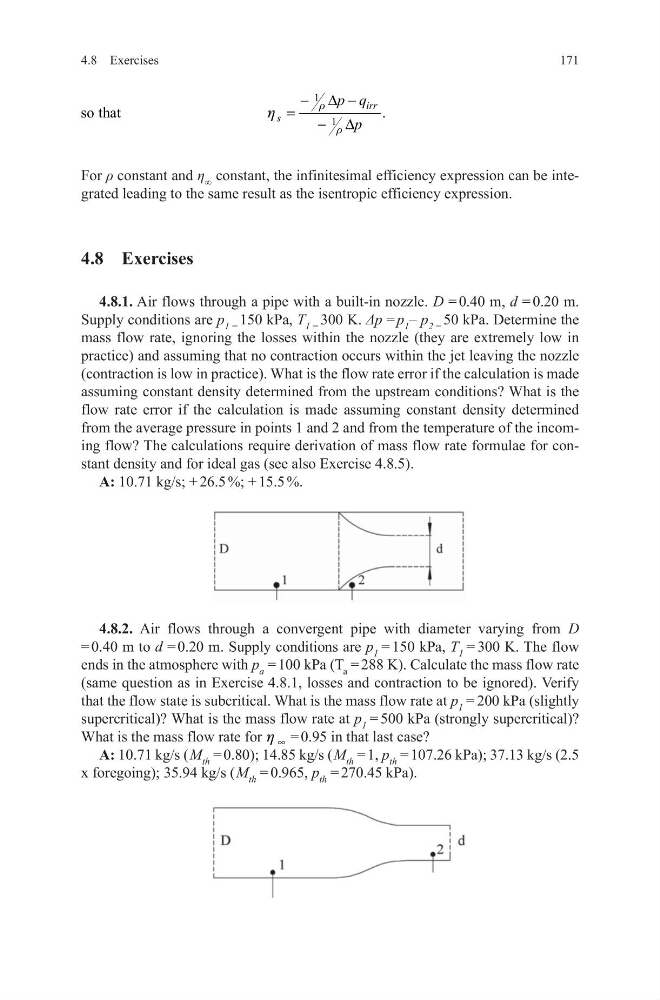
4.8.1. Air flows through a pipe with a built-in nozzle. D = 0.40 m, d = 0.20 m.
Supply conditions are p 1 = 150 kPa, T 1 = 300 K. Δp = p 1 – p 2 = 50 kPa. Determine the
mass flow rate, ignoring the losses within the nozzle (they are extremely low in
practice) and assuming that no contraction occurs within the jet leaving the nozzle
(contraction is low in practice). What is the flow rate error if the calculation is made
assuming constant density determined from the upstream conditions? What is the
flow rate error if the calculation is made assuming constant density determined
from the average pressure in points 1 and 2 and from the temperature of the incoming flow? The calculations require derivation of mass flow rate formulae for constant density and for ideal gas (see also Exercise 4.8.5).
A: 10.71 kg/s; + 26.5 %; + 15.5 %.
4.8.2. Air flows through a convergent pipe with diameter varying from D
= 0.40 m to d = 0.20 m. Supply conditions are p 1 = 150 kPa, T 1 = 300 K. The flow
ends in the atmosphere with p a = 100 kPa (T a = 288 K). Calculate the mass flow rate
(same question as in Exercise 4.8.1, losses and contraction to be ignored). Verify
that the flow state is subcritical. What is the mass flow rate at p 1 = 200 kPa (slightly
supercritical)? What is the mass flow rate at p 1 = 500 kPa (strongly supercritical)?
What is the mass flow rate for h ∞ = 0.95 in that last case?
A: 10.71 kg/s ( M th = 0.80); 14.85 kg/s ( M th = 1, p th = 107.26 kPa); 37.13 kg/s (2.5
x foregoing); 35.94 kg/s ( M th = 0.965, p th = 270.45 kPa).
1
1
so that
.
irr
s
p q
p
r
r
h
− ∆ −
=
− ∆
4.8 Exercises
For ρ constant and η ∞ constant, the infinitesimal efficiency expression can be integrated leading to the same result as the isentropic efficiency expression.
4.8 Exercises
4.8.1. Air flows through a pipe with a built-in nozzle. D = 0.40 m, d = 0.20 m.
Supply conditions are p 1 = 150 kPa, T 1 = 300 K. Δp = p 1 – p 2 = 50 kPa. Determine the
mass flow rate, ignoring the losses within the nozzle (they are extremely low in
practice) and assuming that no contraction occurs within the jet leaving the nozzle
(contraction is low in practice). What is the flow rate error if the calculation is made
assuming constant density determined from the upstream conditions? What is the
flow rate error if the calculation is made assuming constant density determined
from the average pressure in points 1 and 2 and from the temperature of the incoming flow? The calculations require derivation of mass flow rate formulae for constant density and for ideal gas (see also Exercise 4.8.5).
A: 10.71 kg/s; + 26.5 %; + 15.5 %.
4.8.2. Air flows through a convergent pipe with diameter varying from D
= 0.40 m to d = 0.20 m. Supply conditions are p 1 = 150 kPa, T 1 = 300 K. The flow
ends in the atmosphere with p a = 100 kPa (T a = 288 K). Calculate the mass flow rate
(same question as in Exercise 4.8.1, losses and contraction to be ignored). Verify
that the flow state is subcritical. What is the mass flow rate at p 1 = 200 kPa (slightly
supercritical)? What is the mass flow rate at p 1 = 500 kPa (strongly supercritical)?
What is the mass flow rate for h ∞ = 0.95 in that last case?
A: 10.71 kg/s ( M th = 0.80); 14.85 kg/s ( M th = 1, p th = 107.26 kPa); 37.13 kg/s (2.5
x foregoing); 35.94 kg/s ( M th = 0.965, p th = 270.45 kPa).
1
1
so that
.
irr
s
p q
p
r
r
h
− ∆ −
=
− ∆