

142
3 Fans
variation of flow parameters for axial machines will be analysed in Chaps. 13 and
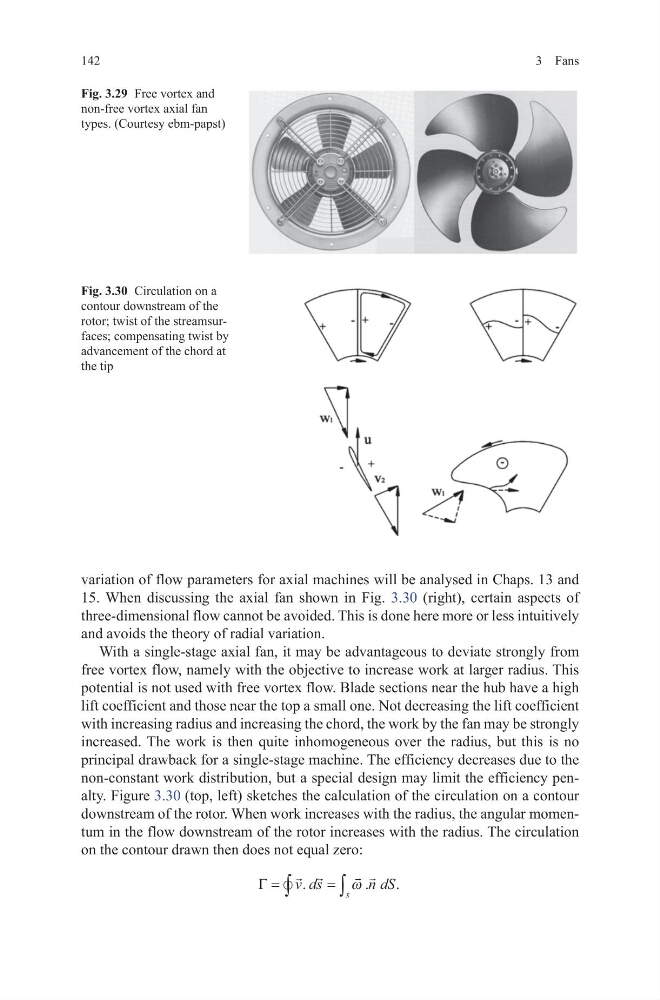
15. When discussing the axial fan shown in Fig. 3.30 (right), certain aspects of
three-dimensional flow cannot be avoided. This is done here more or less intuitively
and avoids the theory of radial variation.
With a single-stage axial fan, it may be advantageous to deviate strongly from
free vortex flow, namely with the objective to increase work at larger radius. This
potential is not used with free vortex flow. Blade sections near the hub have a high
lift coefficient and those near the top a small one. Not decreasing the lift coefficient
with increasing radius and increasing the chord, the work by the fan may be strongly
increased. The work is then quite inhomogeneous over the radius, but this is no
principal drawback for a single-stage machine. The efficiency decreases due to the
non-constant work distribution, but a special design may limit the efficiency penalty. Figure 3.30 (top, left) sketches the calculation of the circulation on a contour
downstream of the rotor. When work increases with the radius, the angular momentum in the flow downstream of the rotor increases with the radius. The circulation
on the contour drawn then does not equal zero:
Γ =
= ∫
∫
v ds
ndS
s
.
.
.
ω
Fig. 3.29 Free vortex and
non-free vortex axial fan
types. (Courtesy ebm-papst)
Fig. 3.30 Circulation on a
contour downstream of the
rotor; twist of the streamsurfaces; compensating twist by
advancement of the chord at
the tip
3 Fans
variation of flow parameters for axial machines will be analysed in Chaps. 13 and
15. When discussing the axial fan shown in Fig. 3.30 (right), certain aspects of
three-dimensional flow cannot be avoided. This is done here more or less intuitively
and avoids the theory of radial variation.
With a single-stage axial fan, it may be advantageous to deviate strongly from
free vortex flow, namely with the objective to increase work at larger radius. This
potential is not used with free vortex flow. Blade sections near the hub have a high
lift coefficient and those near the top a small one. Not decreasing the lift coefficient
with increasing radius and increasing the chord, the work by the fan may be strongly
increased. The work is then quite inhomogeneous over the radius, but this is no
principal drawback for a single-stage machine. The efficiency decreases due to the
non-constant work distribution, but a special design may limit the efficiency penalty. Figure 3.30 (top, left) sketches the calculation of the circulation on a contour
downstream of the rotor. When work increases with the radius, the angular momentum in the flow downstream of the rotor increases with the radius. The circulation
on the contour drawn then does not equal zero:
Γ =
= ∫
∫
v ds
ndS
s
.
.
.
ω
Fig. 3.29 Free vortex and
non-free vortex axial fan
types. (Courtesy ebm-papst)
Fig. 3.30 Circulation on a
contour downstream of the
rotor; twist of the streamsurfaces; compensating twist by
advancement of the chord at
the tip