

3.7 Axial and Mixed-Flow Fans
141
Differences in the performance of axial fans compared to radial ones are related
to the values of total pressure rise and flow rate, relative to peripheral speed and
diameter, expressed by the total pressure coefficient ψ
ρ
= ∆p
u
0
2
2
/
and by the flow
factor
2
2
2
/ (
/ 4)
Q u d
F
p
=
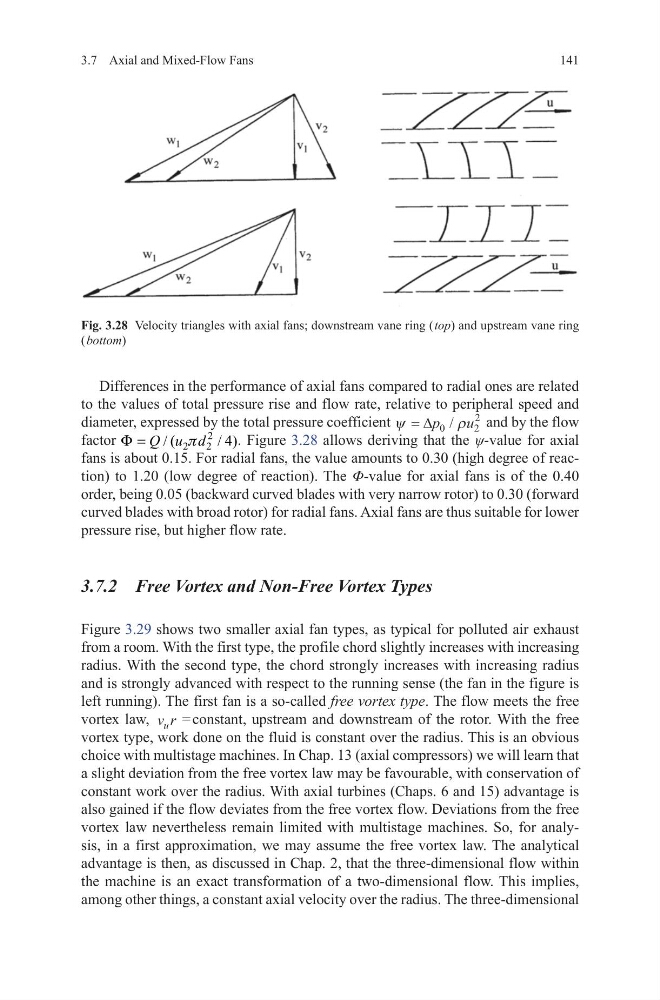
. Figure 3.28 allows deriving that the ψ-value for axial
fans is about 0.15. For radial fans, the value amounts to 0.30 (high degree of reaction) to 1.20 (low degree of reaction). The Φ-value for axial fans is of the 0.40
order, being 0.05 (backward curved blades with very narrow rotor) to 0.30 (forward
curved blades with broad rotor) for radial fans. Axial fans are thus suitable for lower
pressure rise, but higher flow rate.
3.7.2 Free Vortex and Non-Free Vortex Types
Figure 3.29 shows two smaller axial fan types, as typical for polluted air exhaust
from a room. With the first type, the profile chord slightly increases with increasing
radius. With the second type, the chord strongly increases with increasing radius
and is strongly advanced with respect to the running sense (the fan in the figure is
left running). The first fan is a so-called free vortex type. The flow meets the free
vortex law, v r
u = constant, upstream and downstream of the rotor. With the free
vortex type, work done on the fluid is constant over the radius. This is an obvious
choice with multistage machines. In Chap. 13 (axial compressors) we will learn that
a slight deviation from the free vortex law may be favourable, with conservation of
constant work over the radius. With axial turbines (Chaps. 6 and 15) advantage is
also gained if the flow deviates from the free vortex flow. Deviations from the free
vortex law nevertheless remain limited with multistage machines. So, for analysis, in a first approximation, we may assume the free vortex law. The analytical
advantage is then, as discussed in Chap. 2, that the three-dimensional flow within
the machine is an exact transformation of a two-dimensional flow. This implies,
among other things, a constant axial velocity over the radius. The three-dimensional
Fig. 3.28 Velocity triangles with axial fans; downstream vane ring ( top) and upstream vane ring
( bottom)
141
Differences in the performance of axial fans compared to radial ones are related
to the values of total pressure rise and flow rate, relative to peripheral speed and
diameter, expressed by the total pressure coefficient ψ
ρ
= ∆p
u
0
2
2
/
and by the flow
factor
2
2
2
/ (
/ 4)
Q u d
F
p
=
. Figure 3.28 allows deriving that the ψ-value for axial
fans is about 0.15. For radial fans, the value amounts to 0.30 (high degree of reaction) to 1.20 (low degree of reaction). The Φ-value for axial fans is of the 0.40
order, being 0.05 (backward curved blades with very narrow rotor) to 0.30 (forward
curved blades with broad rotor) for radial fans. Axial fans are thus suitable for lower
pressure rise, but higher flow rate.
3.7.2 Free Vortex and Non-Free Vortex Types
Figure 3.29 shows two smaller axial fan types, as typical for polluted air exhaust
from a room. With the first type, the profile chord slightly increases with increasing
radius. With the second type, the chord strongly increases with increasing radius
and is strongly advanced with respect to the running sense (the fan in the figure is
left running). The first fan is a so-called free vortex type. The flow meets the free
vortex law, v r
u = constant, upstream and downstream of the rotor. With the free
vortex type, work done on the fluid is constant over the radius. This is an obvious
choice with multistage machines. In Chap. 13 (axial compressors) we will learn that
a slight deviation from the free vortex law may be favourable, with conservation of
constant work over the radius. With axial turbines (Chaps. 6 and 15) advantage is
also gained if the flow deviates from the free vortex flow. Deviations from the free
vortex law nevertheless remain limited with multistage machines. So, for analysis, in a first approximation, we may assume the free vortex law. The analytical
advantage is then, as discussed in Chap. 2, that the three-dimensional flow within
the machine is an exact transformation of a two-dimensional flow. This implies,
among other things, a constant axial velocity over the radius. The three-dimensional
Fig. 3.28 Velocity triangles with axial fans; downstream vane ring ( top) and upstream vane ring
( bottom)