

134
3 Fans
no operating point exists without incidence loss in both rotor and stator. In practice,
the flow rate at the operating point with maximum efficiency is often considered
as design flow rate. In principle, this is not correct. Considering the operating point
with incidence-free rotor inlet as design operating point is the correct attitude.
3.5 Overall Performance Evaluation
In this section, we derive the performance definitions for turbomachines, with the
example of radial fans. The argumentations are generalised for constant density
fluid machines.
3.5.1 Mechanical Loss
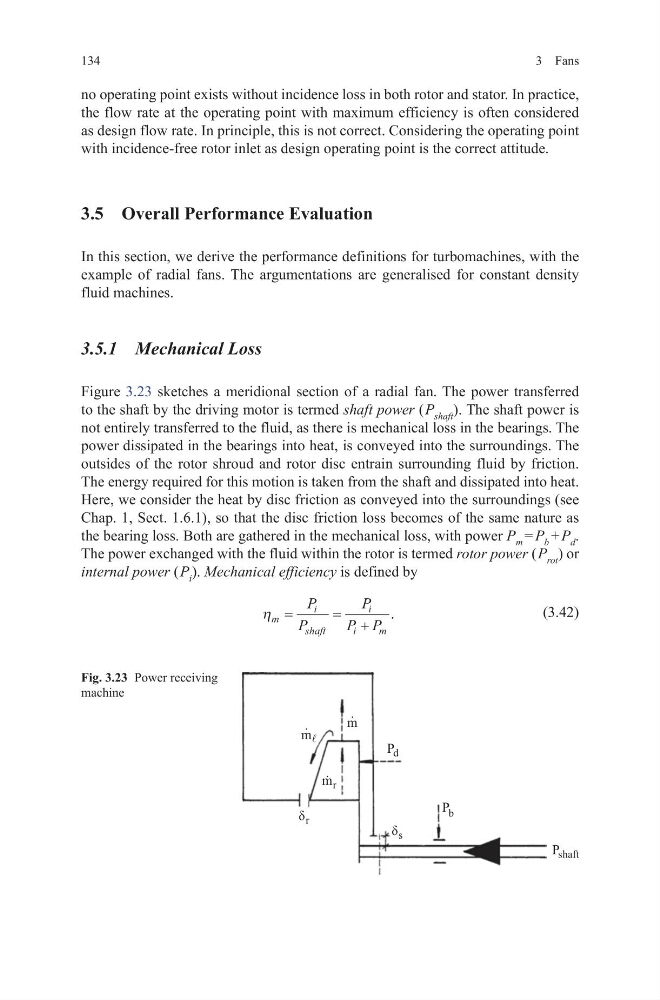
Figure 3.23 sketches a meridional section of a radial fan. The power transferred
to the shaft by the driving motor is termed shaft power ( P shaft ). The shaft power is
not entirely transferred to the fluid, as there is mechanical loss in the bearings. The
power dissipated in the bearings into heat, is conveyed into the surroundings. The
outsides of the rotor shroud and rotor disc entrain surrounding fluid by friction.
The energy required for this motion is taken from the shaft and dissipated into heat.
Here, we consider the heat by disc friction as conveyed into the surroundings (see
Chap. 1, Sect. 1.6.1), so that the disc friction loss becomes of the same nature as
the bearing loss. Both are gathered in the mechanical loss, with power P m = P b + P d .
The power exchanged with the fluid within the rotor is termed rotor power ( P rot ) or
internal power ( P i ). Mechanical efficiency is defined by
(3.42)
η m
i
shaft
i
i
m
P
P
P
P P
=
= +
.
m
.
m
.
r
m
.
r
δ
d
P
b
P
shaft
P
s
δ
Fig. 3.23 Power receiving
machine
3 Fans
no operating point exists without incidence loss in both rotor and stator. In practice,
the flow rate at the operating point with maximum efficiency is often considered
as design flow rate. In principle, this is not correct. Considering the operating point
with incidence-free rotor inlet as design operating point is the correct attitude.
3.5 Overall Performance Evaluation
In this section, we derive the performance definitions for turbomachines, with the
example of radial fans. The argumentations are generalised for constant density
fluid machines.
3.5.1 Mechanical Loss
Figure 3.23 sketches a meridional section of a radial fan. The power transferred
to the shaft by the driving motor is termed shaft power ( P shaft ). The shaft power is
not entirely transferred to the fluid, as there is mechanical loss in the bearings. The
power dissipated in the bearings into heat, is conveyed into the surroundings. The
outsides of the rotor shroud and rotor disc entrain surrounding fluid by friction.
The energy required for this motion is taken from the shaft and dissipated into heat.
Here, we consider the heat by disc friction as conveyed into the surroundings (see
Chap. 1, Sect. 1.6.1), so that the disc friction loss becomes of the same nature as
the bearing loss. Both are gathered in the mechanical loss, with power P m = P b + P d .
The power exchanged with the fluid within the rotor is termed rotor power ( P rot ) or
internal power ( P i ). Mechanical efficiency is defined by
(3.42)
η m
i
shaft
i
i
m
P
P
P
P P
=
= +
.
m
.
m
.
r
m
.
r
δ
d
P
b
P
shaft
P
s
δ
Fig. 3.23 Power receiving
machine