

98
3 Fans
system, is an analogous application. These applications exist in quite varying dimensions. Extreme examples are fans in mines, with flow rates of the order of 500 m
3
/s
and pressure rises of the order of 5000 Pa (two-stage axial fans). Most applications
are more modest, with flow rates up to 4 to 5 m
3
/s and pressure rises up to 2000 Pa,
i.e. power up to 10 kW (radial fans). Also low power applications are found in this
sector, as cooker hood fans or fans in cars. Fans for combustion air supply or combustion gas exhaust constitute a second group. Also quite varying sizes occur here:
from large steam boiler fans to small fans in home heating systems. Fans for cooling
air supply, mainly fans in electronic devices and heat exchangers, constitute a third
group. Some applications have a very low power, e.g. a PC fan has typically 1 W.
All fan types occur. High power examples are fans for cooling air supply to surface
condensers (axial fans) in electric power plants. The above application list certainly
is not complete. We mention fans in vacuum cleaners and hear dryers.
3.1.2 Large Radial Fans
From about a 200 mm rotor diameter onwards, the entire machine is manufactured
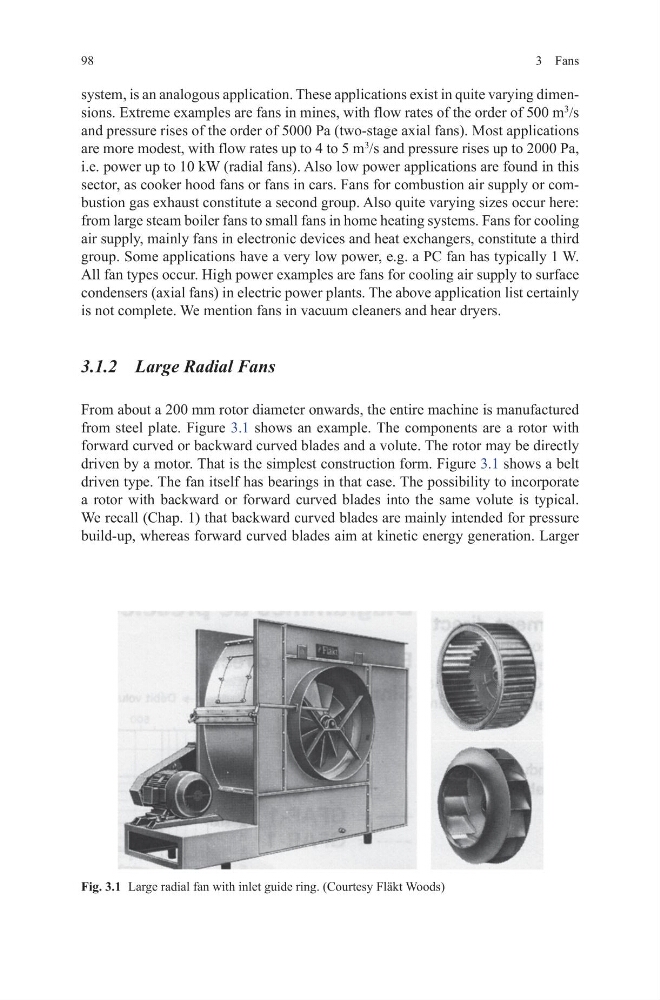
from steel plate. Figure 3.1 shows an example. The components are a rotor with
forward curved or backward curved blades and a volute. The rotor may be directly
driven by a motor. That is the simplest construction form. Figure 3.1 shows a belt
driven type. The fan itself has bearings in that case. The possibility to incorporate
a rotor with backward or forward curved blades into the same volute is typical.
We recall (Chap. 1) that backward curved blades are mainly intended for pressure
build-up, whereas forward curved blades aim at kinetic energy generation. Larger
Fig. 3.1 Large radial fan with inlet guide ring. (Courtesy Fläkt Woods)
3 Fans
system, is an analogous application. These applications exist in quite varying dimensions. Extreme examples are fans in mines, with flow rates of the order of 500 m
3
/s
and pressure rises of the order of 5000 Pa (two-stage axial fans). Most applications
are more modest, with flow rates up to 4 to 5 m
3
/s and pressure rises up to 2000 Pa,
i.e. power up to 10 kW (radial fans). Also low power applications are found in this
sector, as cooker hood fans or fans in cars. Fans for combustion air supply or combustion gas exhaust constitute a second group. Also quite varying sizes occur here:
from large steam boiler fans to small fans in home heating systems. Fans for cooling
air supply, mainly fans in electronic devices and heat exchangers, constitute a third
group. Some applications have a very low power, e.g. a PC fan has typically 1 W.
All fan types occur. High power examples are fans for cooling air supply to surface
condensers (axial fans) in electric power plants. The above application list certainly
is not complete. We mention fans in vacuum cleaners and hear dryers.
3.1.2 Large Radial Fans
From about a 200 mm rotor diameter onwards, the entire machine is manufactured
from steel plate. Figure 3.1 shows an example. The components are a rotor with
forward curved or backward curved blades and a volute. The rotor may be directly
driven by a motor. That is the simplest construction form. Figure 3.1 shows a belt
driven type. The fan itself has bearings in that case. The possibility to incorporate
a rotor with backward or forward curved blades into the same volute is typical.
We recall (Chap. 1) that backward curved blades are mainly intended for pressure
build-up, whereas forward curved blades aim at kinetic energy generation. Larger
Fig. 3.1 Large radial fan with inlet guide ring. (Courtesy Fläkt Woods)