

84
2 Basic Components
Figure 2.27 shows the pressure recovery with a uniform incoming flow. The
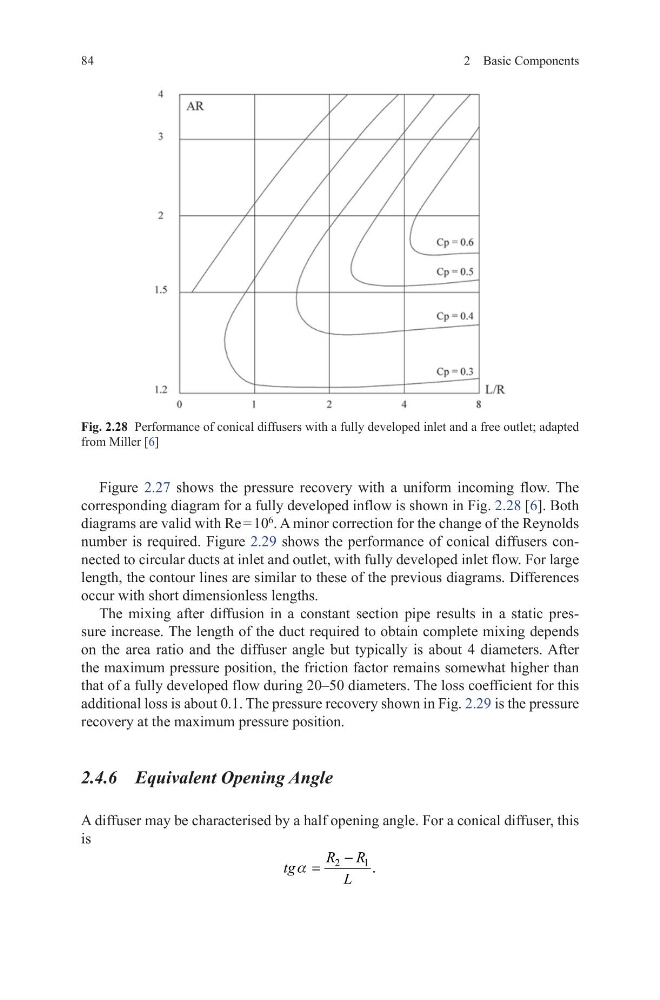
corresponding diagram for a fully developed inflow is shown in Fig. 2.28 [6]. Both
diagrams are valid with Re = 10
6
. A minor correction for the change of the Reynolds
number is required. Figure 2.29 shows the performance of conical diffusers connected to circular ducts at inlet and outlet, with fully developed inlet flow. For large
length, the contour lines are similar to these of the previous diagrams. Differences
occur with short dimensionless lengths.
The mixing after diffusion in a constant section pipe results in a static pressure increase. The length of the duct required to obtain complete mixing depends
on the area ratio and the diffuser angle but typically is about 4 diameters. After
the maximum pressure position, the friction factor remains somewhat higher than
that of a fully developed flow during 20–50 diameters. The loss coefficient for this
additional loss is about 0.1. The pressure recovery shown in Fig. 2.29 is the pressure
recovery at the maximum pressure position.
2.4.6 Equivalent Opening Angle
A diffuser may be characterised by a half opening angle. For a conical diffuser, this
is
2
1
.
R R
tg
L
a
−
=
Fig. 2.28 Performance of conical diffusers with a fully developed inlet and a free outlet; adapted
from Miller [6]
2 Basic Components
Figure 2.27 shows the pressure recovery with a uniform incoming flow. The
corresponding diagram for a fully developed inflow is shown in Fig. 2.28 [6]. Both
diagrams are valid with Re = 10
6
. A minor correction for the change of the Reynolds
number is required. Figure 2.29 shows the performance of conical diffusers connected to circular ducts at inlet and outlet, with fully developed inlet flow. For large
length, the contour lines are similar to these of the previous diagrams. Differences
occur with short dimensionless lengths.
The mixing after diffusion in a constant section pipe results in a static pressure increase. The length of the duct required to obtain complete mixing depends
on the area ratio and the diffuser angle but typically is about 4 diameters. After
the maximum pressure position, the friction factor remains somewhat higher than
that of a fully developed flow during 20–50 diameters. The loss coefficient for this
additional loss is about 0.1. The pressure recovery shown in Fig. 2.29 is the pressure
recovery at the maximum pressure position.
2.4.6 Equivalent Opening Angle
A diffuser may be characterised by a half opening angle. For a conical diffuser, this
is
2
1
.
R R
tg
L
a
−
=
Fig. 2.28 Performance of conical diffusers with a fully developed inlet and a free outlet; adapted
from Miller [6]