

80
2 Basic Components
2
( 0.75 ) 0.5 0.25
−
=
times the average inflow velocity. The corresponding section
area is 2.11 times the inflow section area. The conclusion is that disturbance of the
inlet flow uniformity causes a reduction of the possible pressure recovery. Length
limitation normally occurs with turbomachines, generating an inherent limitation of
the pressure recovery.
Within a real flow, the velocity at the walls equals zero. The slow flow at the
walls can only participate in the diffusion process when there is momentum transfer from the core flow. This transfer is due to molecular viscosity and to turbulent
mixing. Both processes are coupled with energy dissipation. In the first phase of
a diffusion process, strong deceleration near the walls occurs. This results in a
shear stress zone moving to the centre as the fluid advances through the diffuser.
Turbulence produced by the shear enhances momentum exchange. At the outlet
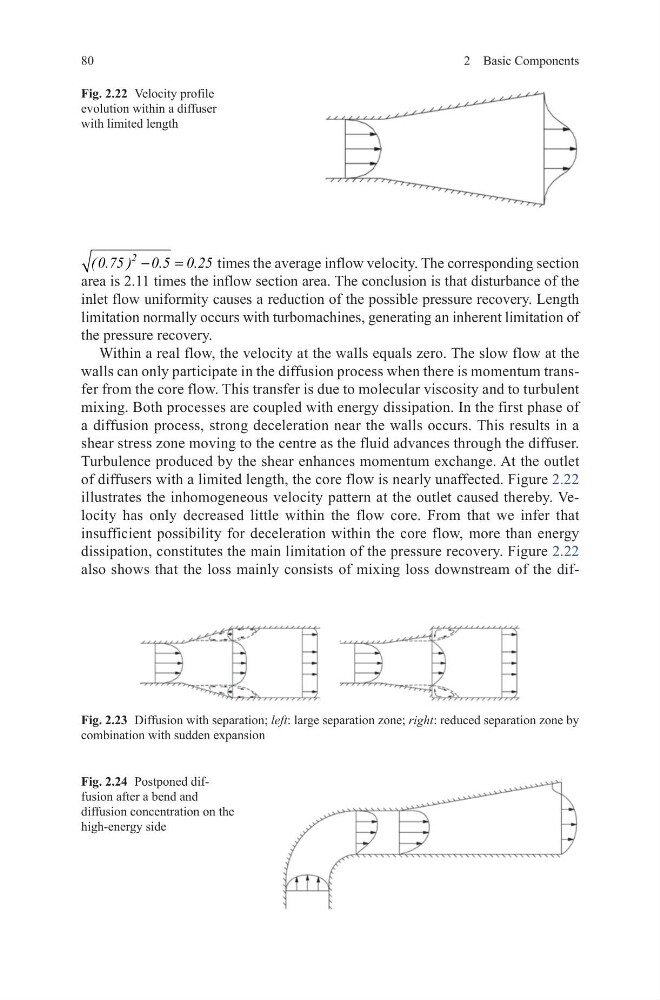
of diffusers with a limited length, the core flow is nearly unaffected. Figure 2.22
illustrates the inhomogeneous velocity pattern at the outlet caused thereby. Velocity has only decreased little within the flow core. From that we infer that
insufficient possibility for deceleration within the core flow, more than energy
dissipation, constitutes the main limitation of the pressure recovery. Figure 2.22
also shows that the loss mainly consists of mixing loss downstream of the difFig. 2.24 Postponed diffusion after a bend and
diffusion concentration on the
high-energy side
Fig. 2.22 Velocity profile
evolution within a diffuser
with limited length
Fig. 2.23 Diffusion with separation; left: large separation zone; right: reduced separation zone by
combination with sudden expansion
2 Basic Components
2
( 0.75 ) 0.5 0.25
−
=
times the average inflow velocity. The corresponding section
area is 2.11 times the inflow section area. The conclusion is that disturbance of the
inlet flow uniformity causes a reduction of the possible pressure recovery. Length
limitation normally occurs with turbomachines, generating an inherent limitation of
the pressure recovery.
Within a real flow, the velocity at the walls equals zero. The slow flow at the
walls can only participate in the diffusion process when there is momentum transfer from the core flow. This transfer is due to molecular viscosity and to turbulent
mixing. Both processes are coupled with energy dissipation. In the first phase of
a diffusion process, strong deceleration near the walls occurs. This results in a
shear stress zone moving to the centre as the fluid advances through the diffuser.
Turbulence produced by the shear enhances momentum exchange. At the outlet
of diffusers with a limited length, the core flow is nearly unaffected. Figure 2.22
illustrates the inhomogeneous velocity pattern at the outlet caused thereby. Velocity has only decreased little within the flow core. From that we infer that
insufficient possibility for deceleration within the core flow, more than energy
dissipation, constitutes the main limitation of the pressure recovery. Figure 2.22
also shows that the loss mainly consists of mixing loss downstream of the difFig. 2.24 Postponed diffusion after a bend and
diffusion concentration on the
high-energy side
Fig. 2.22 Velocity profile
evolution within a diffuser
with limited length
Fig. 2.23 Diffusion with separation; left: large separation zone; right: reduced separation zone by
combination with sudden expansion