

experimenting with the electroosmotic velocity of fluid and the zeta potential under
an imposed electric gradient was first proposed by the two scientists, namely,
Helmholtz and Smoluchowski [cica. 1879], as quoted in Walls (2010). The technology was demonstrated to be successful in removing large quantities of heavy metals
from the soil by electric fields in laboratory studies. The technology involves the
application of low-voltage direct current through electrodes that are placed across a
section of contaminated ground, and the charge moves the contaminant. The principle of the technology is an electric current is used to mobilize ions. In order for
electrokinetic remediation to be carried out, the pore fluid should be present as it has
the following functions: conducting the electrical field, transporting species that are
injected, and controlling and modifying the electrode reactions.
Ions are transported by electromigration, electroosmosis, electrophoresis, and
other modes of transport like diffusion. Electromigration of ionic species is defined
as the movement of ions in the pore fluid of the soil under the influence of an electric
current; cations move toward the cathode and anions move toward the anode.
Cationic and anionic contaminants are both removed by electromigration. Compared
to electroosmosis in terms of cation contaminant migration, electromigration has
been reported to have greater charge of ionic species present, field strength, and ionic
concentration which influences electromigration during electrokinetics (Page and
Page 2002). The movement is described by the following equation:
u m ¼ vE
ð2:4Þ
where u m is the velocity of an ion and v is ionic mobility (Page and Page 2002).
Factors such as concentration, ionic charge, and temperature affect the electrical
conductivity of the solution, and in turn this is related to the ionic mobility.
The second transport mechanism is electroosmosis which is the movement of
pore water under an electrical potential difference from the anode to the cathode.
This process is affected by the soil porosity and the zeta potential of the soil medium.
It occurs due to the drag interaction between the bulk of the liquid in the pore and a
thin layer of charged fluid next to the pore wall. The ions move under the action of
the electric field in a direction parallel (Probstein and Hicks 1993; Reddy and
Parupudi 1997). The electroosmotic flow rate depends on the balance between the
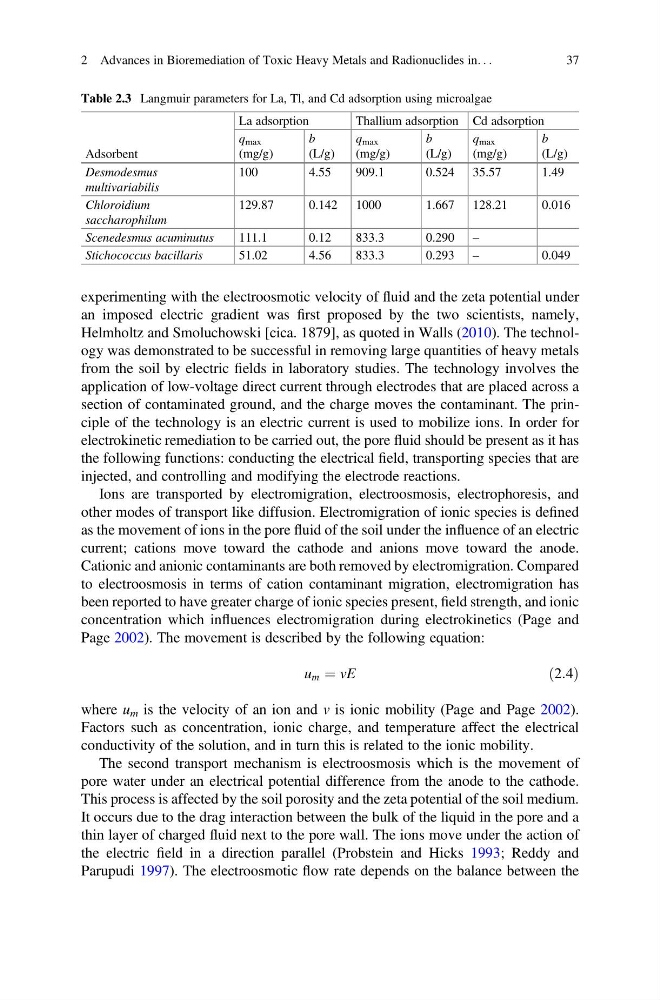
Table 2.3 Langmuir parameters for La, Tl, and Cd adsorption using microalgae
Adsorbent
La adsorption
Thallium adsorption Cd adsorption
q max
(mg/g)
b
(L/g)
q max
(mg/g)
b
(L/g)
q max
(mg/g)
b
(L/g)
Desmodesmus
multivariabilis
100
4.55
909.1
0.524 35.57
1.49
Chloroidium
saccharophilum
129.87
0.142 1000
1.667 128.21
0.016
Scenedesmus acuminutus
111.1
0.12
833.3
0.290 –
Stichococcus bacillaris
51.02
4.56
833.3
0.293 –
0.049
2 Advances in Bioremediation of Toxic Heavy Metals and Radionuclides in. . .
37
an imposed electric gradient was first proposed by the two scientists, namely,
Helmholtz and Smoluchowski [cica. 1879], as quoted in Walls (2010). The technology was demonstrated to be successful in removing large quantities of heavy metals
from the soil by electric fields in laboratory studies. The technology involves the
application of low-voltage direct current through electrodes that are placed across a
section of contaminated ground, and the charge moves the contaminant. The principle of the technology is an electric current is used to mobilize ions. In order for
electrokinetic remediation to be carried out, the pore fluid should be present as it has
the following functions: conducting the electrical field, transporting species that are
injected, and controlling and modifying the electrode reactions.
Ions are transported by electromigration, electroosmosis, electrophoresis, and
other modes of transport like diffusion. Electromigration of ionic species is defined
as the movement of ions in the pore fluid of the soil under the influence of an electric
current; cations move toward the cathode and anions move toward the anode.
Cationic and anionic contaminants are both removed by electromigration. Compared
to electroosmosis in terms of cation contaminant migration, electromigration has
been reported to have greater charge of ionic species present, field strength, and ionic
concentration which influences electromigration during electrokinetics (Page and
Page 2002). The movement is described by the following equation:
u m ¼ vE
ð2:4Þ
where u m is the velocity of an ion and v is ionic mobility (Page and Page 2002).
Factors such as concentration, ionic charge, and temperature affect the electrical
conductivity of the solution, and in turn this is related to the ionic mobility.
The second transport mechanism is electroosmosis which is the movement of
pore water under an electrical potential difference from the anode to the cathode.
This process is affected by the soil porosity and the zeta potential of the soil medium.
It occurs due to the drag interaction between the bulk of the liquid in the pore and a
thin layer of charged fluid next to the pore wall. The ions move under the action of
the electric field in a direction parallel (Probstein and Hicks 1993; Reddy and
Parupudi 1997). The electroosmotic flow rate depends on the balance between the
Table 2.3 Langmuir parameters for La, Tl, and Cd adsorption using microalgae
Adsorbent
La adsorption
Thallium adsorption Cd adsorption
q max
(mg/g)
b
(L/g)
q max
(mg/g)
b
(L/g)
q max
(mg/g)
b
(L/g)
Desmodesmus
multivariabilis
100
4.55
909.1
0.524 35.57
1.49
Chloroidium
saccharophilum
129.87
0.142 1000
1.667 128.21
0.016
Scenedesmus acuminutus
111.1
0.12
833.3
0.290 –
Stichococcus bacillaris
51.02
4.56
833.3
0.293 –
0.049
2 Advances in Bioremediation of Toxic Heavy Metals and Radionuclides in. . .
37