

6.4.3 Algae as Biosorbents
In our latest studies, we evaluated the performance of several species of algae in the
bioflocculation and biosorption of toxic metals and rare earth metals (REMs).
Empirical models were used to evaluate the biosorption kinetics and biosorption
capacity of wet and dry cells. The Langmuir and Freundlich are the most widely used
and accepted simplistic mathematical models in literature as they usually fit the
experimental done relatively well (Volesky and Holan 1995; Arıca et al. 2001;
Mehta and Gaur 2005). These isotherm models reflect metal binding as a function
of equilibrium concentration of a known metal in solution. A Langmuir model
assumes monolayer adsorption solutes onto surface containing a finite number of
identical sites with homogenous distribution of adsorption energy and no transmigration of adsorbed ions. Freundlich model assumes the energy distribution is
heterogeneous with binding sites having a higher affinity for the metal first occupied
(Selatnia et al. 2004; Goksungur et al. 2005; Stumm and Morgan 1995).
Other common isotherm models used include Temkin model whose consideration
is given to the interaction between adsorbate and adsorbent; Dubinin-Radushkevich
(D-R) model which expresses the adsorption mechanism with a Gaussian energy
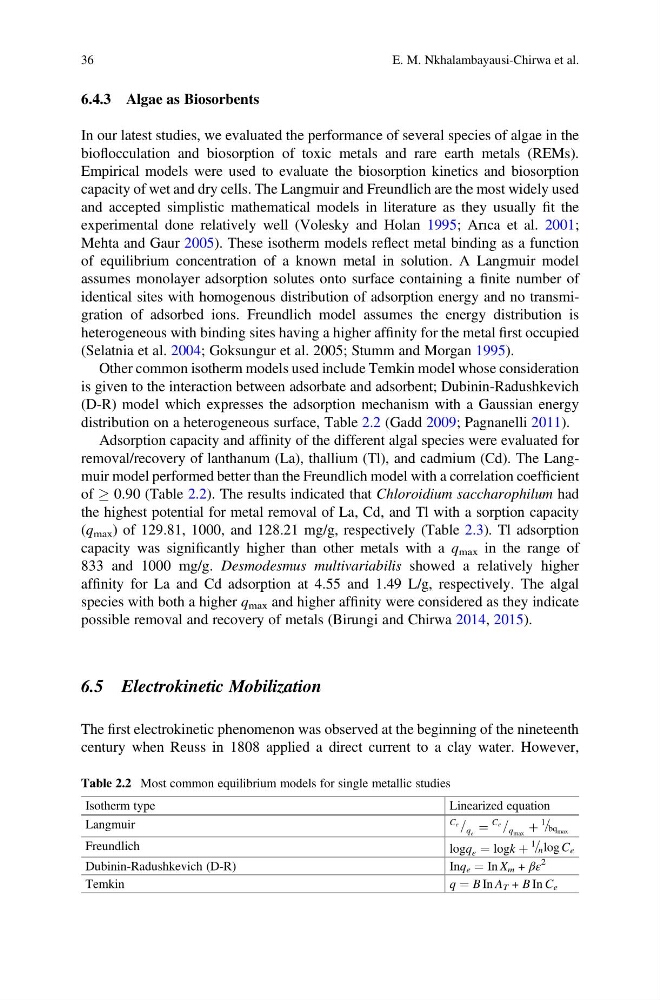
distribution on a heterogeneous surface, Table 2.2 (Gadd 2009; Pagnanelli 2011).
Adsorption capacity and affinity of the different algal species were evaluated for
removal/recovery of lanthanum (La), thallium (Tl), and cadmium (Cd). The Langmuir model performed better than the Freundlich model with a correlation coefficient
of ! 0.90 (Table 2.2). The results indicated that Chloroidium saccharophilum had
the highest potential for metal removal of La, Cd, and Tl with a sorption capacity
(q max ) of 129.81, 1000, and 128.21 mg/g, respectively (Table 2.3). Tl adsorption
capacity was significantly higher than other metals with a q max in the range of
833 and 1000 mg/g. Desmodesmus multivariabilis showed a relatively higher
affinity for La and Cd adsorption at 4.55 and 1.49 L/g, respectively. The algal
species with both a higher q max and higher affinity were considered as they indicate
possible removal and recovery of metals (Birungi and Chirwa 2014, 2015).
6.5 Electrokinetic Mobilization
The first electrokinetic phenomenon was observed at the beginning of the nineteenth
century when Reuss in 1808 applied a direct current to a clay water. However,
Table 2.2 Most common equilibrium models for single metallic studies
Isotherm type
Linearized equation
Langmuir
Ce = q e ¼
Ce = q max þ
1 = bq max
Freundlich
logq e ¼ logk þ
1 = n log C e
Dubinin-Radushkevich (D-R)
Inq e ¼ In X m + βε
2
Temkin
q ¼ B In A T + B In C e
36
E. M. Nkhalambayausi-Chirwa et al.
In our latest studies, we evaluated the performance of several species of algae in the
bioflocculation and biosorption of toxic metals and rare earth metals (REMs).
Empirical models were used to evaluate the biosorption kinetics and biosorption
capacity of wet and dry cells. The Langmuir and Freundlich are the most widely used
and accepted simplistic mathematical models in literature as they usually fit the
experimental done relatively well (Volesky and Holan 1995; Arıca et al. 2001;
Mehta and Gaur 2005). These isotherm models reflect metal binding as a function
of equilibrium concentration of a known metal in solution. A Langmuir model
assumes monolayer adsorption solutes onto surface containing a finite number of
identical sites with homogenous distribution of adsorption energy and no transmigration of adsorbed ions. Freundlich model assumes the energy distribution is
heterogeneous with binding sites having a higher affinity for the metal first occupied
(Selatnia et al. 2004; Goksungur et al. 2005; Stumm and Morgan 1995).
Other common isotherm models used include Temkin model whose consideration
is given to the interaction between adsorbate and adsorbent; Dubinin-Radushkevich
(D-R) model which expresses the adsorption mechanism with a Gaussian energy
distribution on a heterogeneous surface, Table 2.2 (Gadd 2009; Pagnanelli 2011).
Adsorption capacity and affinity of the different algal species were evaluated for
removal/recovery of lanthanum (La), thallium (Tl), and cadmium (Cd). The Langmuir model performed better than the Freundlich model with a correlation coefficient
of ! 0.90 (Table 2.2). The results indicated that Chloroidium saccharophilum had
the highest potential for metal removal of La, Cd, and Tl with a sorption capacity
(q max ) of 129.81, 1000, and 128.21 mg/g, respectively (Table 2.3). Tl adsorption
capacity was significantly higher than other metals with a q max in the range of
833 and 1000 mg/g. Desmodesmus multivariabilis showed a relatively higher
affinity for La and Cd adsorption at 4.55 and 1.49 L/g, respectively. The algal
species with both a higher q max and higher affinity were considered as they indicate
possible removal and recovery of metals (Birungi and Chirwa 2014, 2015).
6.5 Electrokinetic Mobilization
The first electrokinetic phenomenon was observed at the beginning of the nineteenth
century when Reuss in 1808 applied a direct current to a clay water. However,
Table 2.2 Most common equilibrium models for single metallic studies
Isotherm type
Linearized equation
Langmuir
Ce = q e ¼
Ce = q max þ
1 = bq max
Freundlich
logq e ¼ logk þ
1 = n log C e
Dubinin-Radushkevich (D-R)
Inq e ¼ In X m + βε
2
Temkin
q ¼ B In A T + B In C e
36
E. M. Nkhalambayausi-Chirwa et al.