

acidilactici (Tiwari et al. 2013), Klebsiella oxytoca, Citrobacter sp., Serratia
marcescens (Jiranuntipon et al. 2008), Lactobacillus plantarum (Tondee and
Sirianuntapiboon 2008), K. pneumoniae, Salmonella enterica, Enterobacter
aerogenes, and E. cloacae and K. oxytoca, Serratia marcescens, Citrobacter sp.,
and unknown bacterium (Jiranuntipon et al. (2008)), has been reported as potential
bacterial species to degrade and decolorize distillery effluent. The growing acceptance of bacteria for decolorization and degradation of melanoidins containing
distillery effluent is due to the fact that some bacterial species have a specific
extracellular ligninolytic enzymatic system known as MnP, Lac, and LiP capable
of breaking a large number of C¼C, C¼O, and CN bonds present in melanoidins
(Miyata et al. 2000). Chandra et al. (2018a) and Yadav and Chandra (2012) have
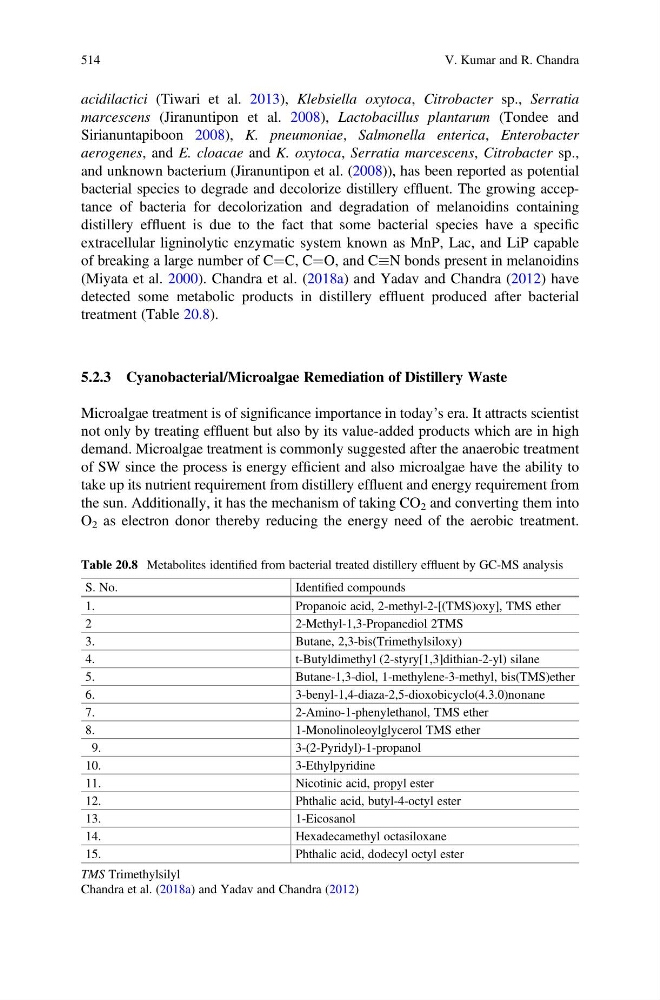
detected some metabolic products in distillery effluent produced after bacterial
treatment (Table 20.8).
5.2.3 Cyanobacterial/Microalgae Remediation of Distillery Waste
Microalgae treatment is of significance importance in today’s era. It attracts scientist
not only by treating effluent but also by its value-added products which are in high
demand. Microalgae treatment is commonly suggested after the anaerobic treatment
of SW since the process is energy efficient and also microalgae have the ability to
take up its nutrient requirement from distillery effluent and energy requirement from
the sun. Additionally, it has the mechanism of taking CO 2 and converting them into
O 2 as electron donor thereby reducing the energy need of the aerobic treatment.
Table 20.8 Metabolites identified from bacterial treated distillery effluent by GC-MS analysis
S. No.
Identified compounds
1.
Propanoic acid, 2-methyl-2-[(TMS)oxy], TMS ether
2
2-Methyl-1,3-Propanediol 2TMS
3.
Butane, 2,3-bis(Trimethylsiloxy)
4.
t-Butyldimethyl (2-styry[1,3]dithian-2-yl) silane
5.
Butane-1,3-diol, 1-methylene-3-methyl, bis(TMS)ether
6.
3-benyl-1,4-diaza-2,5-dioxobicyclo(4.3.0)nonane
7.
2-Amino-1-phenylethanol, TMS ether
8.
1-Monolinoleoylglycerol TMS ether
9.
3-(2-Pyridyl)-1-propanol
10.
3-Ethylpyridine
11.
Nicotinic acid, propyl ester
12.
Phthalic acid, butyl-4-octyl ester
13.
1-Eicosanol
14.
Hexadecamethyl octasiloxane
15.
Phthalic acid, dodecyl octyl ester
TMS Trimethylsilyl
Chandra et al. (2018a) and Yadav and Chandra (2012)
514
V. Kumar and R. Chandra