

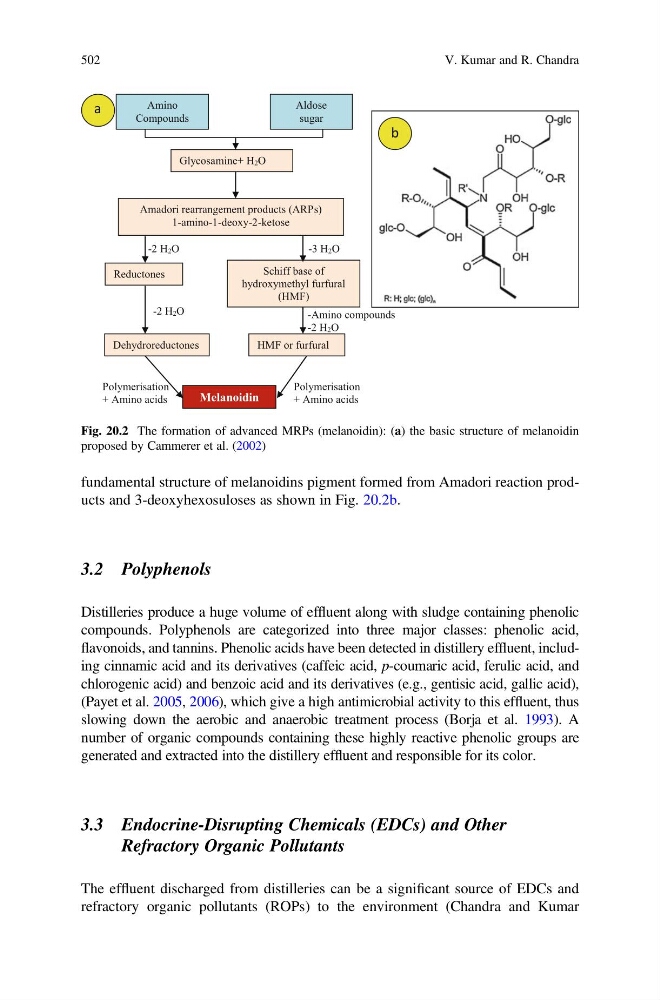
fundamental structure of melanoidins pigment formed from Amadori reaction products and 3-deoxyhexosuloses as shown in Fig. 20.2b.
3.2 Polyphenols
Distilleries produce a huge volume of effluent along with sludge containing phenolic
compounds. Polyphenols are categorized into three major classes: phenolic acid,
flavonoids, and tannins. Phenolic acids have been detected in distillery effluent, including cinnamic acid and its derivatives (caffeic acid, p-coumaric acid, ferulic acid, and
chlorogenic acid) and benzoic acid and its derivatives (e.g., gentisic acid, gallic acid),
(Payet et al. 2005, 2006), which give a high antimicrobial activity to this effluent, thus
slowing down the aerobic and anaerobic treatment process (Borja et al. 1993). A
number of organic compounds containing these highly reactive phenolic groups are
generated and extracted into the distillery effluent and responsible for its color.
3.3 Endocrine-Disrupting Chemicals (EDCs) and Other
Refractory Organic Pollutants
The effluent discharged from distilleries can be a significant source of EDCs and
refractory organic pollutants (ROPs) to the environment (Chandra and Kumar
Aldose
sugar
Amino
Compounds
Glycosamine+ H2O
Amadori rearrangement products (ARPs)
1-amino-1-deoxy-2-ketose
Reductones
Schiff base of
hydroxymethyl furfural
(HMF)
Dehydroreductones
Melanoidin
HMF or furfural
-2 H2O
- 3 H 2O
-2 H2O
-Amino compounds
-2 H2O
Polymerisation
+ Amino acids
Polymerisation
+ Amino acids
a
b
Fig. 20.2 The formation of advanced MRPs (melanoidin): (a) the basic structure of melanoidin
proposed by Cammerer et al. (2002)
502
V. Kumar and R. Chandra
3.2 Polyphenols
Distilleries produce a huge volume of effluent along with sludge containing phenolic
compounds. Polyphenols are categorized into three major classes: phenolic acid,
flavonoids, and tannins. Phenolic acids have been detected in distillery effluent, including cinnamic acid and its derivatives (caffeic acid, p-coumaric acid, ferulic acid, and
chlorogenic acid) and benzoic acid and its derivatives (e.g., gentisic acid, gallic acid),
(Payet et al. 2005, 2006), which give a high antimicrobial activity to this effluent, thus
slowing down the aerobic and anaerobic treatment process (Borja et al. 1993). A
number of organic compounds containing these highly reactive phenolic groups are
generated and extracted into the distillery effluent and responsible for its color.
3.3 Endocrine-Disrupting Chemicals (EDCs) and Other
Refractory Organic Pollutants
The effluent discharged from distilleries can be a significant source of EDCs and
refractory organic pollutants (ROPs) to the environment (Chandra and Kumar
Aldose
sugar
Amino
Compounds
Glycosamine+ H2O
Amadori rearrangement products (ARPs)
1-amino-1-deoxy-2-ketose
Reductones
Schiff base of
hydroxymethyl furfural
(HMF)
Dehydroreductones
Melanoidin
HMF or furfural
-2 H2O
- 3 H 2O
-2 H2O
-Amino compounds
-2 H2O
Polymerisation
+ Amino acids
Polymerisation
+ Amino acids
a
b
Fig. 20.2 The formation of advanced MRPs (melanoidin): (a) the basic structure of melanoidin
proposed by Cammerer et al. (2002)
502
V. Kumar and R. Chandra