

3.1.3 Pesticides
Pesticides have been commonly used to control pests during recent decades
(Timmons 1970; Chauvel et al. 2012), leading to widespread deposition of these
xenobiotics into the environment (Toccalino et al. 2014). The intensive use of
pesticides causes harmful effects on biodiversity, food security, and water resources
(Malaj et al. 2014; Queyrel et al. 2016). Agricultural producers are using these
pesticides to increase food production because the world population is expected to
increase by 30%, to 9.2 billion, by 2050, with the further demand to increase food
production by 70% (Popp et al. 2013). Nonpesticidal tools have been developed and
will be important in the near future, but chemical pesticides are currently the best
solution to pest control and food security (Popp et al. 2013; Fisher et al. 2012).
3.1.4 Dyes
Dyes are important in human lives because they impart color to our clothes, are used
as food colors, and are even used in our medicines. Scientists have done much
research to produce these artificial dyes: more than 10,000 dyes are available
commercially and 7 lakh tons of dyes are produced annually (Zolinger 1987).
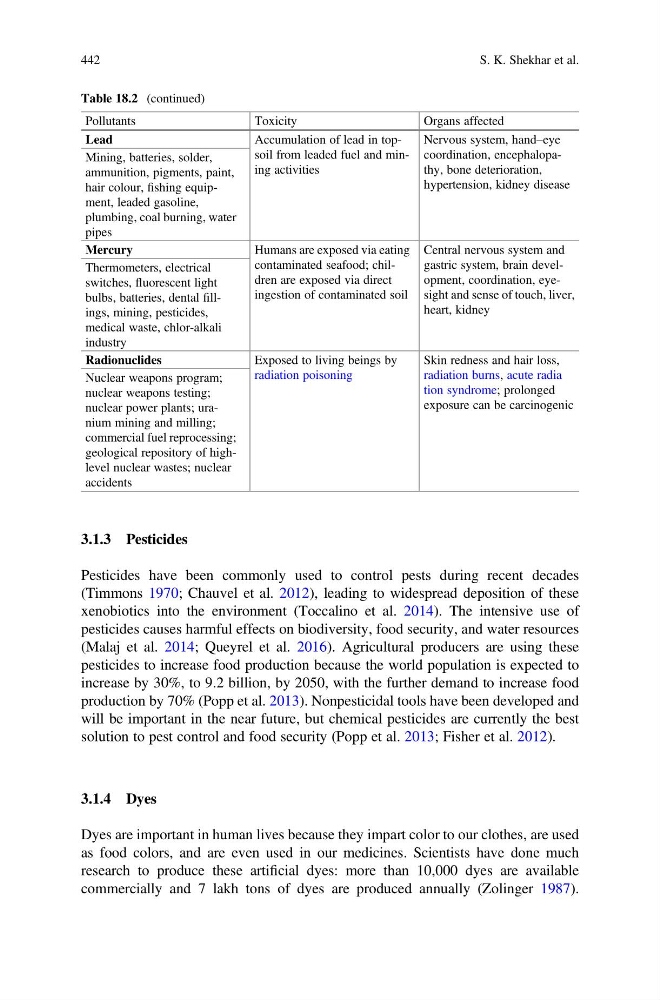
Table 18.2 (continued)
Pollutants
Toxicity
Organs affected
Lead
Accumulation of lead in topsoil from leaded fuel and mining activities
Nervous system, hand–eye
coordination, encephalopathy, bone deterioration,
hypertension, kidney disease
Mining, batteries, solder,
ammunition, pigments, paint,
hair colour, fishing equipment, leaded gasoline,
plumbing, coal burning, water
pipes
Mercury
Humans are exposed via eating
contaminated seafood; children are exposed via direct
ingestion of contaminated soil
Central nervous system and
gastric system, brain development, coordination, eyesight and sense of touch, liver,
heart, kidney
Thermometers, electrical
switches, fluorescent light
bulbs, batteries, dental fillings, mining, pesticides,
medical waste, chlor-alkali
industry
Radionuclides
Exposed to living beings by
radiation poisoning
Skin redness and hair loss,
radiation burns, acute radia
tion syndrome; prolonged
exposure can be carcinogenic
Nuclear weapons program;
nuclear weapons testing;
nuclear power plants; uranium mining and milling;
commercial fuel reprocessing;
geological repository of highlevel nuclear wastes; nuclear
accidents
442
S. K. Shekhar et al.
Pesticides have been commonly used to control pests during recent decades
(Timmons 1970; Chauvel et al. 2012), leading to widespread deposition of these
xenobiotics into the environment (Toccalino et al. 2014). The intensive use of
pesticides causes harmful effects on biodiversity, food security, and water resources
(Malaj et al. 2014; Queyrel et al. 2016). Agricultural producers are using these
pesticides to increase food production because the world population is expected to
increase by 30%, to 9.2 billion, by 2050, with the further demand to increase food
production by 70% (Popp et al. 2013). Nonpesticidal tools have been developed and
will be important in the near future, but chemical pesticides are currently the best
solution to pest control and food security (Popp et al. 2013; Fisher et al. 2012).
3.1.4 Dyes
Dyes are important in human lives because they impart color to our clothes, are used
as food colors, and are even used in our medicines. Scientists have done much
research to produce these artificial dyes: more than 10,000 dyes are available
commercially and 7 lakh tons of dyes are produced annually (Zolinger 1987).
Table 18.2 (continued)
Pollutants
Toxicity
Organs affected
Lead
Accumulation of lead in topsoil from leaded fuel and mining activities
Nervous system, hand–eye
coordination, encephalopathy, bone deterioration,
hypertension, kidney disease
Mining, batteries, solder,
ammunition, pigments, paint,
hair colour, fishing equipment, leaded gasoline,
plumbing, coal burning, water
pipes
Mercury
Humans are exposed via eating
contaminated seafood; children are exposed via direct
ingestion of contaminated soil
Central nervous system and
gastric system, brain development, coordination, eyesight and sense of touch, liver,
heart, kidney
Thermometers, electrical
switches, fluorescent light
bulbs, batteries, dental fillings, mining, pesticides,
medical waste, chlor-alkali
industry
Radionuclides
Exposed to living beings by
radiation poisoning
Skin redness and hair loss,
radiation burns, acute radia
tion syndrome; prolonged
exposure can be carcinogenic
Nuclear weapons program;
nuclear weapons testing;
nuclear power plants; uranium mining and milling;
commercial fuel reprocessing;
geological repository of highlevel nuclear wastes; nuclear
accidents
442
S. K. Shekhar et al.