

Nowadays, sustainability of agriculture without a polluted environment is of
major concern worldwide (Singh et al. 2011), and therefore the beneficial impact
of plant-microbe associations can be a best alternative for this problem. In respect to
this, several bioagents have gathered the attention of researchers for their use in
biofertilizer and some other valuable effects such as healthy crop promotion and
sustainable development of agroecosystem by alteration in physical, chemical, and
biological factors involved in establishment of better interaction between plant and
soil (Barea et al. 2005). For this purpose, studies are going on, and some species of
bioagents have been commercialized like Bacillus, Azospirillum, Pseudomonas,
Azotobacter, Klebsiella, Enterobacter, Variovorax, and Serratia sp. (Glick 2012).
On the other hand, microbes have role in environmental bioremediation as it is a
natural process which is carried out by association of plants and microorganisms.
Phytofiltration
Phytovolatilization
Phytoevaporation
Phytostimulation
Phytodegradation
Phytoassimilation
Phytotransformation
Phytoreduction
Phytooxidation
Rhizosphere
Desorption
Transportation
Nitrilase
Nitroreductases
Oxidases
Peroxidases
Bacteria
Fungi
Cytochromes P450
Hydrolases
Glucosyltransferases
Laccase
Respiration
Acidification
Leakage
Exudation
Adsorption
Precipitation
Redox reactions
Chelation
Complexation
Blastofiltration
Phytocontainment
Phytohydraulics
Phytoaccumulation
Phytoextraction
Phytoconcentration
Phytotransfer
Phytomining
Phytoimmobilization
Phytostabilization
Phytosequestration
Bioremediation
Phytoremediation
Rhizoremediation
Bacterial ACC
deaminase
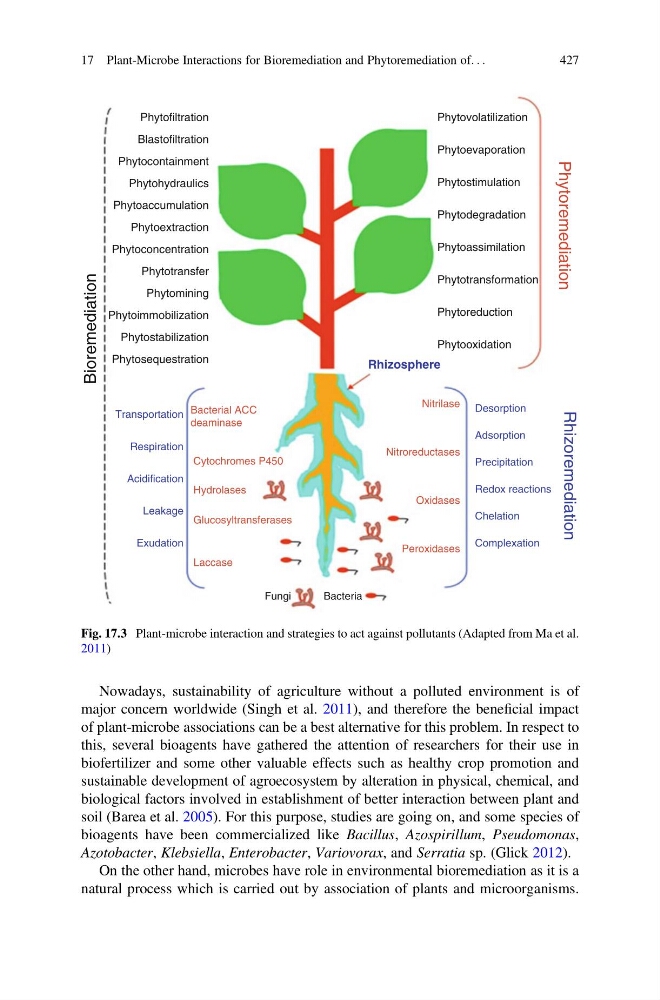
Fig. 17.3 Plant-microbe interaction and strategies to act against pollutants (Adapted from Ma et al.
2011)
17 Plant-Microbe Interactions for Bioremediation and Phytoremediation of. . .
427
major concern worldwide (Singh et al. 2011), and therefore the beneficial impact
of plant-microbe associations can be a best alternative for this problem. In respect to
this, several bioagents have gathered the attention of researchers for their use in
biofertilizer and some other valuable effects such as healthy crop promotion and
sustainable development of agroecosystem by alteration in physical, chemical, and
biological factors involved in establishment of better interaction between plant and
soil (Barea et al. 2005). For this purpose, studies are going on, and some species of
bioagents have been commercialized like Bacillus, Azospirillum, Pseudomonas,
Azotobacter, Klebsiella, Enterobacter, Variovorax, and Serratia sp. (Glick 2012).
On the other hand, microbes have role in environmental bioremediation as it is a
natural process which is carried out by association of plants and microorganisms.
Phytofiltration
Phytovolatilization
Phytoevaporation
Phytostimulation
Phytodegradation
Phytoassimilation
Phytotransformation
Phytoreduction
Phytooxidation
Rhizosphere
Desorption
Transportation
Nitrilase
Nitroreductases
Oxidases
Peroxidases
Bacteria
Fungi
Cytochromes P450
Hydrolases
Glucosyltransferases
Laccase
Respiration
Acidification
Leakage
Exudation
Adsorption
Precipitation
Redox reactions
Chelation
Complexation
Blastofiltration
Phytocontainment
Phytohydraulics
Phytoaccumulation
Phytoextraction
Phytoconcentration
Phytotransfer
Phytomining
Phytoimmobilization
Phytostabilization
Phytosequestration
Bioremediation
Phytoremediation
Rhizoremediation
Bacterial ACC
deaminase
Fig. 17.3 Plant-microbe interaction and strategies to act against pollutants (Adapted from Ma et al.
2011)
17 Plant-Microbe Interactions for Bioremediation and Phytoremediation of. . .
427