

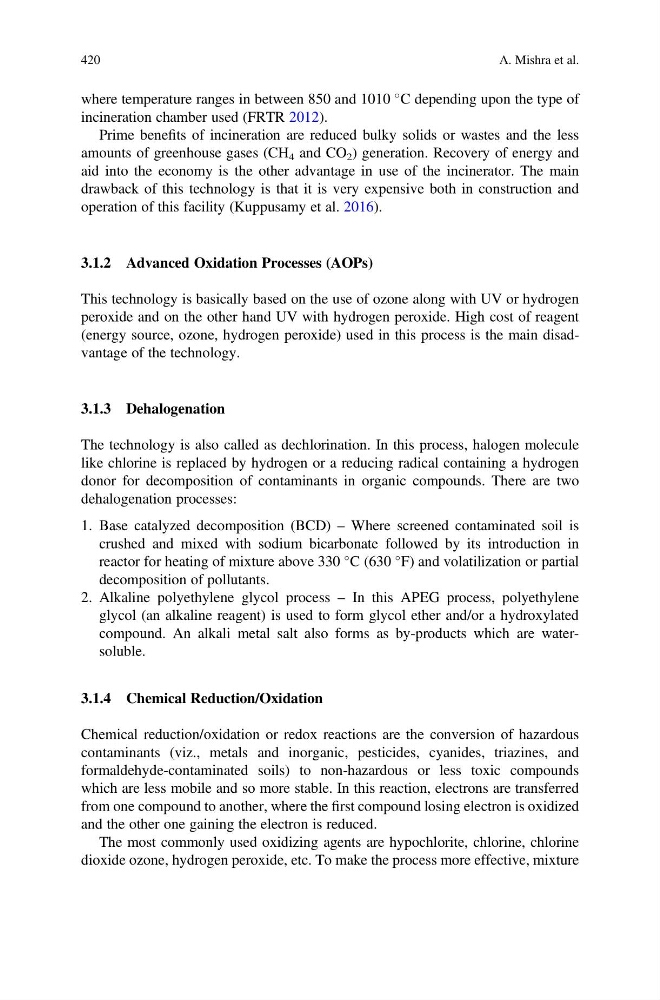
where temperature ranges in between 850 and 1010
C depending upon the type of
incineration chamber used (FRTR 2012).
Prime benefits of incineration are reduced bulky solids or wastes and the less
amounts of greenhouse gases (CH 4 and CO 2 ) generation. Recovery of energy and
aid into the economy is the other advantage in use of the incinerator. The main
drawback of this technology is that it is very expensive both in construction and
operation of this facility (Kuppusamy et al. 2016).
3.1.2 Advanced Oxidation Processes (AOPs)
This technology is basically based on the use of ozone along with UV or hydrogen
peroxide and on the other hand UV with hydrogen peroxide. High cost of reagent
(energy source, ozone, hydrogen peroxide) used in this process is the main disadvantage of the technology.
3.1.3 Dehalogenation
The technology is also called as dechlorination. In this process, halogen molecule
like chlorine is replaced by hydrogen or a reducing radical containing a hydrogen
donor for decomposition of contaminants in organic compounds. There are two
dehalogenation processes:
1. Base catalyzed decomposition (BCD) – Where screened contaminated soil is
crushed and mixed with sodium bicarbonate followed by its introduction in
reactor for heating of mixture above 330
C (630
F) and volatilization or partial
decomposition of pollutants.
2. Alkaline polyethylene glycol process – In this APEG process, polyethylene
glycol (an alkaline reagent) is used to form glycol ether and/or a hydroxylated
compound. An alkali metal salt also forms as by-products which are watersoluble.
3.1.4 Chemical Reduction/Oxidation
Chemical reduction/oxidation or redox reactions are the conversion of hazardous
contaminants (viz., metals and inorganic, pesticides, cyanides, triazines, and
formaldehyde-contaminated soils) to non-hazardous or less toxic compounds
which are less mobile and so more stable. In this reaction, electrons are transferred
from one compound to another, where the first compound losing electron is oxidized
and the other one gaining the electron is reduced.
The most commonly used oxidizing agents are hypochlorite, chlorine, chlorine
dioxide ozone, hydrogen peroxide, etc. To make the process more effective, mixture
420
A. Mishra et al.
C depending upon the type of
incineration chamber used (FRTR 2012).
Prime benefits of incineration are reduced bulky solids or wastes and the less
amounts of greenhouse gases (CH 4 and CO 2 ) generation. Recovery of energy and
aid into the economy is the other advantage in use of the incinerator. The main
drawback of this technology is that it is very expensive both in construction and
operation of this facility (Kuppusamy et al. 2016).
3.1.2 Advanced Oxidation Processes (AOPs)
This technology is basically based on the use of ozone along with UV or hydrogen
peroxide and on the other hand UV with hydrogen peroxide. High cost of reagent
(energy source, ozone, hydrogen peroxide) used in this process is the main disadvantage of the technology.
3.1.3 Dehalogenation
The technology is also called as dechlorination. In this process, halogen molecule
like chlorine is replaced by hydrogen or a reducing radical containing a hydrogen
donor for decomposition of contaminants in organic compounds. There are two
dehalogenation processes:
1. Base catalyzed decomposition (BCD) – Where screened contaminated soil is
crushed and mixed with sodium bicarbonate followed by its introduction in
reactor for heating of mixture above 330
C (630
F) and volatilization or partial
decomposition of pollutants.
2. Alkaline polyethylene glycol process – In this APEG process, polyethylene
glycol (an alkaline reagent) is used to form glycol ether and/or a hydroxylated
compound. An alkali metal salt also forms as by-products which are watersoluble.
3.1.4 Chemical Reduction/Oxidation
Chemical reduction/oxidation or redox reactions are the conversion of hazardous
contaminants (viz., metals and inorganic, pesticides, cyanides, triazines, and
formaldehyde-contaminated soils) to non-hazardous or less toxic compounds
which are less mobile and so more stable. In this reaction, electrons are transferred
from one compound to another, where the first compound losing electron is oxidized
and the other one gaining the electron is reduced.
The most commonly used oxidizing agents are hypochlorite, chlorine, chlorine
dioxide ozone, hydrogen peroxide, etc. To make the process more effective, mixture
420
A. Mishra et al.