

3 Environmental Remediation Technologies
With the increase in human population, industries based on food production, health
stability, automobiles, etc. have also expanded which results in more natural
resources utilization like water, land, and air (Kumar et al. 2011). Various kinds of
environmental pollutants are being used for this purpose and are having adverse
effect on the environment. Hence, cleanup of the environment is necessary. Several
biological and physicochemical remediation technologies (Fig. 17.2) can be adapted
to cure the environment. These technologies are categorized as ex situ or in situ on
the basis of site of treatment.
The transport and treatment of polluted media (soil, water) from contaminated site
to a different location is called ex situ, whereas on-site treatment of pollutants is
called in situ mode of remediation. Both ex situ and in situ methods of remediation
have some advantages and disadvantages in their uses. The major advantage with the
use of in situ is it does not require excavation and transport of contaminated soil from
its site and also the cost of the treatment process and risk of exposure to pollutant are
Major
pollutants
Organic
Inorganic
Heavy Metals
Non-Metals
Nitrate
Ammonia
Sulphate
Phosphate
Cyanide
Cadmium
Lead
Antimony
Arsenic
Mercury
Nickel
Selenium
Silver
Thallium
Beryllium
Zinc
Copper
Chromium
Aldrin
chlordane
Dieldrin
Endrin
Heptachlor
Diioxins
Furans
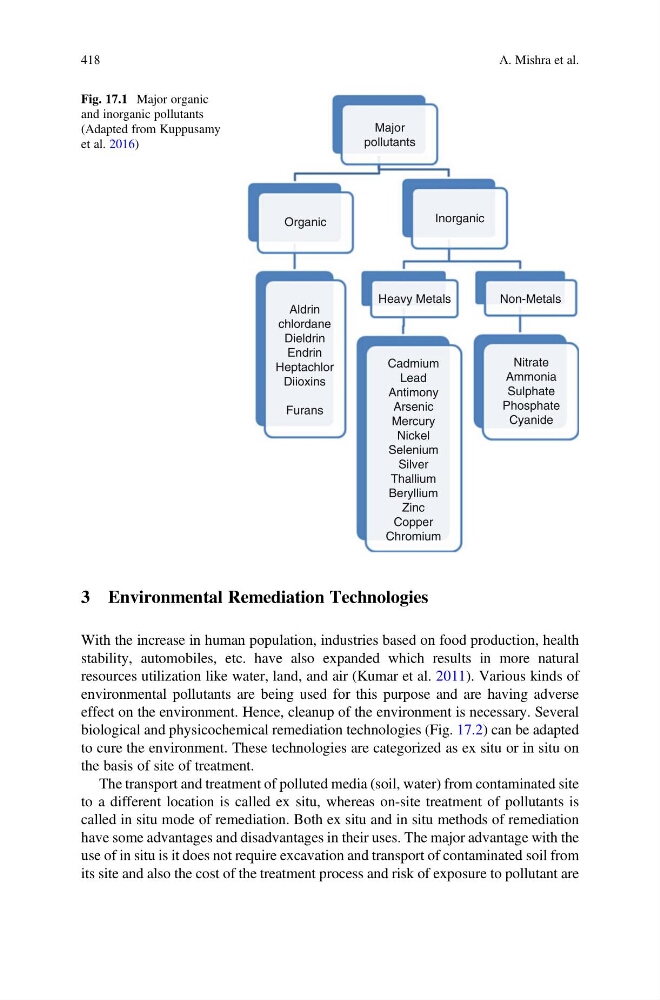
Fig. 17.1 Major organic
and inorganic pollutants
(Adapted from Kuppusamy
et al. 2016)
418
A. Mishra et al.
With the increase in human population, industries based on food production, health
stability, automobiles, etc. have also expanded which results in more natural
resources utilization like water, land, and air (Kumar et al. 2011). Various kinds of
environmental pollutants are being used for this purpose and are having adverse
effect on the environment. Hence, cleanup of the environment is necessary. Several
biological and physicochemical remediation technologies (Fig. 17.2) can be adapted
to cure the environment. These technologies are categorized as ex situ or in situ on
the basis of site of treatment.
The transport and treatment of polluted media (soil, water) from contaminated site
to a different location is called ex situ, whereas on-site treatment of pollutants is
called in situ mode of remediation. Both ex situ and in situ methods of remediation
have some advantages and disadvantages in their uses. The major advantage with the
use of in situ is it does not require excavation and transport of contaminated soil from
its site and also the cost of the treatment process and risk of exposure to pollutant are
Major
pollutants
Organic
Inorganic
Heavy Metals
Non-Metals
Nitrate
Ammonia
Sulphate
Phosphate
Cyanide
Cadmium
Lead
Antimony
Arsenic
Mercury
Nickel
Selenium
Silver
Thallium
Beryllium
Zinc
Copper
Chromium
Aldrin
chlordane
Dieldrin
Endrin
Heptachlor
Diioxins
Furans
Fig. 17.1 Major organic
and inorganic pollutants
(Adapted from Kuppusamy
et al. 2016)
418
A. Mishra et al.