

2.3 Applications
Cadmium is a common component of electric batteries, pigments, coatings, and
electroplating (USGS 2008).
2.3.1 Batteries
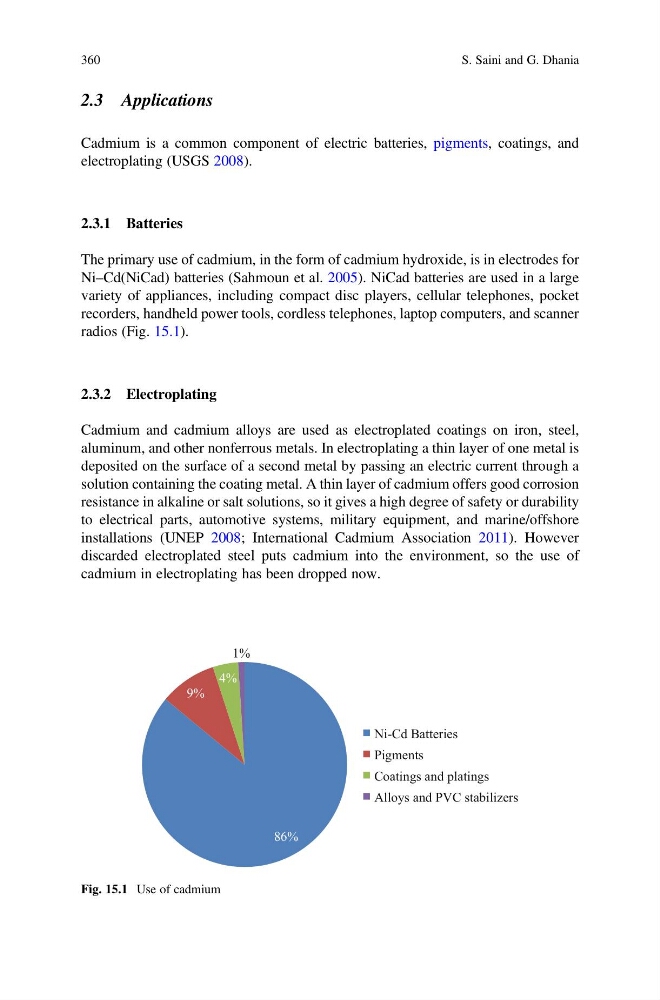
The primary use of cadmium, in the form of cadmium hydroxide, is in electrodes for
Ni–Cd(NiCad) batteries (Sahmoun et al. 2005). NiCad batteries are used in a large
variety of appliances, including compact disc players, cellular telephones, pocket
recorders, handheld power tools, cordless telephones, laptop computers, and scanner
radios (Fig. 15.1).
2.3.2 Electroplating
Cadmium and cadmium alloys are used as electroplated coatings on iron, steel,
aluminum, and other nonferrous metals. In electroplating a thin layer of one metal is
deposited on the surface of a second metal by passing an electric current through a
solution containing the coating metal. A thin layer of cadmium offers good corrosion
resistance in alkaline or salt solutions, so it gives a high degree of safety or durability
to electrical parts, automotive systems, military equipment, and marine/offshore
installations (UNEP 2008; International Cadmium Association 2011). However
discarded electroplated steel puts cadmium into the environment, so the use of
cadmium in electroplating has been dropped now.
86%
9%
4%
1%
Ni-Cd Batteries
Pigments
Coatings and platings
Alloys and PVC stabilizers
Fig. 15.1 Use of cadmium
360
S. Saini and G. Dhania
Cadmium is a common component of electric batteries, pigments, coatings, and
electroplating (USGS 2008).
2.3.1 Batteries
The primary use of cadmium, in the form of cadmium hydroxide, is in electrodes for
Ni–Cd(NiCad) batteries (Sahmoun et al. 2005). NiCad batteries are used in a large
variety of appliances, including compact disc players, cellular telephones, pocket
recorders, handheld power tools, cordless telephones, laptop computers, and scanner
radios (Fig. 15.1).
2.3.2 Electroplating
Cadmium and cadmium alloys are used as electroplated coatings on iron, steel,
aluminum, and other nonferrous metals. In electroplating a thin layer of one metal is
deposited on the surface of a second metal by passing an electric current through a
solution containing the coating metal. A thin layer of cadmium offers good corrosion
resistance in alkaline or salt solutions, so it gives a high degree of safety or durability
to electrical parts, automotive systems, military equipment, and marine/offshore
installations (UNEP 2008; International Cadmium Association 2011). However
discarded electroplated steel puts cadmium into the environment, so the use of
cadmium in electroplating has been dropped now.
86%
9%
4%
1%
Ni-Cd Batteries
Pigments
Coatings and platings
Alloys and PVC stabilizers
Fig. 15.1 Use of cadmium
360
S. Saini and G. Dhania