

Cadmium is a rare element, and its abundance in the earth’s crust is about 0.1 to 0.2
parts per million. It is not found in its pure state in nature and occurs mainly as
cadmium sulfide (CdS, or greenockite) in zinc deposits. Most cadmium is obtained as
a by-product of zinc mining and refining (Llewellyn 1994). In nature eight isotopes of
cadmium exist. The largest producers of cadmium in 1996 were Canada, Japan,
Belgium, the United States, China, Kazakhstan, and Germany (NTP 2004).
2.1 Physical Properties
Atomic radius and ionic radius (Cd
2+ ) of cadmium are 1.56 Å and 1.03 Å, respectively. Its melting point is lower than other transition metals, and when it combines
with other metals in alloys, it lowers their melting point. Its melting point is 321
C
(610
F) and its boiling point is 765
C (1410
F). The density of cadmium is 8.65 g at
25
C and vapor pressure is 1 mm Hg at 394
C. Cadmium has high ductility and
high thermal and electrical conductivity and is an excellent corrosion resistance,
making it suitable for a wide variety of industrial applications. As a bulk metal,
cadmium is insoluble in water and is not flammable; however, in its powdered form,
it may burn and release toxic fumes (IARC 1993).
2.2 Chemical Properties
Burning of cadmium in air leads to the formation of brown amorphous cadmium
oxide (CdO). Cadmium oxide is a colorless amorphous powder, soluble in dilute
acids and ammonium salts and insoluble in alkalis and water. Cadmium by reacting
with hydrochloric acid, sulfuric acid, and nitric acid produces cadmium chloride
(CdCl 2 ), cadmium sulfate (CdSO 4 ), and cadmium nitrate (Cd(NO 3 ) 2 ). Commercial
cadmium chloride is a mixture of hydrates, soluble in water and acetone, slightly
soluble in methanol and ethanol, and insoluble in diethyl ether. It occurs as small
colorless-to-white rhombohedral or hexagonal crystals. Cadmium sulfate is
soluble in water but insoluble in ethanol, acetone, and ammonia and occurs as
colorless-to-white orthorhombic crystals. Cadmium nitrate is soluble in water,
ethanol, acetone, and diethyl ether and occurs as a colorless solid (IARC 1973,
1993; HSDB 2009). The most common oxidation state of cadmium is +2, but it
also exists in the +1 state. The oxidation state +1 is produced by dissolving
cadmium in a mixture of cadmium chloride and aluminum chloride, forming the
Cd 2
2+ cation, which is similar to the Hg 2
2+ cation in mercury(I) chloride (Holleman
et al. 1985; Cotton 1999).
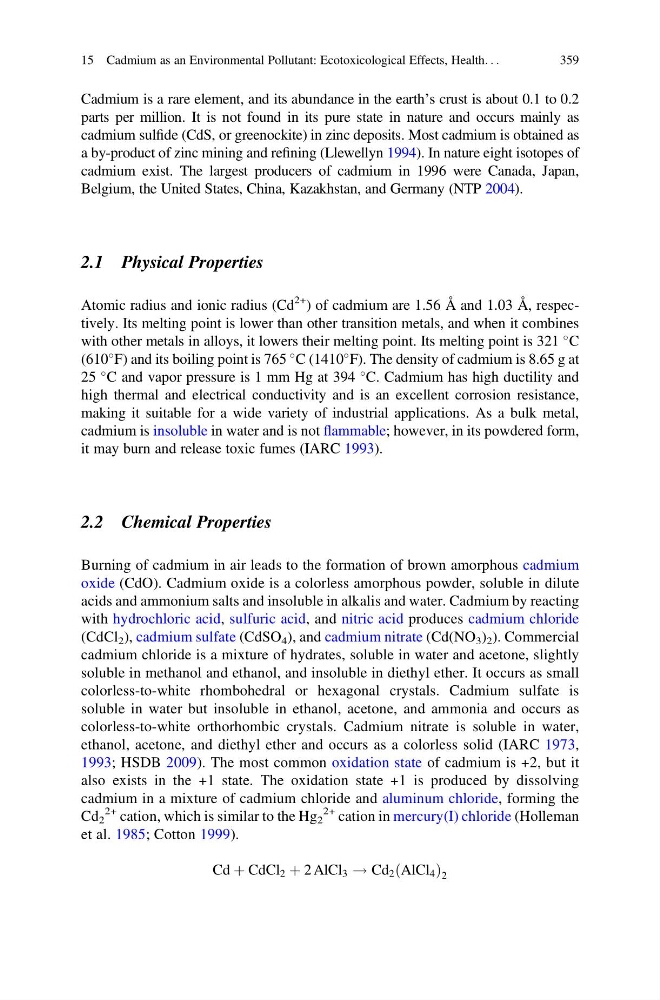
Cd þ CdCl 2 þ 2 AlCl 3 ! Cd 2 AlCl 4
ð
Þ 2
15 Cadmium as an Environmental Pollutant: Ecotoxicological Effects, Health. . .
359
parts per million. It is not found in its pure state in nature and occurs mainly as
cadmium sulfide (CdS, or greenockite) in zinc deposits. Most cadmium is obtained as
a by-product of zinc mining and refining (Llewellyn 1994). In nature eight isotopes of
cadmium exist. The largest producers of cadmium in 1996 were Canada, Japan,
Belgium, the United States, China, Kazakhstan, and Germany (NTP 2004).
2.1 Physical Properties
Atomic radius and ionic radius (Cd
2+ ) of cadmium are 1.56 Å and 1.03 Å, respectively. Its melting point is lower than other transition metals, and when it combines
with other metals in alloys, it lowers their melting point. Its melting point is 321
C
(610
F) and its boiling point is 765
C (1410
F). The density of cadmium is 8.65 g at
25
C and vapor pressure is 1 mm Hg at 394
C. Cadmium has high ductility and
high thermal and electrical conductivity and is an excellent corrosion resistance,
making it suitable for a wide variety of industrial applications. As a bulk metal,
cadmium is insoluble in water and is not flammable; however, in its powdered form,
it may burn and release toxic fumes (IARC 1993).
2.2 Chemical Properties
Burning of cadmium in air leads to the formation of brown amorphous cadmium
oxide (CdO). Cadmium oxide is a colorless amorphous powder, soluble in dilute
acids and ammonium salts and insoluble in alkalis and water. Cadmium by reacting
with hydrochloric acid, sulfuric acid, and nitric acid produces cadmium chloride
(CdCl 2 ), cadmium sulfate (CdSO 4 ), and cadmium nitrate (Cd(NO 3 ) 2 ). Commercial
cadmium chloride is a mixture of hydrates, soluble in water and acetone, slightly
soluble in methanol and ethanol, and insoluble in diethyl ether. It occurs as small
colorless-to-white rhombohedral or hexagonal crystals. Cadmium sulfate is
soluble in water but insoluble in ethanol, acetone, and ammonia and occurs as
colorless-to-white orthorhombic crystals. Cadmium nitrate is soluble in water,
ethanol, acetone, and diethyl ether and occurs as a colorless solid (IARC 1973,
1993; HSDB 2009). The most common oxidation state of cadmium is +2, but it
also exists in the +1 state. The oxidation state +1 is produced by dissolving
cadmium in a mixture of cadmium chloride and aluminum chloride, forming the
Cd 2
2+ cation, which is similar to the Hg 2
2+ cation in mercury(I) chloride (Holleman
et al. 1985; Cotton 1999).
Cd þ CdCl 2 þ 2 AlCl 3 ! Cd 2 AlCl 4
ð
Þ 2
15 Cadmium as an Environmental Pollutant: Ecotoxicological Effects, Health. . .
359