

L
À1 day
À1 ) were achieved in 25% piggery wastewater diluted with growth medium
(modified freshwater medium) (Kuo et al. 2015). Wang et al. (2012) reported the
maximum lipid productivity of 6.3 g L
À1 day
À1 from the mixotrophic cultivation of
Chlorella pyrenoidosa in diluted piggery wastewater with COD of 1000 mg/l.
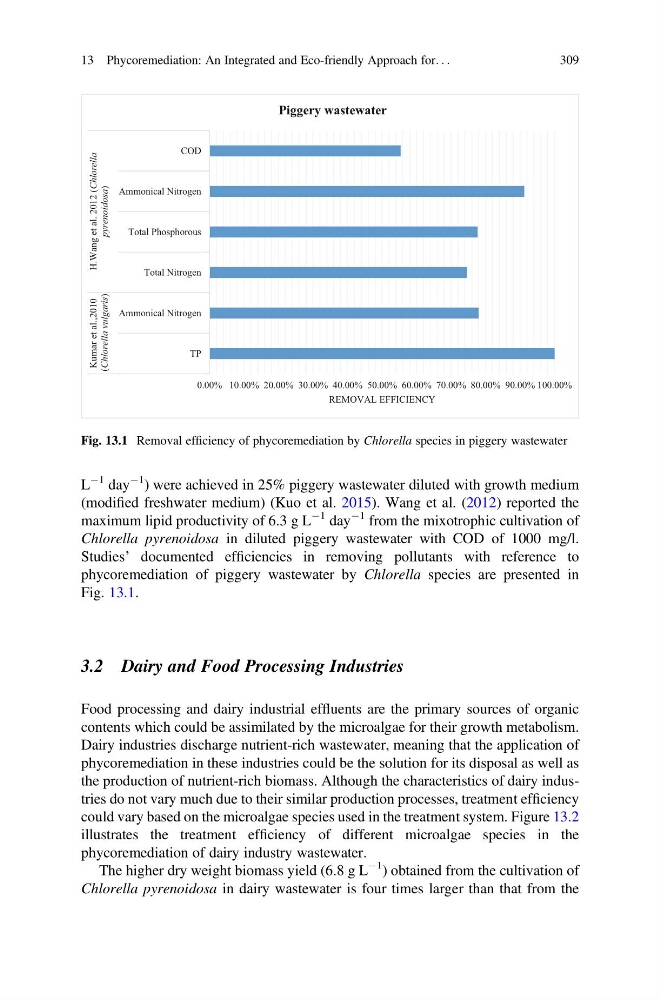
Studies’ documented efficiencies in removing pollutants with reference to
phycoremediation of piggery wastewater by Chlorella species are presented in
Fig. 13.1.
3.2 Dairy and Food Processing Industries
Food processing and dairy industrial effluents are the primary sources of organic
contents which could be assimilated by the microalgae for their growth metabolism.
Dairy industries discharge nutrient-rich wastewater, meaning that the application of
phycoremediation in these industries could be the solution for its disposal as well as
the production of nutrient-rich biomass. Although the characteristics of dairy industries do not vary much due to their similar production processes, treatment efficiency
could vary based on the microalgae species used in the treatment system. Figure 13.2
illustrates the treatment efficiency of different microalgae species in the
phycoremediation of dairy industry wastewater.
The higher dry weight biomass yield (6.8 g L
À1 ) obtained from the cultivation of
Chlorella pyrenoidosa in dairy wastewater is four times larger than that from the
0.00% 10.00% 20.00% 30.00% 40.00% 50.00% 60.00% 70.00% 80.00% 90.00% 100.00%
TP
Ammonical Nitrogen
Total Nitrogen
Total Phosphorous
Ammonical Nitrogen
COD
Kumar et al.,2010
(Chlorella vulgaris)
a
l
l
e
r
o
l
h
C
(
2
1
0
2
.
l
a
t
e
g
n
a
W
.
H
pyrenoidosa)
REMOVAL EFFICIENCY
Piggery wastewater
Fig. 13.1 Removal efficiency of phycoremediation by Chlorella species in piggery wastewater
13 Phycoremediation: An Integrated and Eco-friendly Approach for. . .
309
À1 day
À1 ) were achieved in 25% piggery wastewater diluted with growth medium
(modified freshwater medium) (Kuo et al. 2015). Wang et al. (2012) reported the
maximum lipid productivity of 6.3 g L
À1 day
À1 from the mixotrophic cultivation of
Chlorella pyrenoidosa in diluted piggery wastewater with COD of 1000 mg/l.
Studies’ documented efficiencies in removing pollutants with reference to
phycoremediation of piggery wastewater by Chlorella species are presented in
Fig. 13.1.
3.2 Dairy and Food Processing Industries
Food processing and dairy industrial effluents are the primary sources of organic
contents which could be assimilated by the microalgae for their growth metabolism.
Dairy industries discharge nutrient-rich wastewater, meaning that the application of
phycoremediation in these industries could be the solution for its disposal as well as
the production of nutrient-rich biomass. Although the characteristics of dairy industries do not vary much due to their similar production processes, treatment efficiency
could vary based on the microalgae species used in the treatment system. Figure 13.2
illustrates the treatment efficiency of different microalgae species in the
phycoremediation of dairy industry wastewater.
The higher dry weight biomass yield (6.8 g L
À1 ) obtained from the cultivation of
Chlorella pyrenoidosa in dairy wastewater is four times larger than that from the
0.00% 10.00% 20.00% 30.00% 40.00% 50.00% 60.00% 70.00% 80.00% 90.00% 100.00%
TP
Ammonical Nitrogen
Total Nitrogen
Total Phosphorous
Ammonical Nitrogen
COD
Kumar et al.,2010
(Chlorella vulgaris)
a
l
l
e
r
o
l
h
C
(
2
1
0
2
.
l
a
t
e
g
n
a
W
.
H
pyrenoidosa)
REMOVAL EFFICIENCY
Piggery wastewater
Fig. 13.1 Removal efficiency of phycoremediation by Chlorella species in piggery wastewater
13 Phycoremediation: An Integrated and Eco-friendly Approach for. . .
309