

2.2 Biosorption
2.2.1 Organic Pollutants
Some natural and synthetic steroid hormones including bisphenol A (BPA), estrone
(E 1 ), 17β-estradiol (E 2 ), estriol (E 3 ), 17 α-ethynylestradiol (EE 2 ), and diethylstilbestrol (DES) are ubiquitous in influents, effluents, and sludge of wastewater treatment
plants (WWTPs) (Combalbert and Hernandez-Raquet 2010). Microalgae showed
their ability to remove these organic pollutants, particularly EDCs (Dosnon-Olette
et al. 2010; Ji et al. 2014). EDC removal methods using algae commonly include
biodegradation (Li et al. 2009), oxidation (Deborde et al. 2008), photodegradation
(Neamţu and Frimmel 2006), and photoelectrocatalysis (Brugnera et al. 2010).
2.2.2 Inorganic Pollutants
Many algae have immense capability to sorb metals with a potential of treating
inorganic water pollutants (Kumar et al. 2015). Algal biosorption of heavy metals is
hypothesized to occur in a two-phase process: (1) heavy metal ions are adsorbed
onto extracellular materials (e.g., polysaccharides) and cell wall (carboxyl, sulfate,
and phosphate groups), and (2) heavy metals are passed through cell wall and
accumulated in a cell. Microalgae have been found to be effective in removing
heavy metals due to the high binding affinity of their cell membrane to heavy metals
(Chong et al. 2000). For real-world application of microalgal technologies for heavy
metal removal, several research questions still need to be addressed: (1) selection of
specific algal species with high heavy metal sorption capacity, (2) adequate understanding of biosorption mechanisms, (3) development of an economical method for
cell immobilization and better models for predicting heavy metal sorption, and
(4) economic feasibility of algal biosorption technologies compared to existing
physicochemical methods.
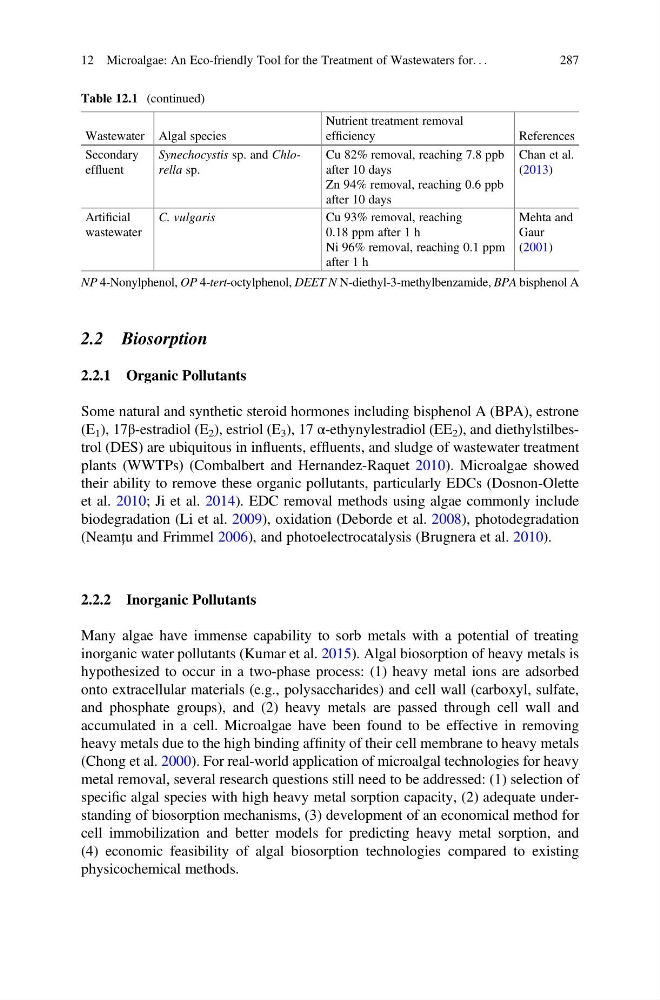
Table 12.1 (continued)
Wastewater Algal species
Nutrient treatment removal
efficiency
References
Secondary
effluent
Synechocystis sp. and Chlorella sp.
Cu 82% removal, reaching 7.8 ppb
after 10 days
Zn 94% removal, reaching 0.6 ppb
after 10 days
Chan et al.
(2013)
Artificial
wastewater
C. vulgaris
Cu 93% removal, reaching
0.18 ppm after 1 h
Ni 96% removal, reaching 0.1 ppm
after 1 h
Mehta and
Gaur
(2001)
NP 4-Nonylphenol, OP 4-tert-octylphenol, DEET N N-diethyl-3-methylbenzamide, BPA bisphenol A
12 Microalgae: An Eco-friendly Tool for the Treatment of Wastewaters for. . .
287
2.2.1 Organic Pollutants
Some natural and synthetic steroid hormones including bisphenol A (BPA), estrone
(E 1 ), 17β-estradiol (E 2 ), estriol (E 3 ), 17 α-ethynylestradiol (EE 2 ), and diethylstilbestrol (DES) are ubiquitous in influents, effluents, and sludge of wastewater treatment
plants (WWTPs) (Combalbert and Hernandez-Raquet 2010). Microalgae showed
their ability to remove these organic pollutants, particularly EDCs (Dosnon-Olette
et al. 2010; Ji et al. 2014). EDC removal methods using algae commonly include
biodegradation (Li et al. 2009), oxidation (Deborde et al. 2008), photodegradation
(Neamţu and Frimmel 2006), and photoelectrocatalysis (Brugnera et al. 2010).
2.2.2 Inorganic Pollutants
Many algae have immense capability to sorb metals with a potential of treating
inorganic water pollutants (Kumar et al. 2015). Algal biosorption of heavy metals is
hypothesized to occur in a two-phase process: (1) heavy metal ions are adsorbed
onto extracellular materials (e.g., polysaccharides) and cell wall (carboxyl, sulfate,
and phosphate groups), and (2) heavy metals are passed through cell wall and
accumulated in a cell. Microalgae have been found to be effective in removing
heavy metals due to the high binding affinity of their cell membrane to heavy metals
(Chong et al. 2000). For real-world application of microalgal technologies for heavy
metal removal, several research questions still need to be addressed: (1) selection of
specific algal species with high heavy metal sorption capacity, (2) adequate understanding of biosorption mechanisms, (3) development of an economical method for
cell immobilization and better models for predicting heavy metal sorption, and
(4) economic feasibility of algal biosorption technologies compared to existing
physicochemical methods.
Table 12.1 (continued)
Wastewater Algal species
Nutrient treatment removal
efficiency
References
Secondary
effluent
Synechocystis sp. and Chlorella sp.
Cu 82% removal, reaching 7.8 ppb
after 10 days
Zn 94% removal, reaching 0.6 ppb
after 10 days
Chan et al.
(2013)
Artificial
wastewater
C. vulgaris
Cu 93% removal, reaching
0.18 ppm after 1 h
Ni 96% removal, reaching 0.1 ppm
after 1 h
Mehta and
Gaur
(2001)
NP 4-Nonylphenol, OP 4-tert-octylphenol, DEET N N-diethyl-3-methylbenzamide, BPA bisphenol A
12 Microalgae: An Eco-friendly Tool for the Treatment of Wastewaters for. . .
287