

4 Conclusion
Since using FCs causes environmental pollutions, finding renewable energy sources
such as MFCs as an alternative to nonrenewable energy sources has been considerably discussed over recent years. Generation of bioelectricity, second fuel
(biohydrogen) production, usage in WWT plants, and also serving as a sensor or a
biosensor are the most vital applications of MFCs. Besides, these analytical devices
can be used for bioremediation of toxic compounds. However, MFC technology is
still in research level, and tremendous efforts need to be done to make them available
for commercialization.
References
Aelterman P, Rabaey K, Clauwaert P, Verstraete W (2006a) Microbial fuel cells for wastewater
treatment. Water Sci Technol 54:9–15
Aelterman P, Rabaey K, Pham HT, Boon N, Verstraete W (2006b) Continuous electricity generation at high voltages and currents using stacked microbial fuel cells. Environ Sci Technol
40:3388–3394
Asghary M, Raoof JB, Rahimnejad M, Ojani R (2016) A novel self-powered and sensitive labelfree DNA biosensor in microbial fuel cell. Biosens Bioelectron 82:173–176
Bard AJ, Faulkner LR (2001) Electrochemical methods. Fundamentals and applications, 2nd edn.
Wiley, New York
1800
1600
1400
1200
1000
800
600
400
200
0
0.0
0.2
0.4
0.6
0.8
650
600
Cathode potential
Power density
550
500
450
Cathode Potential (mV)
Power density (mW/m 2
)
Current density (mA/cm 2 )
400
350
300
250
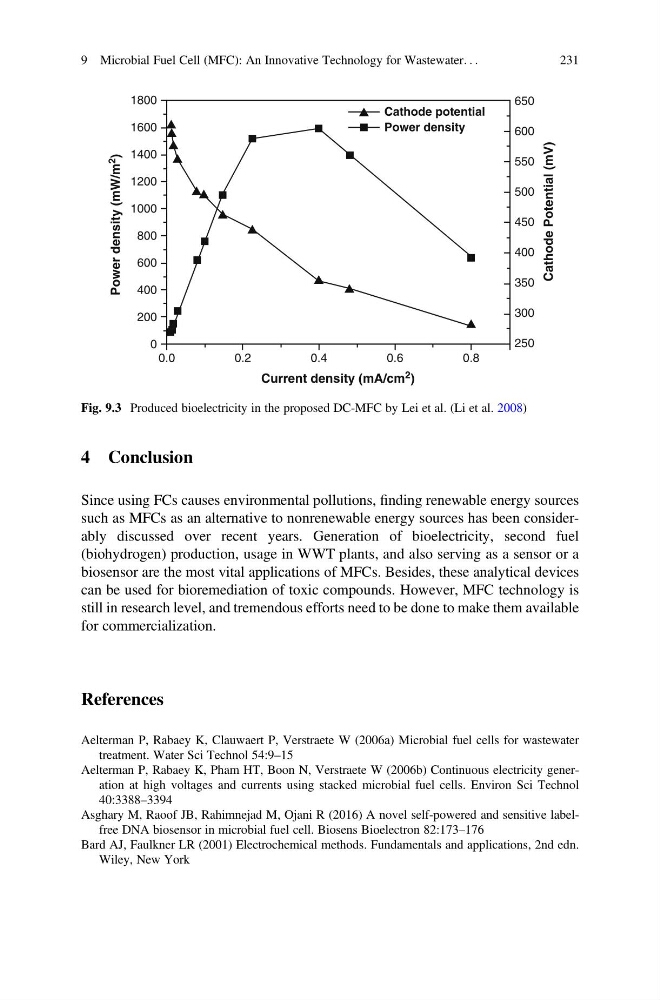
Fig. 9.3 Produced bioelectricity in the proposed DC-MFC by Lei et al. (Li et al. 2008)
9 Microbial Fuel Cell (MFC): An Innovative Technology for Wastewater. . .
231
Since using FCs causes environmental pollutions, finding renewable energy sources
such as MFCs as an alternative to nonrenewable energy sources has been considerably discussed over recent years. Generation of bioelectricity, second fuel
(biohydrogen) production, usage in WWT plants, and also serving as a sensor or a
biosensor are the most vital applications of MFCs. Besides, these analytical devices
can be used for bioremediation of toxic compounds. However, MFC technology is
still in research level, and tremendous efforts need to be done to make them available
for commercialization.
References
Aelterman P, Rabaey K, Clauwaert P, Verstraete W (2006a) Microbial fuel cells for wastewater
treatment. Water Sci Technol 54:9–15
Aelterman P, Rabaey K, Pham HT, Boon N, Verstraete W (2006b) Continuous electricity generation at high voltages and currents using stacked microbial fuel cells. Environ Sci Technol
40:3388–3394
Asghary M, Raoof JB, Rahimnejad M, Ojani R (2016) A novel self-powered and sensitive labelfree DNA biosensor in microbial fuel cell. Biosens Bioelectron 82:173–176
Bard AJ, Faulkner LR (2001) Electrochemical methods. Fundamentals and applications, 2nd edn.
Wiley, New York
1800
1600
1400
1200
1000
800
600
400
200
0
0.0
0.2
0.4
0.6
0.8
650
600
Cathode potential
Power density
550
500
450
Cathode Potential (mV)
Power density (mW/m 2
)
Current density (mA/cm 2 )
400
350
300
250
Fig. 9.3 Produced bioelectricity in the proposed DC-MFC by Lei et al. (Li et al. 2008)
9 Microbial Fuel Cell (MFC): An Innovative Technology for Wastewater. . .
231