

sulfides from wastewater by Rabaey et al. in 2006 (Rabaey et al. 2006). It’s worth
remarking that an oligotrophic MFC is able to be operated with a BOD value of
about 5 mg/l (Moon et al. 2005; Phung et al. 2004), and in some cases up to 90% of
COD has been removed (Wang et al. 2012), and the CE of about 80% has been
shown before (Kim et al. 2005).
2.8.4.1 Water Quality Improvement by MFC
Providing clean water and adequate sanitation systems in developing countries to
overcome diseases is required. Up to now, various chemical and biological methods
have been used to measure the water quality and to ensure the safety of water for
consumers. However, these methods have several problems including being expensive and complexity in use. But, many research have been done in the world to prove
the use of the MFC technology for measuring and monitoring water quality due to its
simplicity, rapid response, and its ability to function on-site and real time (Chouler
and Di Lorenzo 2015; Orta et al. 2017).
2.8.4.2 Comparison of MFC with Conventional Wastewater Treatment Plant
There are two main disadvantages for the conventional aerobic treatment. The first
one is the high capital investment, and the second one is the remarkable and
significant operational and energy consumption cost. For instance, sewage aeration
shows an energy requirement of about 0.5 kWh/m
3 . Besides, great amounts of
surplus sludge are produced that need a suitable treatment (Aelterman et al. 2006a,
b). To overcome the aforementioned drawbacks, MFCs are the best answer to
several problems that traditional treatment plant faces. Ability of energy recovering
out of wastewater and limiting both the energy input and the excess sludge production are the advantages of WWT by MFCs (Rabaey and Verstraete 2005). The other
advantage of MFCs lies in the fact that it is their direct harvesting of electricity unlike
the conventional way which is a two-step process (Aelterman et al. 2006a, b). It’s
worth noting that MFC has tremendous advantages in comparison with conventional
activated sludge (CAS) such as using an air-cathode MFC to consume gaseous
oxygen from the atmosphere (Park and Zeikus 2003) that can significantly reduce
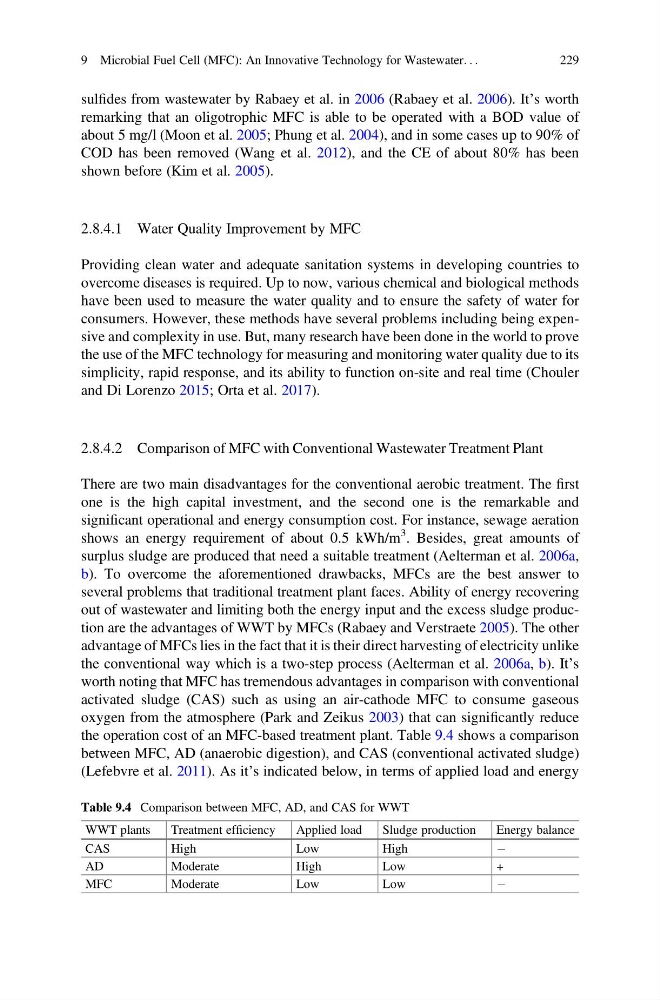
the operation cost of an MFC-based treatment plant. Table 9.4 shows a comparison
between MFC, AD (anaerobic digestion), and CAS (conventional activated sludge)
(Lefebvre et al. 2011). As it’s indicated below, in terms of applied load and energy
Table 9.4 Comparison between MFC, AD, and CAS for WWT
WWT plants
Treatment efficiency
Applied load
Sludge production
Energy balance
CAS
High
Low
High
À
AD
Moderate
High
Low
+
MFC
Moderate
Low
Low
À
9 Microbial Fuel Cell (MFC): An Innovative Technology for Wastewater. . .
229
remarking that an oligotrophic MFC is able to be operated with a BOD value of
about 5 mg/l (Moon et al. 2005; Phung et al. 2004), and in some cases up to 90% of
COD has been removed (Wang et al. 2012), and the CE of about 80% has been
shown before (Kim et al. 2005).
2.8.4.1 Water Quality Improvement by MFC
Providing clean water and adequate sanitation systems in developing countries to
overcome diseases is required. Up to now, various chemical and biological methods
have been used to measure the water quality and to ensure the safety of water for
consumers. However, these methods have several problems including being expensive and complexity in use. But, many research have been done in the world to prove
the use of the MFC technology for measuring and monitoring water quality due to its
simplicity, rapid response, and its ability to function on-site and real time (Chouler
and Di Lorenzo 2015; Orta et al. 2017).
2.8.4.2 Comparison of MFC with Conventional Wastewater Treatment Plant
There are two main disadvantages for the conventional aerobic treatment. The first
one is the high capital investment, and the second one is the remarkable and
significant operational and energy consumption cost. For instance, sewage aeration
shows an energy requirement of about 0.5 kWh/m
3 . Besides, great amounts of
surplus sludge are produced that need a suitable treatment (Aelterman et al. 2006a,
b). To overcome the aforementioned drawbacks, MFCs are the best answer to
several problems that traditional treatment plant faces. Ability of energy recovering
out of wastewater and limiting both the energy input and the excess sludge production are the advantages of WWT by MFCs (Rabaey and Verstraete 2005). The other
advantage of MFCs lies in the fact that it is their direct harvesting of electricity unlike
the conventional way which is a two-step process (Aelterman et al. 2006a, b). It’s
worth noting that MFC has tremendous advantages in comparison with conventional
activated sludge (CAS) such as using an air-cathode MFC to consume gaseous
oxygen from the atmosphere (Park and Zeikus 2003) that can significantly reduce
the operation cost of an MFC-based treatment plant. Table 9.4 shows a comparison
between MFC, AD (anaerobic digestion), and CAS (conventional activated sludge)
(Lefebvre et al. 2011). As it’s indicated below, in terms of applied load and energy
Table 9.4 Comparison between MFC, AD, and CAS for WWT
WWT plants
Treatment efficiency
Applied load
Sludge production
Energy balance
CAS
High
Low
High
À
AD
Moderate
High
Low
+
MFC
Moderate
Low
Low
À
9 Microbial Fuel Cell (MFC): An Innovative Technology for Wastewater. . .
229