

2.8 Applications of MFC
As stated earlier, MFC as a new and novel technology is validated to be applied in
some of the interesting sections which are classified into four superb categories.
2.8.1 Electricity Generation
As previously mentioned, providing sustainable production of energy out of biodegradable reduced organic components is one of the most valuable applications of
MFCs. Considering the fact, MFCs not only function on diverse types of uncomplicated carbohydrates but also have an effective function on complex substrates
presented in wastewaters (Rabaey and Verstraete 2005). Consequently, knowing
about different metabolic pathways used by bacteria to optimize and develop energy
production is an essential knowledge to be considered. Because of the low rate of
electron transfer in MFCs, power levels in MFC systems are relatively low
(Rahimnejad and Najafpour 2018), and that’s why mediators have been used as an
accelerating agent for transferring electrons in anode chamber. Generating appropriate power for the small electrical devices would be the main purpose of MFCs.
For instance, ten LED lamp and one digital clock had been turned on with fabricated
stacked MFCs and operated for the about 2 days by Rahimnejad et al. in 2014
(Rahimnejad et al. 2015). As a matter of fact, anaerobic sewage sludge can be
introduced as appropriate inoculums for MFCs due to containing super valuable
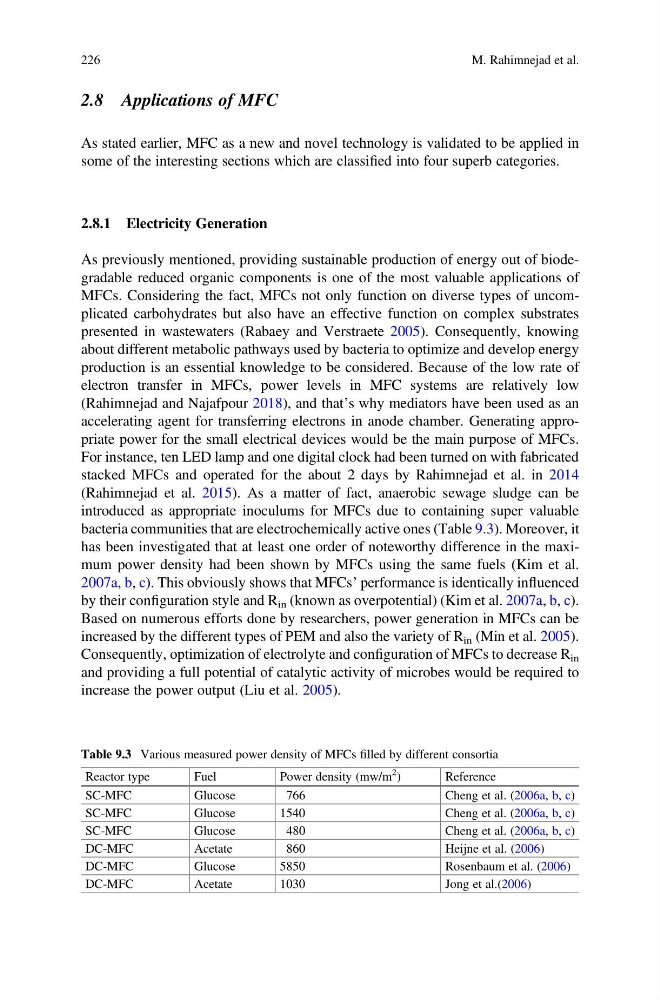
bacteria communities that are electrochemically active ones (Table 9.3). Moreover, it
has been investigated that at least one order of noteworthy difference in the maximum power density had been shown by MFCs using the same fuels (Kim et al.
2007a, b, c). This obviously shows that MFCs’ performance is identically influenced
by their configuration style and R in (known as overpotential) (Kim et al. 2007a, b, c).
Based on numerous efforts done by researchers, power generation in MFCs can be
increased by the different types of PEM and also the variety of R in (Min et al. 2005).
Consequently, optimization of electrolyte and configuration of MFCs to decrease R in
and providing a full potential of catalytic activity of microbes would be required to
increase the power output (Liu et al. 2005).
Table 9.3 Various measured power density of MFCs filled by different consortia
Reactor type
Fuel
Power density (mw/m
2
)
Reference
SC-MFC
Glucose
766
Cheng et al. (2006a, b, c)
SC-MFC
Glucose
1540
Cheng et al. (2006a, b, c)
SC-MFC
Glucose
480
Cheng et al. (2006a, b, c)
DC-MFC
Acetate
860
Heijne et al. (2006)
DC-MFC
Glucose
5850
Rosenbaum et al. (2006)
DC-MFC
Acetate
1030
Jong et al.(2006)
226
M. Rahimnejad et al.
As stated earlier, MFC as a new and novel technology is validated to be applied in
some of the interesting sections which are classified into four superb categories.
2.8.1 Electricity Generation
As previously mentioned, providing sustainable production of energy out of biodegradable reduced organic components is one of the most valuable applications of
MFCs. Considering the fact, MFCs not only function on diverse types of uncomplicated carbohydrates but also have an effective function on complex substrates
presented in wastewaters (Rabaey and Verstraete 2005). Consequently, knowing
about different metabolic pathways used by bacteria to optimize and develop energy
production is an essential knowledge to be considered. Because of the low rate of
electron transfer in MFCs, power levels in MFC systems are relatively low
(Rahimnejad and Najafpour 2018), and that’s why mediators have been used as an
accelerating agent for transferring electrons in anode chamber. Generating appropriate power for the small electrical devices would be the main purpose of MFCs.
For instance, ten LED lamp and one digital clock had been turned on with fabricated
stacked MFCs and operated for the about 2 days by Rahimnejad et al. in 2014
(Rahimnejad et al. 2015). As a matter of fact, anaerobic sewage sludge can be
introduced as appropriate inoculums for MFCs due to containing super valuable
bacteria communities that are electrochemically active ones (Table 9.3). Moreover, it
has been investigated that at least one order of noteworthy difference in the maximum power density had been shown by MFCs using the same fuels (Kim et al.
2007a, b, c). This obviously shows that MFCs’ performance is identically influenced
by their configuration style and R in (known as overpotential) (Kim et al. 2007a, b, c).
Based on numerous efforts done by researchers, power generation in MFCs can be
increased by the different types of PEM and also the variety of R in (Min et al. 2005).
Consequently, optimization of electrolyte and configuration of MFCs to decrease R in
and providing a full potential of catalytic activity of microbes would be required to
increase the power output (Liu et al. 2005).
Table 9.3 Various measured power density of MFCs filled by different consortia
Reactor type
Fuel
Power density (mw/m
2
)
Reference
SC-MFC
Glucose
766
Cheng et al. (2006a, b, c)
SC-MFC
Glucose
1540
Cheng et al. (2006a, b, c)
SC-MFC
Glucose
480
Cheng et al. (2006a, b, c)
DC-MFC
Acetate
860
Heijne et al. (2006)
DC-MFC
Glucose
5850
Rosenbaum et al. (2006)
DC-MFC
Acetate
1030
Jong et al.(2006)
226
M. Rahimnejad et al.