

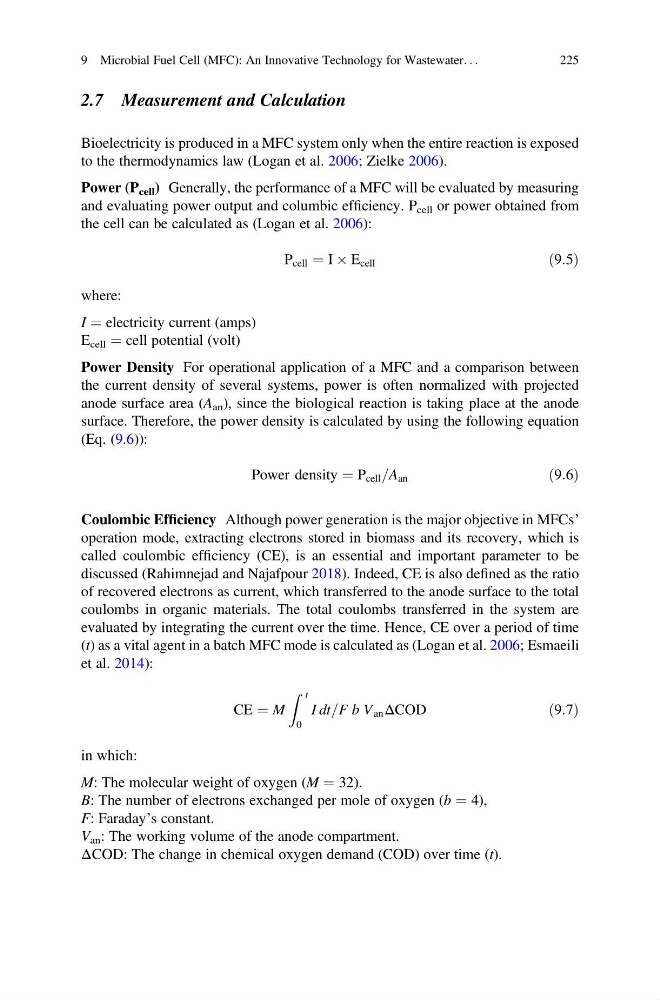
2.7 Measurement and Calculation
Bioelectricity is produced in a MFC system only when the entire reaction is exposed
to the thermodynamics law (Logan et al. 2006; Zielke 2006).
Power (P cell ) Generally, the performance of a MFC will be evaluated by measuring
and evaluating power output and columbic efficiency. P cell or power obtained from
the cell can be calculated as (Logan et al. 2006):
P cell ¼ I Â E cell
ð9:5Þ
where:
I ¼ electricity current (amps)
E cell ¼ cell potential (volt)
Power Density For operational application of a MFC and a comparison between
the current density of several systems, power is often normalized with projected
anode surface area (A an ), since the biological reaction is taking place at the anode
surface. Therefore, the power density is calculated by using the following equation
(Eq. (9.6)):
Power density ¼ P cell =A an
ð9:6Þ
Coulombic Efficiency Although power generation is the major objective in MFCs’
operation mode, extracting electrons stored in biomass and its recovery, which is
called coulombic efficiency (CE), is an essential and important parameter to be
discussed (Rahimnejad and Najafpour 2018). Indeed, CE is also defined as the ratio
of recovered electrons as current, which transferred to the anode surface to the total
coulombs in organic materials. The total coulombs transferred in the system are
evaluated by integrating the current over the time. Hence, CE over a period of time
(t) as a vital agent in a batch MFC mode is calculated as (Logan et al. 2006; Esmaeili
et al. 2014):
CE ¼ M
Z t
0
I dt=F b V an ΔCOD
ð9:7Þ
in which:
M: The molecular weight of oxygen (M ¼ 32).
B: The number of electrons exchanged per mole of oxygen (b ¼ 4),
F: Faraday’s constant.
V an : The working volume of the anode compartment.
ΔCOD: The change in chemical oxygen demand (COD) over time (t).
9 Microbial Fuel Cell (MFC): An Innovative Technology for Wastewater. . .
225
Bioelectricity is produced in a MFC system only when the entire reaction is exposed
to the thermodynamics law (Logan et al. 2006; Zielke 2006).
Power (P cell ) Generally, the performance of a MFC will be evaluated by measuring
and evaluating power output and columbic efficiency. P cell or power obtained from
the cell can be calculated as (Logan et al. 2006):
P cell ¼ I Â E cell
ð9:5Þ
where:
I ¼ electricity current (amps)
E cell ¼ cell potential (volt)
Power Density For operational application of a MFC and a comparison between
the current density of several systems, power is often normalized with projected
anode surface area (A an ), since the biological reaction is taking place at the anode
surface. Therefore, the power density is calculated by using the following equation
(Eq. (9.6)):
Power density ¼ P cell =A an
ð9:6Þ
Coulombic Efficiency Although power generation is the major objective in MFCs’
operation mode, extracting electrons stored in biomass and its recovery, which is
called coulombic efficiency (CE), is an essential and important parameter to be
discussed (Rahimnejad and Najafpour 2018). Indeed, CE is also defined as the ratio
of recovered electrons as current, which transferred to the anode surface to the total
coulombs in organic materials. The total coulombs transferred in the system are
evaluated by integrating the current over the time. Hence, CE over a period of time
(t) as a vital agent in a batch MFC mode is calculated as (Logan et al. 2006; Esmaeili
et al. 2014):
CE ¼ M
Z t
0
I dt=F b V an ΔCOD
ð9:7Þ
in which:
M: The molecular weight of oxygen (M ¼ 32).
B: The number of electrons exchanged per mole of oxygen (b ¼ 4),
F: Faraday’s constant.
V an : The working volume of the anode compartment.
ΔCOD: The change in chemical oxygen demand (COD) over time (t).
9 Microbial Fuel Cell (MFC): An Innovative Technology for Wastewater. . .
225