

oxidoreductases have been applied most often (Ramanavicius and Ramanaviciene
2009). Despite high selectivity of enzymes to catalyze oxidation of a wide range of
fuels, the use of enzymes in EFCs is limited by their major specific problems such as
their low electron transfer rate, poor enzyme stability, high cost of extraction,
separation, and purification of enzymes (Asghary et al. 2016; Zhou and Dong 2011).
2.1.2 Microbial Fuel Cells
MFCs as a novel and promising technology have gained increasing attention during
the past decades due to their ability to provide new opportunities for the sustainable
and green energy out of biodegradable organic matters by using microorganisms as
biocatalyst (Rabaey and Verstraete 2005). In MFCs, active microorganisms eliminate the requirements for the isolation of individual enzymes, and they are able to
catalyze a more complete oxidation reaction of many biofuels. Also, their ability to
be less susceptible in order to poisoning under neutral conditions resulting in the
bioelectricity production from reductive substances has been demonstrated recently
(Ramanavicius and Ramanaviciene 2009).
2.2 History of MFC
The first concept of MFC has been introduced by Potter in 1911. After that Logan
and Regan figured out that bacteria such as Escherichia coli and Saccharomyces
have the capability of generating electrical current by breaking down organic
compounds such as acetate and glucose. After the first innovation, efforts in this
area were almost stopped for about 55 years (Park and Zeikus 2002).
Until the 1950s and early 1960s, no serious researches on MFCs have been done.
In the 1980s it was discovered that the current density and power output could be
greatly enhanced by addition of electron mediators. However, it was discovered that
sometimes there is no need to use any types of artificial mediators to transfer
produced electrons from bacteria to the surface of anode electrodes (Gil et al.
2003) since there are lots of microbes such as Clostridium beijerinckii and
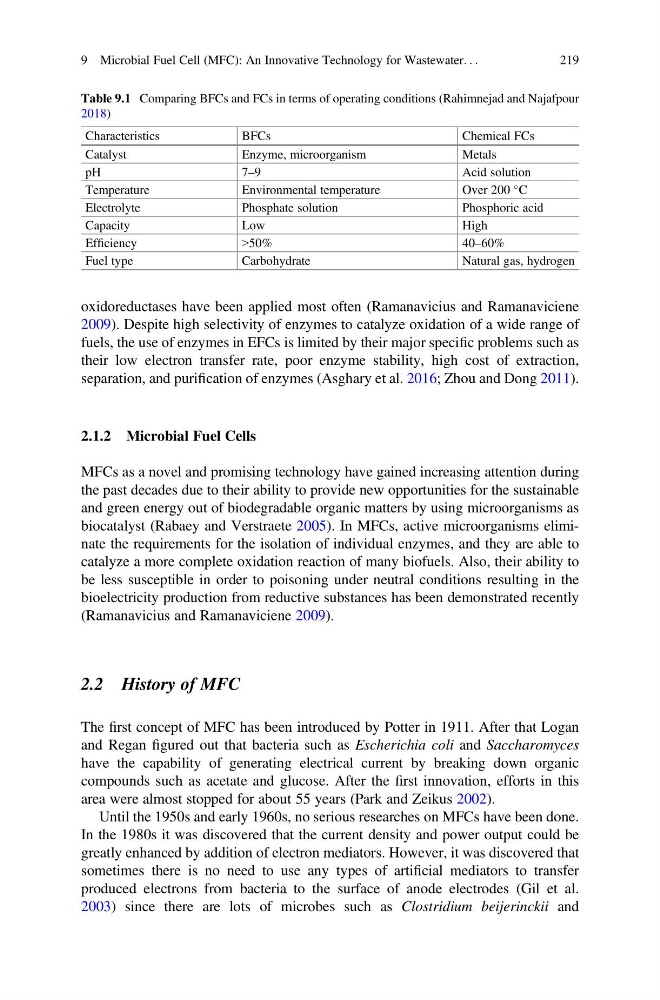
Table 9.1 Comparing BFCs and FCs in terms of operating conditions (Rahimnejad and Najafpour
2018)
Characteristics
BFCs
Chemical FCs
Catalyst
Enzyme, microorganism
Metals
pH
7–9
Acid solution
Temperature
Environmental temperature
Over 200
C
Electrolyte
Phosphate solution
Phosphoric acid
Capacity
Low
High
Efficiency
˃50%
40–60%
Fuel type
Carbohydrate
Natural gas, hydrogen
9 Microbial Fuel Cell (MFC): An Innovative Technology for Wastewater. . .
219
2009). Despite high selectivity of enzymes to catalyze oxidation of a wide range of
fuels, the use of enzymes in EFCs is limited by their major specific problems such as
their low electron transfer rate, poor enzyme stability, high cost of extraction,
separation, and purification of enzymes (Asghary et al. 2016; Zhou and Dong 2011).
2.1.2 Microbial Fuel Cells
MFCs as a novel and promising technology have gained increasing attention during
the past decades due to their ability to provide new opportunities for the sustainable
and green energy out of biodegradable organic matters by using microorganisms as
biocatalyst (Rabaey and Verstraete 2005). In MFCs, active microorganisms eliminate the requirements for the isolation of individual enzymes, and they are able to
catalyze a more complete oxidation reaction of many biofuels. Also, their ability to
be less susceptible in order to poisoning under neutral conditions resulting in the
bioelectricity production from reductive substances has been demonstrated recently
(Ramanavicius and Ramanaviciene 2009).
2.2 History of MFC
The first concept of MFC has been introduced by Potter in 1911. After that Logan
and Regan figured out that bacteria such as Escherichia coli and Saccharomyces
have the capability of generating electrical current by breaking down organic
compounds such as acetate and glucose. After the first innovation, efforts in this
area were almost stopped for about 55 years (Park and Zeikus 2002).
Until the 1950s and early 1960s, no serious researches on MFCs have been done.
In the 1980s it was discovered that the current density and power output could be
greatly enhanced by addition of electron mediators. However, it was discovered that
sometimes there is no need to use any types of artificial mediators to transfer
produced electrons from bacteria to the surface of anode electrodes (Gil et al.
2003) since there are lots of microbes such as Clostridium beijerinckii and
Table 9.1 Comparing BFCs and FCs in terms of operating conditions (Rahimnejad and Najafpour
2018)
Characteristics
BFCs
Chemical FCs
Catalyst
Enzyme, microorganism
Metals
pH
7–9
Acid solution
Temperature
Environmental temperature
Over 200
C
Electrolyte
Phosphate solution
Phosphoric acid
Capacity
Low
High
Efficiency
˃50%
40–60%
Fuel type
Carbohydrate
Natural gas, hydrogen
9 Microbial Fuel Cell (MFC): An Innovative Technology for Wastewater. . .
219