

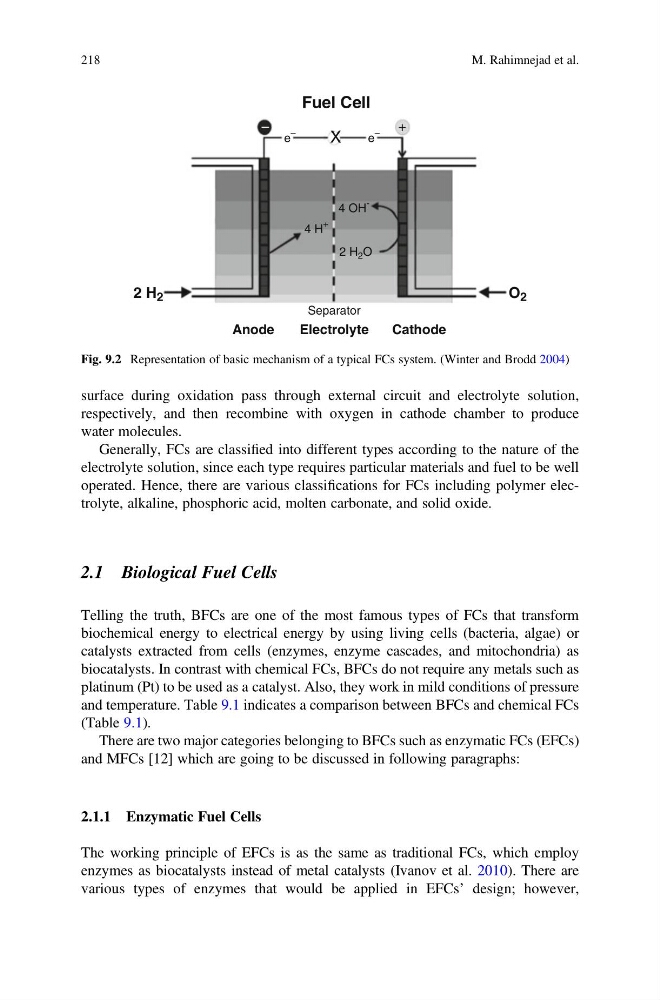
surface during oxidation pass through external circuit and electrolyte solution,
respectively, and then recombine with oxygen in cathode chamber to produce
water molecules.
Generally, FCs are classified into different types according to the nature of the
electrolyte solution, since each type requires particular materials and fuel to be well
operated. Hence, there are various classifications for FCs including polymer electrolyte, alkaline, phosphoric acid, molten carbonate, and solid oxide.
2.1 Biological Fuel Cells
Telling the truth, BFCs are one of the most famous types of FCs that transform
biochemical energy to electrical energy by using living cells (bacteria, algae) or
catalysts extracted from cells (enzymes, enzyme cascades, and mitochondria) as
biocatalysts. In contrast with chemical FCs, BFCs do not require any metals such as
platinum (Pt) to be used as a catalyst. Also, they work in mild conditions of pressure
and temperature. Table 9.1 indicates a comparison between BFCs and chemical FCs
(Table 9.1).
There are two major categories belonging to BFCs such as enzymatic FCs (EFCs)
and MFCs [12] which are going to be discussed in following paragraphs:
2.1.1 Enzymatic Fuel Cells
The working principle of EFCs is as the same as traditional FCs, which employ
enzymes as biocatalysts instead of metal catalysts (Ivanov et al. 2010). There are
various types of enzymes that would be applied in EFCs’ design; however,
4 H
+
4 OH
-
X
Separator
Anode
2 H 2
O 2
Electrolyte
Fuel Cell
Cathode
e
–
–
+
e
–
2 H 2 O
Fig. 9.2 Representation of basic mechanism of a typical FCs system. (Winter and Brodd 2004)
218
M. Rahimnejad et al.
respectively, and then recombine with oxygen in cathode chamber to produce
water molecules.
Generally, FCs are classified into different types according to the nature of the
electrolyte solution, since each type requires particular materials and fuel to be well
operated. Hence, there are various classifications for FCs including polymer electrolyte, alkaline, phosphoric acid, molten carbonate, and solid oxide.
2.1 Biological Fuel Cells
Telling the truth, BFCs are one of the most famous types of FCs that transform
biochemical energy to electrical energy by using living cells (bacteria, algae) or
catalysts extracted from cells (enzymes, enzyme cascades, and mitochondria) as
biocatalysts. In contrast with chemical FCs, BFCs do not require any metals such as
platinum (Pt) to be used as a catalyst. Also, they work in mild conditions of pressure
and temperature. Table 9.1 indicates a comparison between BFCs and chemical FCs
(Table 9.1).
There are two major categories belonging to BFCs such as enzymatic FCs (EFCs)
and MFCs [12] which are going to be discussed in following paragraphs:
2.1.1 Enzymatic Fuel Cells
The working principle of EFCs is as the same as traditional FCs, which employ
enzymes as biocatalysts instead of metal catalysts (Ivanov et al. 2010). There are
various types of enzymes that would be applied in EFCs’ design; however,
4 H
+
4 OH
-
X
Separator
Anode
2 H 2
O 2
Electrolyte
Fuel Cell
Cathode
e
–
–
+
e
–
2 H 2 O
Fig. 9.2 Representation of basic mechanism of a typical FCs system. (Winter and Brodd 2004)
218
M. Rahimnejad et al.