

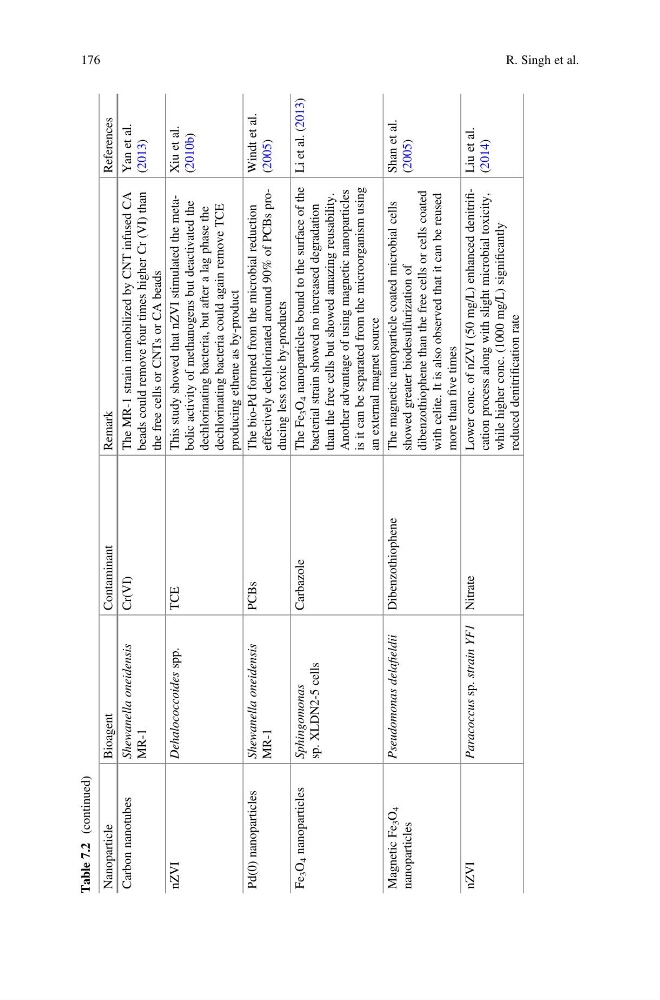
Table 7.2
(continued)
Nanoparticle
Bioagent
Contaminant
Remark
References
Carbon nanotubes
Shewanella oneidensis
MR-1
Cr(VI)
The MR-1 strain immobilized by CNT infused CA
beads could remove four times higher Cr (VI) than
the free cells or CNTs or CA beads
Yan et al.
(2013)
nZVI
Dehalococcoides
spp.
TCE
This study showed that nZVI stimulated the metabolic activity of methanogens but deactivated the
dechlorinating bacteria, but after a lag phase the
dechlorinating bacteria could again remove TCE
producing ethene as by-product
Xiu et al.
(2010b)
Pd(0) nanoparticles
Shewanella oneidensis
MR-1
PCBs
The bio-Pd formed from the microbial reduction
effectively dechlorinated around 90% of PCBs producing less toxic by-products
Windt et al.
(2005)
Fe
3 O
4 nanoparticles
Sphingomonas
sp. XLDN2-5 cells
Carbazole
The Fe
3 O
4 nanoparticles bound to the surface of the
bacterial strain showed no increased degradation
than the free cells but showed amazing reusability.
Another advantage of using magnetic nanoparticles
is it can be separated from the microorganism using
an external magnet source
Li et al. (2013)
Magnetic Fe
3 O
4
nanoparticles
Pseudomonas delafieldii
Dibenzothiophene
The magnetic nanoparticle coated microbial cells
showed greater biodesulfurization of
dibenzothiophene than the free cells or cells coated
with celite. It is also observed that it can be reused
more than
five times
Shan et al.
(2005)
nZVI
Paracoccus
sp. strain YF1
Nitrate
Lower conc. of nZVI (50 mg/L) enhanced denitrification process along with slight microbial toxicity,
while higher conc. (1000 mg/L) significantly
reduced denitrification rate
Liu et al.
(2014)
176
R. Singh et al.
(continued)
Nanoparticle
Bioagent
Contaminant
Remark
References
Carbon nanotubes
Shewanella oneidensis
MR-1
Cr(VI)
The MR-1 strain immobilized by CNT infused CA
beads could remove four times higher Cr (VI) than
the free cells or CNTs or CA beads
Yan et al.
(2013)
nZVI
Dehalococcoides
spp.
TCE
This study showed that nZVI stimulated the metabolic activity of methanogens but deactivated the
dechlorinating bacteria, but after a lag phase the
dechlorinating bacteria could again remove TCE
producing ethene as by-product
Xiu et al.
(2010b)
Pd(0) nanoparticles
Shewanella oneidensis
MR-1
PCBs
The bio-Pd formed from the microbial reduction
effectively dechlorinated around 90% of PCBs producing less toxic by-products
Windt et al.
(2005)
Fe
3 O
4 nanoparticles
Sphingomonas
sp. XLDN2-5 cells
Carbazole
The Fe
3 O
4 nanoparticles bound to the surface of the
bacterial strain showed no increased degradation
than the free cells but showed amazing reusability.
Another advantage of using magnetic nanoparticles
is it can be separated from the microorganism using
an external magnet source
Li et al. (2013)
Magnetic Fe
3 O
4
nanoparticles
Pseudomonas delafieldii
Dibenzothiophene
The magnetic nanoparticle coated microbial cells
showed greater biodesulfurization of
dibenzothiophene than the free cells or cells coated
with celite. It is also observed that it can be reused
more than
five times
Shan et al.
(2005)
nZVI
Paracoccus
sp. strain YF1
Nitrate
Lower conc. of nZVI (50 mg/L) enhanced denitrification process along with slight microbial toxicity,
while higher conc. (1000 mg/L) significantly
reduced denitrification rate
Liu et al.
(2014)
176
R. Singh et al.