

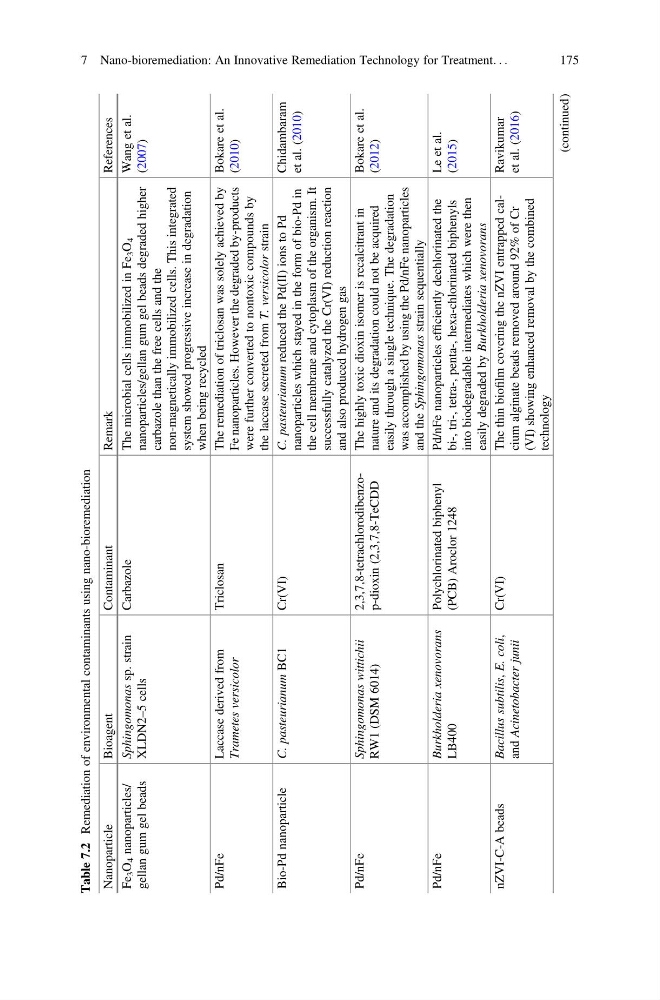
Table 7.2
Remediation of environmental contaminants using nano-bioremediation
Nanoparticle
Bioagent
Contaminant
Remark
References
Fe
3 O
4 nanoparticles/
gellan gum gel beads
Sphingomonas
sp. strain
XLDN2–5 cells
Carbazole
The microbial cells immobilized in Fe
3 O
4
nanoparticles/gellan gum gel beads degraded higher
carbazole than the free cells and the
non-magnetically immobilized cells. This integrated
system showed progressive increase in degradation
when being recycled
Wang et al.
(2007)
Pd/nFe
Laccase derived from
Trametes versicolor
Triclosan
The remediation of triclosan was solely achieved by
Fe nanoparticles. However the degraded by-products
were further converted to nontoxic compounds by
the laccase secreted from T. versicolor
strain
Bokare et al.
(2010)
Bio-Pd nanoparticle
C. pasteurianum
BC1
Cr(VI)
C. pasteurianum
reduced the Pd(II) ions to Pd
nanoparticles which stayed in the form of bio-Pd in
the cell membrane and cytoplasm of the organism. It
successfully catalyzed the Cr(VI) reduction reaction
and also produced hydrogen gas
Chidambaram
et al. (2010)
Pd/nFe
Sphingomonas wittichii
RW1 (DSM 6014)
2,3,7,8-tetrachlorodibenzop-dioxin (2,3,7,8-TeCDD
The highly toxic dioxin isomer is recalcitrant in
nature and its degradation could not be acquired
easily through a single technique. The degradation
was accomplished by using the Pd/nFe nanoparticles
and the Sphingomonas
strain sequentially
Bokare et al.
(2012)
Pd/nFe
Burkholderia xenovorans
LB400
Polychlorinated biphenyl
(PCB) Aroclor 1248
Pd/nFe nanoparticles efficiently dechlorinated the
bi-, tri-, tetra-, penta-, hexa-chlorinated biphenyls
into biodegradable intermediates which were then
easily degraded by Burkholderia xenovorans
Le et al.
(2015)
nZVI-C-A beads
Bacillus subtilis, E. coli,
and Acinetobacter junii
Cr(VI)
The thin biofilm covering the nZVI entrapped calcium alginate beads removed around 92% of Cr
(VI) showing enhanced removal by the combined
technology
Ravikumar
et al. (2016)
(continued)
7 Nano-bioremediation: An Innovative Remediation Technology for Treatment. . .
175
Remediation of environmental contaminants using nano-bioremediation
Nanoparticle
Bioagent
Contaminant
Remark
References
Fe
3 O
4 nanoparticles/
gellan gum gel beads
Sphingomonas
sp. strain
XLDN2–5 cells
Carbazole
The microbial cells immobilized in Fe
3 O
4
nanoparticles/gellan gum gel beads degraded higher
carbazole than the free cells and the
non-magnetically immobilized cells. This integrated
system showed progressive increase in degradation
when being recycled
Wang et al.
(2007)
Pd/nFe
Laccase derived from
Trametes versicolor
Triclosan
The remediation of triclosan was solely achieved by
Fe nanoparticles. However the degraded by-products
were further converted to nontoxic compounds by
the laccase secreted from T. versicolor
strain
Bokare et al.
(2010)
Bio-Pd nanoparticle
C. pasteurianum
BC1
Cr(VI)
C. pasteurianum
reduced the Pd(II) ions to Pd
nanoparticles which stayed in the form of bio-Pd in
the cell membrane and cytoplasm of the organism. It
successfully catalyzed the Cr(VI) reduction reaction
and also produced hydrogen gas
Chidambaram
et al. (2010)
Pd/nFe
Sphingomonas wittichii
RW1 (DSM 6014)
2,3,7,8-tetrachlorodibenzop-dioxin (2,3,7,8-TeCDD
The highly toxic dioxin isomer is recalcitrant in
nature and its degradation could not be acquired
easily through a single technique. The degradation
was accomplished by using the Pd/nFe nanoparticles
and the Sphingomonas
strain sequentially
Bokare et al.
(2012)
Pd/nFe
Burkholderia xenovorans
LB400
Polychlorinated biphenyl
(PCB) Aroclor 1248
Pd/nFe nanoparticles efficiently dechlorinated the
bi-, tri-, tetra-, penta-, hexa-chlorinated biphenyls
into biodegradable intermediates which were then
easily degraded by Burkholderia xenovorans
Le et al.
(2015)
nZVI-C-A beads
Bacillus subtilis, E. coli,
and Acinetobacter junii
Cr(VI)
The thin biofilm covering the nZVI entrapped calcium alginate beads removed around 92% of Cr
(VI) showing enhanced removal by the combined
technology
Ravikumar
et al. (2016)
(continued)
7 Nano-bioremediation: An Innovative Remediation Technology for Treatment. . .
175