

3 Nano-bioremediation: An Integrated Approach Toward
Environmental Clean-up
Nano-bioremediation is an integrated technology that applies both nanotechnology
and bioremediation together to achieve a remediation that is more efficient, less time
taking, and environment friendly than the individual processes. Integrated approach
could overcome the disadvantages of individual technologies and can provide better
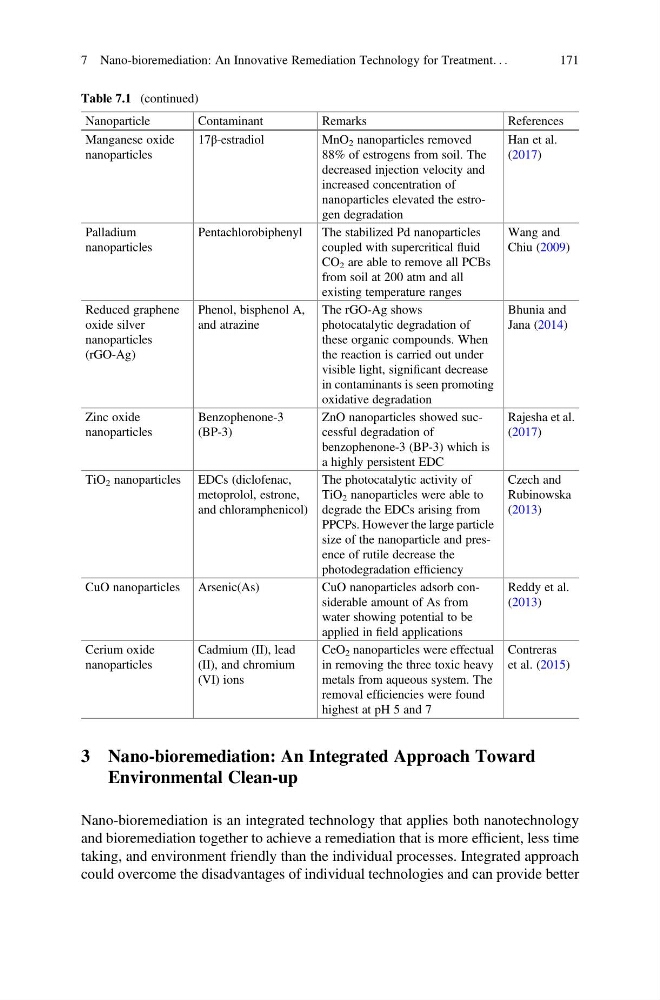
Table 7.1 (continued)
Nanoparticle
Contaminant
Remarks
References
Manganese oxide
nanoparticles
17β-estradiol
MnO 2 nanoparticles removed
88% of estrogens from soil. The
decreased injection velocity and
increased concentration of
nanoparticles elevated the estrogen degradation
Han et al.
(2017)
Palladium
nanoparticles
Pentachlorobiphenyl
The stabilized Pd nanoparticles
coupled with supercritical fluid
CO 2 are able to remove all PCBs
from soil at 200 atm and all
existing temperature ranges
Wang and
Chiu (2009)
Reduced graphene
oxide silver
nanoparticles
(rGO-Ag)
Phenol, bisphenol A,
and atrazine
The rGO-Ag shows
photocatalytic degradation of
these organic compounds. When
the reaction is carried out under
visible light, significant decrease
in contaminants is seen promoting
oxidative degradation
Bhunia and
Jana (2014)
Zinc oxide
nanoparticles
Benzophenone-3
(BP-3)
ZnO nanoparticles showed successful degradation of
benzophenone-3 (BP-3) which is
a highly persistent EDC
Rajesha et al.
(2017)
TiO 2 nanoparticles EDCs (diclofenac,
metoprolol, estrone,
and chloramphenicol)
The photocatalytic activity of
TiO 2 nanoparticles were able to
degrade the EDCs arising from
PPCPs. However the large particle
size of the nanoparticle and presence of rutile decrease the
photodegradation efficiency
Czech and
Rubinowska
(2013)
CuO nanoparticles Arsenic(As)
CuO nanoparticles adsorb considerable amount of As from
water showing potential to be
applied in field applications
Reddy et al.
(2013)
Cerium oxide
nanoparticles
Cadmium (II), lead
(II), and chromium
(VI) ions
CeO 2 nanoparticles were effectual
in removing the three toxic heavy
metals from aqueous system. The
removal efficiencies were found
highest at pH 5 and 7
Contreras
et al. (2015)
7 Nano-bioremediation: An Innovative Remediation Technology for Treatment. . .
171
Environmental Clean-up
Nano-bioremediation is an integrated technology that applies both nanotechnology
and bioremediation together to achieve a remediation that is more efficient, less time
taking, and environment friendly than the individual processes. Integrated approach
could overcome the disadvantages of individual technologies and can provide better
Table 7.1 (continued)
Nanoparticle
Contaminant
Remarks
References
Manganese oxide
nanoparticles
17β-estradiol
MnO 2 nanoparticles removed
88% of estrogens from soil. The
decreased injection velocity and
increased concentration of
nanoparticles elevated the estrogen degradation
Han et al.
(2017)
Palladium
nanoparticles
Pentachlorobiphenyl
The stabilized Pd nanoparticles
coupled with supercritical fluid
CO 2 are able to remove all PCBs
from soil at 200 atm and all
existing temperature ranges
Wang and
Chiu (2009)
Reduced graphene
oxide silver
nanoparticles
(rGO-Ag)
Phenol, bisphenol A,
and atrazine
The rGO-Ag shows
photocatalytic degradation of
these organic compounds. When
the reaction is carried out under
visible light, significant decrease
in contaminants is seen promoting
oxidative degradation
Bhunia and
Jana (2014)
Zinc oxide
nanoparticles
Benzophenone-3
(BP-3)
ZnO nanoparticles showed successful degradation of
benzophenone-3 (BP-3) which is
a highly persistent EDC
Rajesha et al.
(2017)
TiO 2 nanoparticles EDCs (diclofenac,
metoprolol, estrone,
and chloramphenicol)
The photocatalytic activity of
TiO 2 nanoparticles were able to
degrade the EDCs arising from
PPCPs. However the large particle
size of the nanoparticle and presence of rutile decrease the
photodegradation efficiency
Czech and
Rubinowska
(2013)
CuO nanoparticles Arsenic(As)
CuO nanoparticles adsorb considerable amount of As from
water showing potential to be
applied in field applications
Reddy et al.
(2013)
Cerium oxide
nanoparticles
Cadmium (II), lead
(II), and chromium
(VI) ions
CeO 2 nanoparticles were effectual
in removing the three toxic heavy
metals from aqueous system. The
removal efficiencies were found
highest at pH 5 and 7
Contreras
et al. (2015)
7 Nano-bioremediation: An Innovative Remediation Technology for Treatment. . .
171