

conditions (Ekka et al. 2016). Another research shows that gold nanoparticles with
surface coatings can be reused for 6 times with more than 90% conversion efficiency
and keep high activity even after exposing in air for 1 month (Guo et al. 2016).
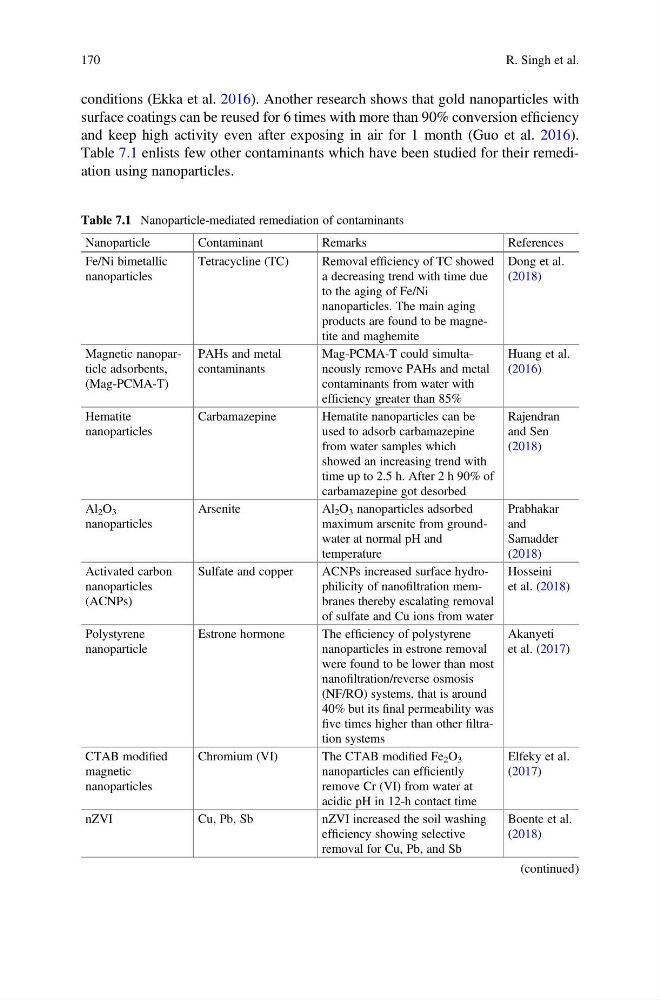
Table 7.1 enlists few other contaminants which have been studied for their remediation using nanoparticles.
Table 7.1 Nanoparticle-mediated remediation of contaminants
Nanoparticle
Contaminant
Remarks
References
Fe/Ni bimetallic
nanoparticles
Tetracycline (TC)
Removal efficiency of TC showed
a decreasing trend with time due
to the aging of Fe/Ni
nanoparticles. The main aging
products are found to be magnetite and maghemite
Dong et al.
(2018)
Magnetic nanoparticle adsorbents,
(Mag-PCMA-T)
PAHs and metal
contaminants
Mag-PCMA-T could simultaneously remove PAHs and metal
contaminants from water with
efficiency greater than 85%
Huang et al.
(2016)
Hematite
nanoparticles
Carbamazepine
Hematite nanoparticles can be
used to adsorb carbamazepine
from water samples which
showed an increasing trend with
time up to 2.5 h. After 2 h 90% of
carbamazepine got desorbed
Rajendran
and Sen
(2018)
Al 2 O 3
nanoparticles
Arsenite
Al 2 O 3 nanoparticles adsorbed
maximum arsenite from groundwater at normal pH and
temperature
Prabhakar
and
Samadder
(2018)
Activated carbon
nanoparticles
(ACNPs)
Sulfate and copper
ACNPs increased surface hydrophilicity of nanofiltration membranes thereby escalating removal
of sulfate and Cu ions from water
Hosseini
et al. (2018)
Polystyrene
nanoparticle
Estrone hormone
The efficiency of polystyrene
nanoparticles in estrone removal
were found to be lower than most
nanofiltration/reverse osmosis
(NF/RO) systems, that is around
40% but its final permeability was
five times higher than other filtration systems
Akanyeti
et al. (2017)
CTAB modified
magnetic
nanoparticles
Chromium (VI)
The CTAB modified Fe 2 O 3
nanoparticles can efficiently
remove Cr (VI) from water at
acidic pH in 12-h contact time
Elfeky et al.
(2017)
nZVI
Cu, Pb, Sb
nZVI increased the soil washing
efficiency showing selective
removal for Cu, Pb, and Sb
Boente et al.
(2018)
(continued)
170
R. Singh et al.
surface coatings can be reused for 6 times with more than 90% conversion efficiency
and keep high activity even after exposing in air for 1 month (Guo et al. 2016).
Table 7.1 enlists few other contaminants which have been studied for their remediation using nanoparticles.
Table 7.1 Nanoparticle-mediated remediation of contaminants
Nanoparticle
Contaminant
Remarks
References
Fe/Ni bimetallic
nanoparticles
Tetracycline (TC)
Removal efficiency of TC showed
a decreasing trend with time due
to the aging of Fe/Ni
nanoparticles. The main aging
products are found to be magnetite and maghemite
Dong et al.
(2018)
Magnetic nanoparticle adsorbents,
(Mag-PCMA-T)
PAHs and metal
contaminants
Mag-PCMA-T could simultaneously remove PAHs and metal
contaminants from water with
efficiency greater than 85%
Huang et al.
(2016)
Hematite
nanoparticles
Carbamazepine
Hematite nanoparticles can be
used to adsorb carbamazepine
from water samples which
showed an increasing trend with
time up to 2.5 h. After 2 h 90% of
carbamazepine got desorbed
Rajendran
and Sen
(2018)
Al 2 O 3
nanoparticles
Arsenite
Al 2 O 3 nanoparticles adsorbed
maximum arsenite from groundwater at normal pH and
temperature
Prabhakar
and
Samadder
(2018)
Activated carbon
nanoparticles
(ACNPs)
Sulfate and copper
ACNPs increased surface hydrophilicity of nanofiltration membranes thereby escalating removal
of sulfate and Cu ions from water
Hosseini
et al. (2018)
Polystyrene
nanoparticle
Estrone hormone
The efficiency of polystyrene
nanoparticles in estrone removal
were found to be lower than most
nanofiltration/reverse osmosis
(NF/RO) systems, that is around
40% but its final permeability was
five times higher than other filtration systems
Akanyeti
et al. (2017)
CTAB modified
magnetic
nanoparticles
Chromium (VI)
The CTAB modified Fe 2 O 3
nanoparticles can efficiently
remove Cr (VI) from water at
acidic pH in 12-h contact time
Elfeky et al.
(2017)
nZVI
Cu, Pb, Sb
nZVI increased the soil washing
efficiency showing selective
removal for Cu, Pb, and Sb
Boente et al.
(2018)
(continued)
170
R. Singh et al.