

tannery industry have experienced regular problems because the design is poor and
has less capacity, but for the betterment of production, they are working over the
capacity. In this situation, constructed wetlands are good choices to enhance the
natural presentation.
4 Removal of Toxic Elements from Industrial Wastewater
in a Constructed Wetland
Constructed wetlands are mostly used for treatment of domestic wastewater, but due
to high pollution load from industries, the use of constructed wetlands for the
treatment of industrial discharge has increased over the past 10 years (Korkusuz
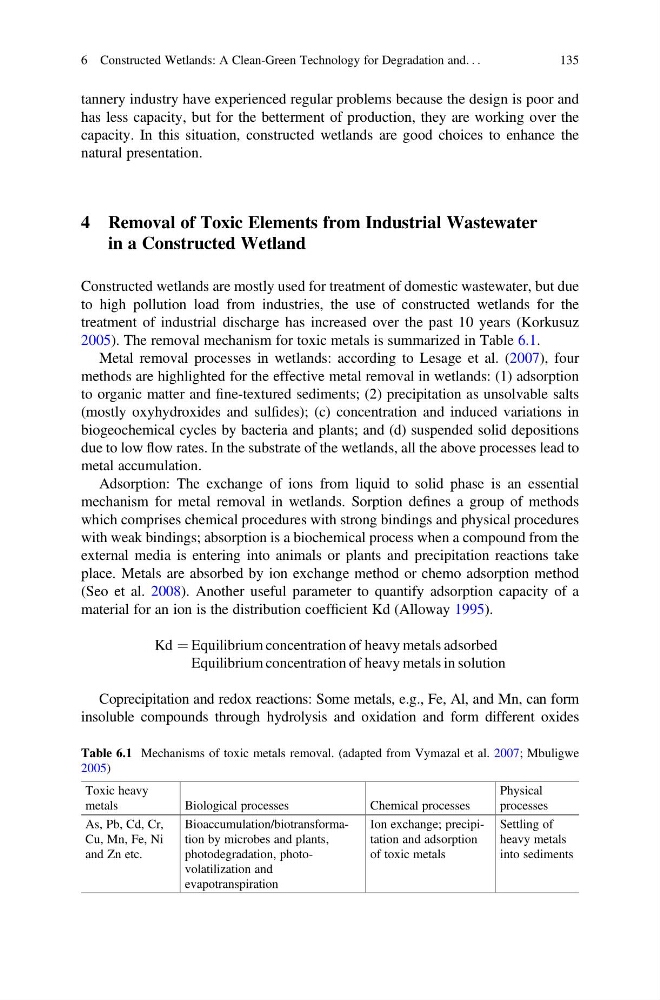
2005). The removal mechanism for toxic metals is summarized in Table 6.1.
Metal removal processes in wetlands: according to Lesage et al. (2007), four
methods are highlighted for the effective metal removal in wetlands: (1) adsorption
to organic matter and fine-textured sediments; (2) precipitation as unsolvable salts
(mostly oxyhydroxides and sulfides); (c) concentration and induced variations in
biogeochemical cycles by bacteria and plants; and (d) suspended solid depositions
due to low flow rates. In the substrate of the wetlands, all the above processes lead to
metal accumulation.
Adsorption: The exchange of ions from liquid to solid phase is an essential
mechanism for metal removal in wetlands. Sorption defines a group of methods
which comprises chemical procedures with strong bindings and physical procedures
with weak bindings; absorption is a biochemical process when a compound from the
external media is entering into animals or plants and precipitation reactions take
place. Metals are absorbed by ion exchange method or chemo adsorption method
(Seo et al. 2008). Another useful parameter to quantify adsorption capacity of a
material for an ion is the distribution coefficient Kd (Alloway 1995).
Kd ¼ Equilibrium concentration of heavy metals adsorbed
Equilibrium concentration of heavy metals in solution
Coprecipitation and redox reactions: Some metals, e.g., Fe, Al, and Mn, can form
insoluble compounds through hydrolysis and oxidation and form different oxides
Table 6.1 Mechanisms of toxic metals removal. (adapted from Vymazal et al. 2007; Mbuligwe
2005)
Toxic heavy
metals
Biological processes
Chemical processes
Physical
processes
As, Pb, Cd, Cr,
Cu, Mn, Fe, Ni
and Zn etc.
Bioaccumulation/biotransformation by microbes and plants,
photodegradation, photovolatilization and
evapotranspiration
Ion exchange; precipitation and adsorption
of toxic metals
Settling of
heavy metals
into sediments
6 Constructed Wetlands: A Clean-Green Technology for Degradation and. . .
135
has less capacity, but for the betterment of production, they are working over the
capacity. In this situation, constructed wetlands are good choices to enhance the
natural presentation.
4 Removal of Toxic Elements from Industrial Wastewater
in a Constructed Wetland
Constructed wetlands are mostly used for treatment of domestic wastewater, but due
to high pollution load from industries, the use of constructed wetlands for the
treatment of industrial discharge has increased over the past 10 years (Korkusuz
2005). The removal mechanism for toxic metals is summarized in Table 6.1.
Metal removal processes in wetlands: according to Lesage et al. (2007), four
methods are highlighted for the effective metal removal in wetlands: (1) adsorption
to organic matter and fine-textured sediments; (2) precipitation as unsolvable salts
(mostly oxyhydroxides and sulfides); (c) concentration and induced variations in
biogeochemical cycles by bacteria and plants; and (d) suspended solid depositions
due to low flow rates. In the substrate of the wetlands, all the above processes lead to
metal accumulation.
Adsorption: The exchange of ions from liquid to solid phase is an essential
mechanism for metal removal in wetlands. Sorption defines a group of methods
which comprises chemical procedures with strong bindings and physical procedures
with weak bindings; absorption is a biochemical process when a compound from the
external media is entering into animals or plants and precipitation reactions take
place. Metals are absorbed by ion exchange method or chemo adsorption method
(Seo et al. 2008). Another useful parameter to quantify adsorption capacity of a
material for an ion is the distribution coefficient Kd (Alloway 1995).
Kd ¼ Equilibrium concentration of heavy metals adsorbed
Equilibrium concentration of heavy metals in solution
Coprecipitation and redox reactions: Some metals, e.g., Fe, Al, and Mn, can form
insoluble compounds through hydrolysis and oxidation and form different oxides
Table 6.1 Mechanisms of toxic metals removal. (adapted from Vymazal et al. 2007; Mbuligwe
2005)
Toxic heavy
metals
Biological processes
Chemical processes
Physical
processes
As, Pb, Cd, Cr,
Cu, Mn, Fe, Ni
and Zn etc.
Bioaccumulation/biotransformation by microbes and plants,
photodegradation, photovolatilization and
evapotranspiration
Ion exchange; precipitation and adsorption
of toxic metals
Settling of
heavy metals
into sediments
6 Constructed Wetlands: A Clean-Green Technology for Degradation and. . .
135