

44
S. Dhyani and D. Dhyani
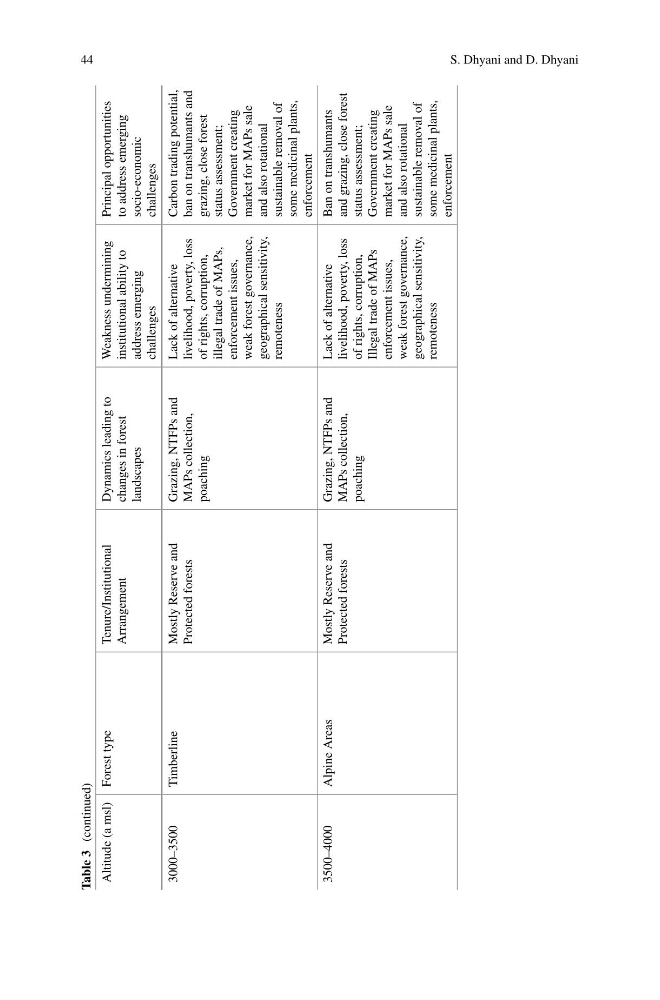
Table 3
(continued)
Altitude (a msl) Forest type
Tenure/Institutional
Arrangement
Dynamics leading to
changes in forest
landscapes
Weakness undermining
institutional ability to
address emerging
challenges
Principal opportunities
to address emerging
socio-economic
challenges
3000–3500
Timberline
Mostly Reserve and
Protected forests
Grazing, NTFPs and
MAPs collection,
poaching
Lack of alternative
livelihood, poverty, loss
of rights, corruption,
illegal trade of MAPs,
enforcement issues,
weak forest governance,
geographical sensitivity,
remoteness
Carbon trading potential,
ban on transhumants and
grazing, close forest
status assessment;
Government creating
market for MAPs sale
and also rotational
sustainable removal of
some medicinal plants,
enforcement
3500–4000
Alpine Areas
Mostly Reserve and
Protected forests
Grazing, NTFPs and
MAPs collection,
poaching
Lack of alternative
livelihood, poverty, loss
of rights, corruption,
Illegal trade of MAPs
enforcement issues,
weak forest governance,
geographical sensitivity,
remoteness
Ban on transhumants
and grazing, close forest
status assessment;
Government creating
market for MAPs sale
and also rotational
sustainable removal of
some medicinal plants,
enforcement
S. Dhyani and D. Dhyani
Table 3
(continued)
Altitude (a msl) Forest type
Tenure/Institutional
Arrangement
Dynamics leading to
changes in forest
landscapes
Weakness undermining
institutional ability to
address emerging
challenges
Principal opportunities
to address emerging
socio-economic
challenges
3000–3500
Timberline
Mostly Reserve and
Protected forests
Grazing, NTFPs and
MAPs collection,
poaching
Lack of alternative
livelihood, poverty, loss
of rights, corruption,
illegal trade of MAPs,
enforcement issues,
weak forest governance,
geographical sensitivity,
remoteness
Carbon trading potential,
ban on transhumants and
grazing, close forest
status assessment;
Government creating
market for MAPs sale
and also rotational
sustainable removal of
some medicinal plants,
enforcement
3500–4000
Alpine Areas
Mostly Reserve and
Protected forests
Grazing, NTFPs and
MAPs collection,
poaching
Lack of alternative
livelihood, poverty, loss
of rights, corruption,
Illegal trade of MAPs
enforcement issues,
weak forest governance,
geographical sensitivity,
remoteness
Ban on transhumants
and grazing, close forest
status assessment;
Government creating
market for MAPs sale
and also rotational
sustainable removal of
some medicinal plants,
enforcement