

540
S. Chatterjee and A. Tandon
climate change will be one of the major contributors (Stern 2006; Christian 2007).
The Environmental Justice Foundation (EJF 2017) in their recent report suggested
that hundreds of millions of people will be ‘forced migrated’ by 2100 due to sealevel rise. United Nations (UN) in their migration report mentioned that as of 2015,
approximately 244 million people migrated from their own country, and another 740
million were displaced within their country (UNDESA 2016). The Global Knowledge Partnership on Migration and Development (KNOMAD) project estimated that
more than 700 million people a year may likely get internally displaced but this
data was not verified by any true scale (KNOMAD 2017; Bell and Edwards 2013).
Displacement of 40.3 million people in the year 2016 was reported by the Internal
Displacement Monitoring Centre (IDMC 2017) and the main cause was both conflict
and sudden-onset hazards. In 2016, the most number of internal displacements took
place in Democratic Republic of Congo, Syria, Iraq, Afghanistan and Nigeria. Internal displacement mainly occurred in those places where vulnerability is high and
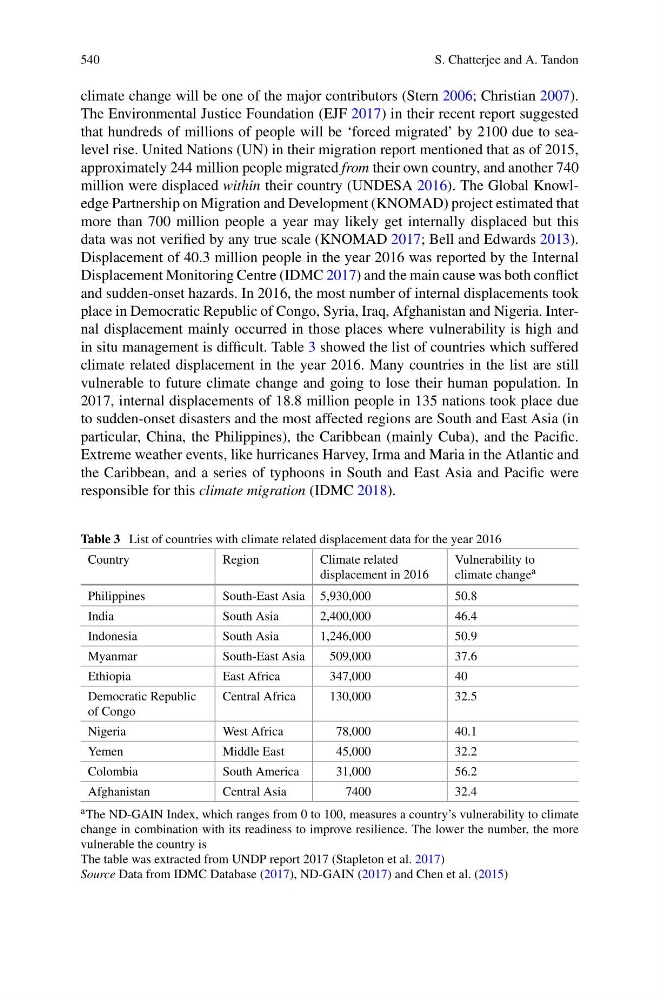
in situ management is difficult. Table 3 showed the list of countries which suffered
climate related displacement in the year 2016. Many countries in the list are still
vulnerable to future climate change and going to lose their human population. In
2017, internal displacements of 18.8 million people in 135 nations took place due
to sudden-onset disasters and the most affected regions are South and East Asia (in
particular, China, the Philippines), the Caribbean (mainly Cuba), and the Pacific.
Extreme weather events, like hurricanes Harvey, Irma and Maria in the Atlantic and
the Caribbean, and a series of typhoons in South and East Asia and Pacific were
responsible for this climate migration (IDMC 2018).
Table 3 List of countries with climate related displacement data for the year 2016
Country
Region
Climate related
displacement in 2016
Vulnerability to
climate change a
Philippines
South-East Asia 5,930,000
50.8
India
South Asia
2,400,000
46.4
Indonesia
South Asia
1,246,000
50.9
Myanmar
South-East Asia
509,000
37.6
Ethiopia
East Africa
347,000
40
Democratic Republic
of Congo
Central Africa
130,000
32.5
Nigeria
West Africa
78,000
40.1
Yemen
Middle East
45,000
32.2
Colombia
South America
31,000
56.2
Afghanistan
Central Asia
7400
32.4
a The ND-GAIN Index, which ranges from 0 to 100, measures a country’s vulnerability to climate
change in combination with its readiness to improve resilience. The lower the number, the more
vulnerable the country is
The table was extracted from UNDP report 2017 (Stapleton et al. 2017)
Source Data from IDMC Database (2017), ND-GAIN (2017) and Chen et al. (2015)
S. Chatterjee and A. Tandon
climate change will be one of the major contributors (Stern 2006; Christian 2007).
The Environmental Justice Foundation (EJF 2017) in their recent report suggested
that hundreds of millions of people will be ‘forced migrated’ by 2100 due to sealevel rise. United Nations (UN) in their migration report mentioned that as of 2015,
approximately 244 million people migrated from their own country, and another 740
million were displaced within their country (UNDESA 2016). The Global Knowledge Partnership on Migration and Development (KNOMAD) project estimated that
more than 700 million people a year may likely get internally displaced but this
data was not verified by any true scale (KNOMAD 2017; Bell and Edwards 2013).
Displacement of 40.3 million people in the year 2016 was reported by the Internal
Displacement Monitoring Centre (IDMC 2017) and the main cause was both conflict
and sudden-onset hazards. In 2016, the most number of internal displacements took
place in Democratic Republic of Congo, Syria, Iraq, Afghanistan and Nigeria. Internal displacement mainly occurred in those places where vulnerability is high and
in situ management is difficult. Table 3 showed the list of countries which suffered
climate related displacement in the year 2016. Many countries in the list are still
vulnerable to future climate change and going to lose their human population. In
2017, internal displacements of 18.8 million people in 135 nations took place due
to sudden-onset disasters and the most affected regions are South and East Asia (in
particular, China, the Philippines), the Caribbean (mainly Cuba), and the Pacific.
Extreme weather events, like hurricanes Harvey, Irma and Maria in the Atlantic and
the Caribbean, and a series of typhoons in South and East Asia and Pacific were
responsible for this climate migration (IDMC 2018).
Table 3 List of countries with climate related displacement data for the year 2016
Country
Region
Climate related
displacement in 2016
Vulnerability to
climate change a
Philippines
South-East Asia 5,930,000
50.8
India
South Asia
2,400,000
46.4
Indonesia
South Asia
1,246,000
50.9
Myanmar
South-East Asia
509,000
37.6
Ethiopia
East Africa
347,000
40
Democratic Republic
of Congo
Central Africa
130,000
32.5
Nigeria
West Africa
78,000
40.1
Yemen
Middle East
45,000
32.2
Colombia
South America
31,000
56.2
Afghanistan
Central Asia
7400
32.4
a The ND-GAIN Index, which ranges from 0 to 100, measures a country’s vulnerability to climate
change in combination with its readiness to improve resilience. The lower the number, the more
vulnerable the country is
The table was extracted from UNDP report 2017 (Stapleton et al. 2017)
Source Data from IDMC Database (2017), ND-GAIN (2017) and Chen et al. (2015)