

Climate Change Impact on Eco-biology and Socio-economy …
539
or humanitarian assistance, but should also be dealt with considering sustainable
development processes. Human migration is not a new phenomenon as this has happened throughout history; but anthropogenic activities which are mainly responsible
for recent climate change complicates this scenario. Flooding, sea-level rise and
abnormally high temperatures around the globe are the results of increasing drought,
uneven rainfall and global temperature rise (Blunden and Arndt 2017). Due to the
abrupt change in climate in many regions of the world, climate-related hazards are
very frequent. The frequency, intensity, duration, and timing of these slow and sudden hazards may vary (IPCC 2012, 2014) but its overall impact is destruction of the
ecosystems. One should not forget that all the living beings are highly dependent
on the ecosystem with respect to water, food, energy and other important services
(Cozzetto et al. 2013).
In 2016, sudden-onset climate-related hazards like typhoons and floods have
forced to displace over 24 million people which were 32 times more than other
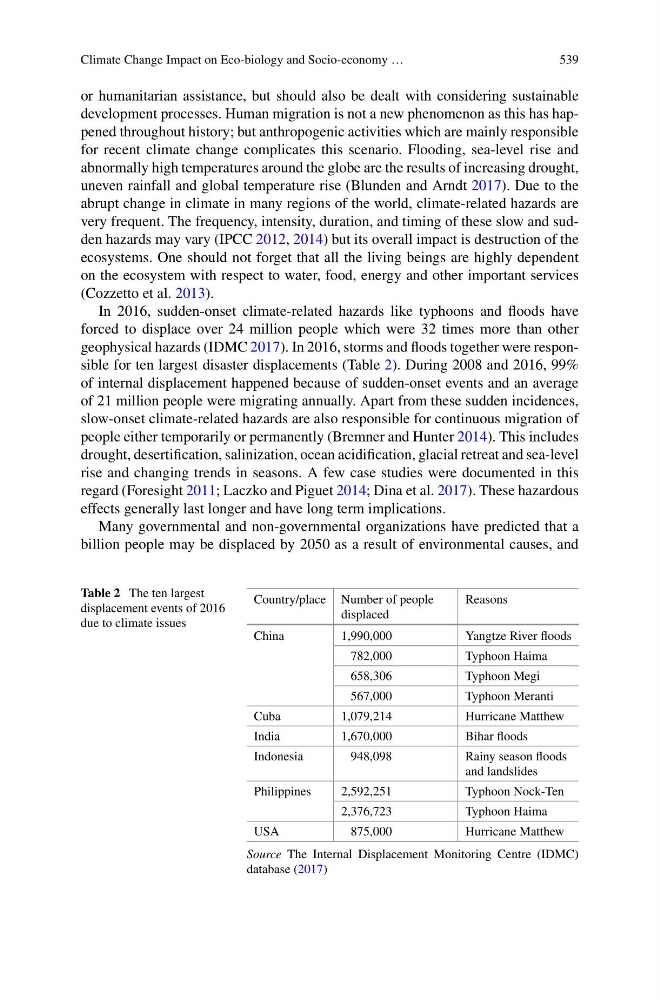
geophysical hazards (IDMC 2017). In 2016, storms and floods together were responsible for ten largest disaster displacements (Table 2). During 2008 and 2016, 99%
of internal displacement happened because of sudden-onset events and an average
of 21 million people were migrating annually. Apart from these sudden incidences,
slow-onset climate-related hazards are also responsible for continuous migration of
people either temporarily or permanently (Bremner and Hunter 2014). This includes
drought, desertification, salinization, ocean acidification, glacial retreat and sea-level
rise and changing trends in seasons. A few case studies were documented in this
regard (Foresight 2011; Laczko and Piguet 2014; Dina et al. 2017). These hazardous
effects generally last longer and have long term implications.
Many governmental and non-governmental organizations have predicted that a
billion people may be displaced by 2050 as a result of environmental causes, and
Table 2 The ten largest
displacement events of 2016
due to climate issues
Country/place Number of people
displaced
Reasons
China
1,990,000
Yangtze River floods
782,000
Typhoon Haima
658,306
Typhoon Megi
567,000
Typhoon Meranti
Cuba
1,079,214
Hurricane Matthew
India
1,670,000
Bihar floods
Indonesia
948,098
Rainy season floods
and landslides
Philippines
2,592,251
Typhoon Nock-Ten
2,376,723
Typhoon Haima
USA
875,000
Hurricane Matthew
Source The Internal Displacement Monitoring Centre (IDMC)
database (2017)
539
or humanitarian assistance, but should also be dealt with considering sustainable
development processes. Human migration is not a new phenomenon as this has happened throughout history; but anthropogenic activities which are mainly responsible
for recent climate change complicates this scenario. Flooding, sea-level rise and
abnormally high temperatures around the globe are the results of increasing drought,
uneven rainfall and global temperature rise (Blunden and Arndt 2017). Due to the
abrupt change in climate in many regions of the world, climate-related hazards are
very frequent. The frequency, intensity, duration, and timing of these slow and sudden hazards may vary (IPCC 2012, 2014) but its overall impact is destruction of the
ecosystems. One should not forget that all the living beings are highly dependent
on the ecosystem with respect to water, food, energy and other important services
(Cozzetto et al. 2013).
In 2016, sudden-onset climate-related hazards like typhoons and floods have
forced to displace over 24 million people which were 32 times more than other
geophysical hazards (IDMC 2017). In 2016, storms and floods together were responsible for ten largest disaster displacements (Table 2). During 2008 and 2016, 99%
of internal displacement happened because of sudden-onset events and an average
of 21 million people were migrating annually. Apart from these sudden incidences,
slow-onset climate-related hazards are also responsible for continuous migration of
people either temporarily or permanently (Bremner and Hunter 2014). This includes
drought, desertification, salinization, ocean acidification, glacial retreat and sea-level
rise and changing trends in seasons. A few case studies were documented in this
regard (Foresight 2011; Laczko and Piguet 2014; Dina et al. 2017). These hazardous
effects generally last longer and have long term implications.
Many governmental and non-governmental organizations have predicted that a
billion people may be displaced by 2050 as a result of environmental causes, and
Table 2 The ten largest
displacement events of 2016
due to climate issues
Country/place Number of people
displaced
Reasons
China
1,990,000
Yangtze River floods
782,000
Typhoon Haima
658,306
Typhoon Megi
567,000
Typhoon Meranti
Cuba
1,079,214
Hurricane Matthew
India
1,670,000
Bihar floods
Indonesia
948,098
Rainy season floods
and landslides
Philippines
2,592,251
Typhoon Nock-Ten
2,376,723
Typhoon Haima
USA
875,000
Hurricane Matthew
Source The Internal Displacement Monitoring Centre (IDMC)
database (2017)